
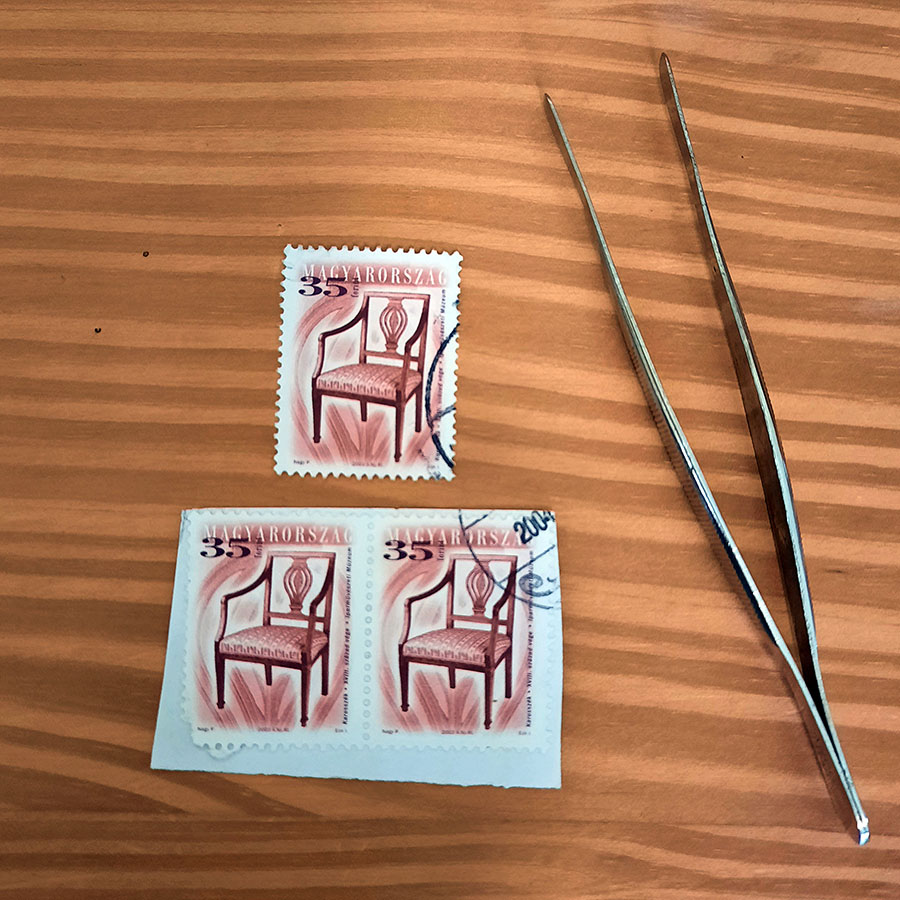
Issued Jan. 30, 2003
When we think of what characterizes a nation or people, many often first think of language, food, or art. But furniture? The Magyars, who peopled the area now known as Hungary, have always had an artistic aesthetic distinct from the rest of central Europe. Some of their characteristic design elements, such as their distinctive red and blue color combinations, developed internally. Others, such as their Turkish or Italian Renaissance influences, result from Hungary’s many foreign occupations over the last millennium and centralized geographic position, respectively.
Hungarian furniture-making is one area of folk art that perfectly displays these various elements and influences. Traditional Hungarian and Transylvanian furniture-making typically involves painting the pieces in colorful and detailed floral motifs. But for the one-color furniture series issued first in 1999, stamp designers focused more on the shape and function of various chairs. The series spanned several sets over at least seven years, making stamps in the series an easy find for collectors of modern Hungarian stamps (especially the 100fo, if my collection can be considered typical).

The Hungarian Museum of Applied Arts, located in Budapest, is the third-oldest applied arts museum in the world. You can browse 400+ armchairs among the 42,000 items available for view in their digital collection database. As you do, it’s easy to spot the exact chair that inspired this stamp, part of the fourth set in the furniture stamp series. The late 18th century, carved walnut chair is described as such on their translated website:
“The prismatic legs are splayed at the front, with shoes, while the back ones are slightly bent to the back. The front legs continue into the curved arm-support, while the back ones are combined with the framework of the square-shaped back support. The top of the back is straight; there is an inserted, carved, and pierced vase motif, with a vertical, carved, and gilt palmetta in its axis. The seat is trapezoid, with newer upholstery and a later cover.”
I enjoyed how the stamp designer echoed the “carved palmetta” as an enlarged, more abstract element behind the chair. The teardrop shape both helps encircle the chair as its frame and create movement around the field of the stamp. Other furniture stamps in this series listed as “armchairs” include the 65fo, also issued 2003.
What do you think? Would this stamp have a place in your collection? Do you have more insight into Hungarian furniture-making? I’d love to hear your thoughts!
Written along the side: “Karosszék – XVIII. Század vége – Iparmüvészeti Múzeum” English translation: “Armchair – 18. End of century – Museum of Applied Arts”
 Armchair Philately
Leave a comment