

Issued June 12, 1981 | Cat# 2697
When I was first reviewing the stamp collection I inherited, there were a number of beautiful Hungarian stamps with gold leaf and interesting designs. But this train stamp with an engineering-friendly grid design and E13B typeface caught my eye. The top of this 2Ft stamp reads “G. Stephenson, 1781–1948” and features a very Victorian profile.
Why did Hungary issue a stamp of this man with a very un-Hungarian name?
In my journey to learn more, I discovered more than I thought I would ever know about locomotive engineering, Hungarian railway history, and a potential stamp collecting topic that has yet to be fully explored.
Who was George Stephenson?
George Stephenson (June 9, 1781–August 12, 1848) was a British civil and mechanical engineer who is renowned as the “Father of Railways”. Stephenson built the first steam locomotive, the Locomotion No. 1. His company built the first locomotive to carry passengers on the first public rail line, the Stockton and Darlington Railway, in 1825. They also built the first public intercity railway line in the world to use locomotives. Called the Liverpool and Manchester Railway, the line opened in 1830. His chosen rail gauge, sometimes called “Stephenson gauge”, was the basis for the 4 feet 8 1⁄2 inches (1.435 m) standard gauge used by most of the world’s railways.

I found a lovely commemorative panel on Amazon (above) that showcases the stamp. (Although, since it was created by the Franklin Mint in 1983 for “The History of Science & Invention Mint Stamp Collection”, the art is sadly of a different style, though beautiful in its own right.) The back of the panel has this information, printed in both English and German:
Probably the greatest of all the inventions in 19th-century England was the steam railway. And among those most influential in the development of this important means of transportation were George Stephenson and his son Robert.
The elder Stephenson, born in 1781, was brought up in impoverished circumstances but, while working in a coal mine in northeast England, taught himself to read and write. He had been working as an assistant fireman for a number of years when his skill as a mechanic was recognized, and he became a colliery engine builder. By studying the principle involved in the construction of earlier steam locomotives and stationary engines, he was able to build his first locomotive in 1814. He then accomplished the surveying and building on an 8-mile (13km) colliery railway, and was appointed chief engineer of the Stockton and Darlington Railway. He persuaded its owners to utilize steam motive power and with the help of his son Robert built the line’s first locomotive, the Locomotion.
In 1829 the Stephensons’ locomotive, Rocket, was the winner of a competition held by the Liverpool & Manchester Railway to decide on the most suitable locomotive. It traveled at a maximum speed of 24 mph (38 km/h) and had a tubular boiler that later became standard on other locomotives.
Why is He on a Hungarian Stamp?
Hungary commemorated Stephenson, admittedly a giant in locomotive engineering, on the 200th anniversary of his birth. But why, when the man had no Hungarian connections?
Of course, there’s no reason why Hungary can’t feature whomever they want on their stamps. There is, after all, a long history of nations featuring global figures, from celebrities like Charlie Chaplin to political figures like Princess Diana and JFK. When it comes to this stamp, however, the connections seem obvious when you understand a little about rail transport in Hungary.
As mentioned above, Stephenson’s company built the first public intercity locomotive line in 1830. Nations around the world were quick to understand the importance of fast and efficient transportation of people and goods. In Hungary, the first steam locomotive railway line was opened on July 15, 1846 between Pest and Vác. The Romantic poet Sándor Petőfi rode on the first train and wrote a poem predicting that rails would connect Hungary like blood vessels in the human body. Indeed, within a couple generations, it appears they did just that.
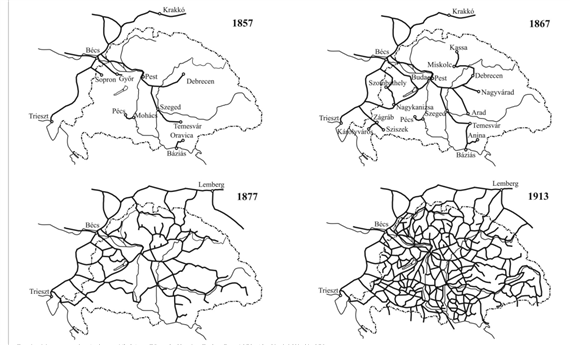
Before World War I, more than half (52%) of the Austro-Hungarian Empire’s railways were built in Hungary. By 1910, the total length of the rail networks of the Hungarian Kingdom reached 14,210 miles (22,869 kilometers) and linked more than 1,490 settlements. That made Hungarian railways the 6th most dense in the world (ahead of countries such as Germany and France).
This makes sense when you look at Hungary on a map. Inner Hungary was centrally located in Europe, landlocked, and surrounded by mountain ranges. The Alps rise to the west, while the Carpathians curl around Hungary’s north and east side, and the Dinaric Alps sit to the southwest. Not only would rail transport be relatively easy to build across the Great Hungarian Plain, but it would greatly ease the burden of transporting goods and people across the border.
Today, Hungary is a member of the International Union of Railways (UIC). The nation operates a network of 4,905 miles of railways (7,893 km), 1,902 miles of which (3,060 km) are electrified. The vast majority of those lines are still “Stephenson” or standard gauge.


Other Stephenson Stamps
This was the first stamp that caught my eye. But this isn’t the only Hungarian stamp featuring Stephenson. He was also featured as the 5fo denomination (Cat# C56) in the “explorers and inventors” airmail stamp series of 1948 (coincidentally on the 100th anniversary of his death). In 1961, Stephenson was again featured in a triptych for the “Conference of Transport Ministers of Communist Countries held at Budapest”. The 60fo yellow and olive stamp is Cat# 1400. Plus, the Rocket was again featured on a 40f stamp in the 1979 train series.
A quick Google image search revealed more Stephenson stamps from around the world. Republique de Djibouti commemorated Stephenson and his Rocket on a lovely colorful stamp in 1981 (55 Fdj), as did Grenada in 1991 (75c). Poland issued a 1.50ZL stamp of Stephenson and his “Rackieta” in 1979. And fittingly, Britain celebrated the Public Railways and the Liverpool and Manchester Railway, including Stephenson’s Rocket and Locomotion Engines, between 1975–1980 (7p and 12p). A separate UK stamp featuring both his profile and locomotive was priced 56p.
The American Topical Association doesn’t currently offer a list of Stephenson stamps. But if you’re a collector of train stamps, this could be an interesting subtopic to explore.
What do you think? Were you intrigued by this totally ‘80s stamp as much as I? Do you collect stamps featuring trains? I’d love to hear your thoughts!
 Armchair Philately
Leave a comment