
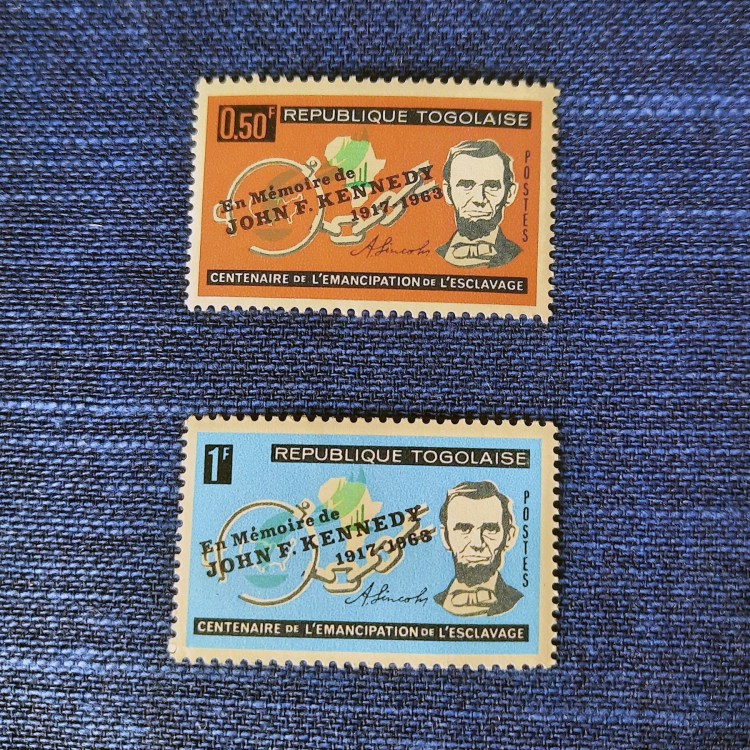
Issued March 7, 1964 | Michel TG 407, TG 408
I was recently gifted a lovely Togolese stamp depicting an Iberian caravel, a 15th-century sailing ship. When I went to place it with my other Togolese stamps, two in number, I was reminded how interesting those stamps were. Stamps from an African country commemorating an historical American moment, overprinted to honor a contemporary American tragedy.
The pieces of this puzzle weren’t too difficult to put together. However, the journey did take me from one side of the Atlantic to the other and back again.
What’s Togo’s Connection to the Emancipation Proclamation?
Togo, officially the Togolese Republic, is a sliver of a nation on Africa’s Gold Coast whose borders are compressed by Ghana to the west and Benin to the east to a width of around 70 miles (115km). At 21,925 square miles (56,785 km2), the nation is slightly larger than Croatia and smaller than West Virginia.
From the 16th to the 18th centuries, the coastal area was a major trading center for Europeans to purchase slaves. The practice earned Togo and the surrounding region the name “The Slave Coast”. “Togoland” was colonized by Germany and given over to France after WWI. It was not until 1960 that the tropical nation gained her independence. Togo elected Sylvanus Olympio, formerly their prime minister, as their first president in a contentious election in 1961. According to Wikipedia:
Olympio tried to reduce dependence on France by establishing cooperation with the United States, United Kingdom, and West Germany. He also rejected the efforts of French soldiers who were demobilized after the Algerian War and tried to get a position in the Togolese army. These factors eventually led to a military coup on 13 January 1963, during which he was assassinated by a group of soldiers under the direction of Sergeant Gnassingbé Eyadéma. A State [sic] of emergency was declared in Togo.
The military handed over power to an interim government led by Nicolas Grunitzky. In May 1963, Grunitzky was elected President of the Republic.
It was during this period of extreme political instability that La Poste du Togo issued these stamps. The design, also issued as a multicolor souvenir sheet, depicts outlines of the U.S. and Africa united by broken shackles. A portrait of Abraham Lincoln, along with his signature, makes up the right third of the design. Below, it reads, “CENTENAIRE DE L’ÉMANCIPATION DE L’ESCLAVAGE”: Centenary of the Emancipation Proclamation.
Togo, at this time desperately trying to assert herself as an independent nation (and not yet decided on how to do so), was looking to her past and America’s inspiration as a way to unfetter herself from her colonizers.
Why would Togo Honor JFK?
Another major global event had just happened in America which was reverberating around the world: the assassination of President John F. Kennedy. The president died on November 22, 1963 when his motorcade was attacked by a lone gunman firing from a nearby building. The whole world mourned the tragedy, and the philatelic world commemorated it through souvenir sheets and commemorative issues from myriad nations in the following months.
Togo had her own connection to JFK. In March 1962, President Olympio visited the United States and met the American president. The occasion had already been commemorated on a souvenir sheet and an issue of stamps in six denominations that year. At the start of the next year, Olympio would be dead. By the end of 1963, so would JFK.
So, why would the nation honor an assassinated American president, but not their own?
Presumably, the Togolese opposition party that overthrew Olympio’s government would not have requested the postal service issue a stamp in his honor. However, with so many other nations issuing stamps to honor JFK, La Poste du Togo would have recognized the philatelic value of having one of their own. Without doing more research into La Poste du Togo’s production schedule, I’m left to assume that violent politics and unstable resources did not allow a new stamp design to be produced with a quick turnaround at this time. An overprint on an existing design with an American theme was the way to go.
The overprint reads: “En Mémoire de John F. Kennedy 1917-1963”.
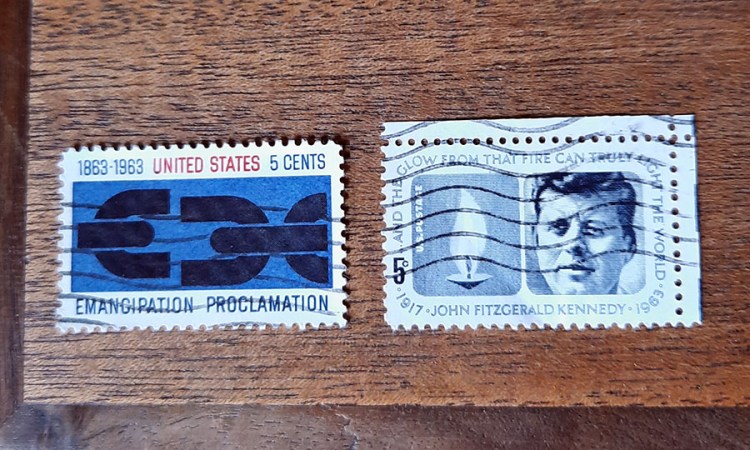
Other Related Stamps from the U.S. and Togo
As an armchair philatelist, I’d be hard pressed to list out all the stamps depicting Abraham Lincoln or JFK (numbering 340 and 736, respectively, according to the ATA). However, there are a few specific stamps that come to mind.
In America, the closest equivalent would be our own stamp depicting the centenary of the Emancipation Proclamation (above left). This 5¢ stamp was issued on August 16, 1963 (Scott 1233). It was closely followed by the 5¢ President John Fitzgerald Kennedy Memorial stamp on May 29, 1964 (Scott 1246, above right).
As mentioned earlier, my two Togolese stamps were also issued as an imperforate souvenir sheet of four (Michel TG BL12). A second version of the souvenir sheet with JFK’s silhouette overlaid was also printed (Michel TG BL13).
In my search, I also discovered a few other stamps depicting Togo’s President Olympio. On April 27, 1960, he was featured in his role as prime minister carrying the flag of a newly independent Togo (Scott 376, 377, 378, 380). As president in 1962, Olympio is depicted traveling to the U.S. to meet with JFK in a set of six denominations, as well as a souvenir sheet (Scott 437A).
I’m so far unaware of other nations that celebrated the centenary of the Emancipation Proclamation through stamps. But I’m sure I will continue to discover them as I continue my global journey into philately.
What do you think? Are you familiar with the JFK memorial stamps of the world? What is the best catalog to reference for African stamps (I grant I was all over the place)? I’d love to hear your feedback!
 Armchair Philately
Leave a comment