
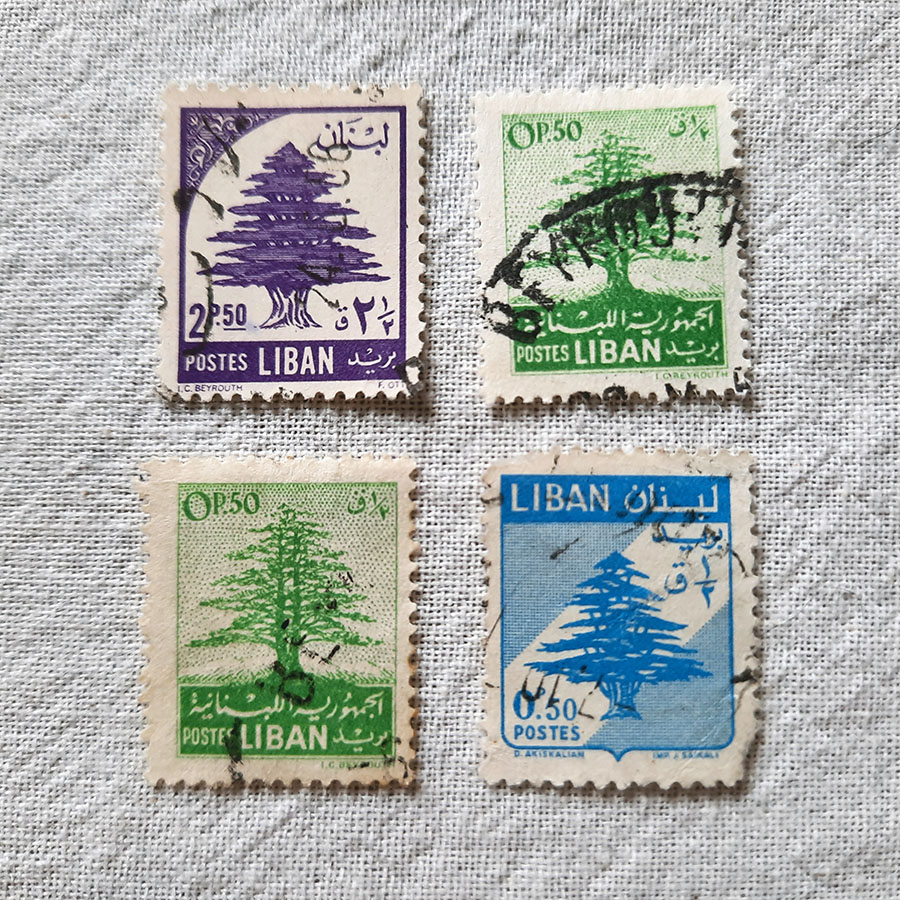
🇱🇧 Lebanon, multiple denominations | Issued 1952–1958 | Scott 256, 298, 325
Sometimes, something so vital and ubiquitous to a culture becomes commonplace and immaterial over time. And when that happens, it’s easy to wipe out the very aspects of it that made it incredible to begin with. Unfortunately, the stamps at the root of this post depict something once vital to the very seeds of civilization that is now at risk of destruction.
If you’re unfamiliar with the Cedar of Lebanon, I hope you find its story as fascinating as I do.

What is the Cedar of Lebanon?
The cedar of Lebanon is both a native species of tree and an historical and religious symbol in the Middle East.
The Lebanon cedar, the plant
The plant Cedrus libani (Arabic: أرز لبناني, romanized: ʾarz Lubnāniyy) is a large, evergreen pine tree native to the mountains of the Eastern Mediterranean basin (southern Turkey, Syria, and Lebanon). Another variety can be found on Cyprus. It can reach 130 feet (40 m) in height, and is characterized by a massive trunk up to eight feet (2.5 m) in diameter. A long-living tree, it does not even begin to produce cones until around 40 years in age. Some Lebanon cedar trees have been known to live in excess of 1,000 years.
Since practically the dawn of civilization, the tree’s wood has been prized for its exceptional durability, fine grain, attractive yellow color, and fragrance. Cedar resin and essential oil are also produced from the tree. Cedar was imported to Egypt for boat construction during the reign of the 4th dynasty king Sneferu, ca. 2613-2589 BC. Egyptians also used cedar resin during the mummification process and cedar wood for some of “their first hieroglyph bearing rolls of papyrus”. In the Ottoman Empire, their timber was used to construct railways. British troops also used cedar to build railroads during WWI.
The Cedar of Lebanon in mythology and religion
The earliest mention of Lebanon cedars, in fact, comes from one of the earliest works of literature. In the Epic of Gilgamesh, the titular Sumerian hero and his friend, Enkidu, travel to the legendary Cedar Forest to kill its guardian and cut down its trees to build their city. Early versions of the story place the forest in Iran. However, later Babylonian accounts of the story place the Cedar Forest in Lebanon.
Lebanon cedars also feature 103 times in the Bible. Their practical use was mentioned when Solomon procured cedar timber to build the Temple in Jerusalem. Moses also ordered Hebrew priests to use their bark as a treatment for leprosy. The trees were also a meaningful symbol for power and longevity. Psalm 92:12 says, “The righteous shall flourish like the palm tree: he shall grow like a cedar in Lebanon”.
References to the trees in Psalm 104:16 are said to support claims of the Hebrew creation story’s proximity to the Cedars of God forest in the Kadisha Valley of Bsharre, Lebanon. Firstly, the verse listed below mentions the cedars were planted with God’s hands. Secondly, an adjacent village in the Kadisha Valley is known as Edhen (Eden). Believers see the connection as a way to pinpoint the geographical location of the God-made garden.
The trees of the Lord are well watered,
Psalm 104:16–18
the cedars of Lebanon that he planted.
There the birds make their nests;
the stork has its home in the junipers.
The high mountains belong to the wild goats;
the crags are a refuge for the hyrax.
What is the national significance of the Cedar of Lebanon?
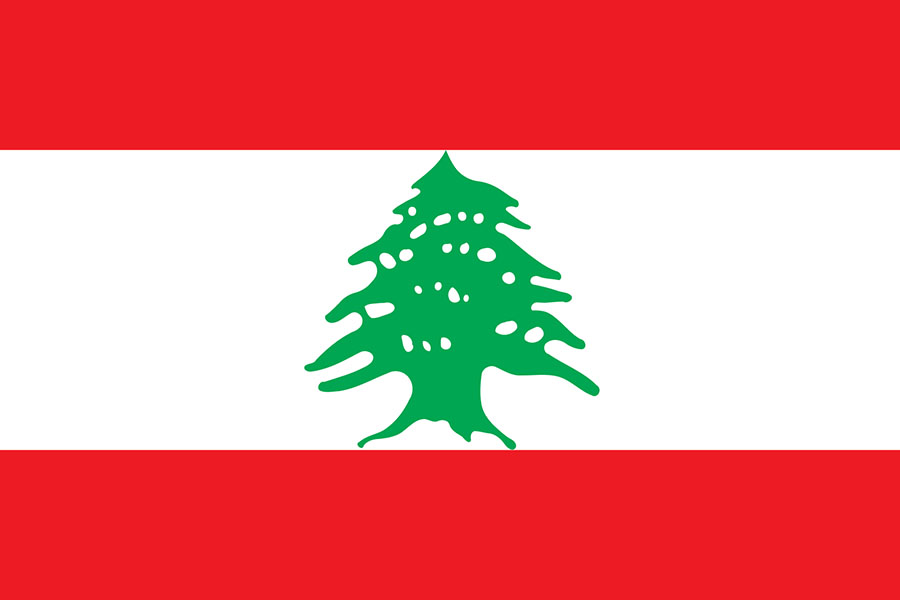
From ancient Sumer to today, the Cedar of Lebanon has always been a significant national and cultural symbol in Lebanon. In addition to being their national emblem, the tree is displayed on both the flag and coat of arms of Lebanon. It is also the logo of Middle East Airlines, which is Lebanon’s national carrier.
Recently, the tree has become the main symbol of many Lebanese political parties and movements. It is the symbol for the Lebanese Forces, and it was the main symbol of Lebanon’s “Cedar Revolution” of 2005, the 2019–20 Lebanese protests.
The Cedars of God forest has been a UNESCO World Heritage Site since 1998.
Cedars of Lebanon around the world
These trees grow natively in the Middle East, but Lebanon cedars are cultivated as ornamental species in parks and gardens around the world. In Britain, the first tree was planted no later than 1664, and Lebanon cedars feature prominently in London’s Highgate Cemetery. One 280-year-old specimen had to be cut down and replaced in 2019, but was immortalized in a scene from the 2018 film “Fantastic Beasts: The Crimes of Grindelwald”.
Another beautiful specimen can still be seen near Conservatory Water inside the 72nd Street entrance to Central Park in New York City. Hot Springs National Park in Arkansas has a Lebanon cedar estimated to be more than 100 years old within their Champion Tree program.
However, you may not find as many Lebanon cedars in Tennessee as you might expect. Despite the name, Cedars of Lebanon State Park, part of the Cedars of Lebanon State Forest, is named for the eastern red cedar trees found throughout the area. The trees reminded early American settlers of the Biblical cedar forests that thrived across Mount Lebanon. (Side note: Even though the tree species may not be the same, the area has its own claim to fame. The state forest is home to 19 rare and endangered species of plants that grow profusely there and nowhere else in the world.)
Extensive deforestation has wiped out much of the original forests throughout the Middle East. Throughout history, there have been many efforts to conserve the trees and reforest the region. The first recorded efforts to conserve the trees were ordered by the Roman emperor Hadrian. According to Wikipedia, he created an imperial forest and ordered it marked by inscribed boundary stones, two of which are in the museum of the American University of Beirut.
Today, more than 50 million young cedars are planted annually in Turkey. The Lebanese state has created several reserves, including the Esh-Shouf Cedar Reserve, which is home to about 25% of all remaining cedars in Lebanon. However, drought and fires caused by climate change still threaten the species.
The Cedar of Lebanon on stamps
The first true Lebanese stamp design (not a surcharged French stamp) depicted the Cedar of Lebanon (Scott 50, 1925). Through the 1950s—and, indeed, well into the 1980s, at least—Lebanon would issue a number of small definitives with variations of the Cedar of Lebanon design. Some included stylized frames, while others depict the tree on “natural” backgrounds. From my small collection, I’ve pulled the following examples:
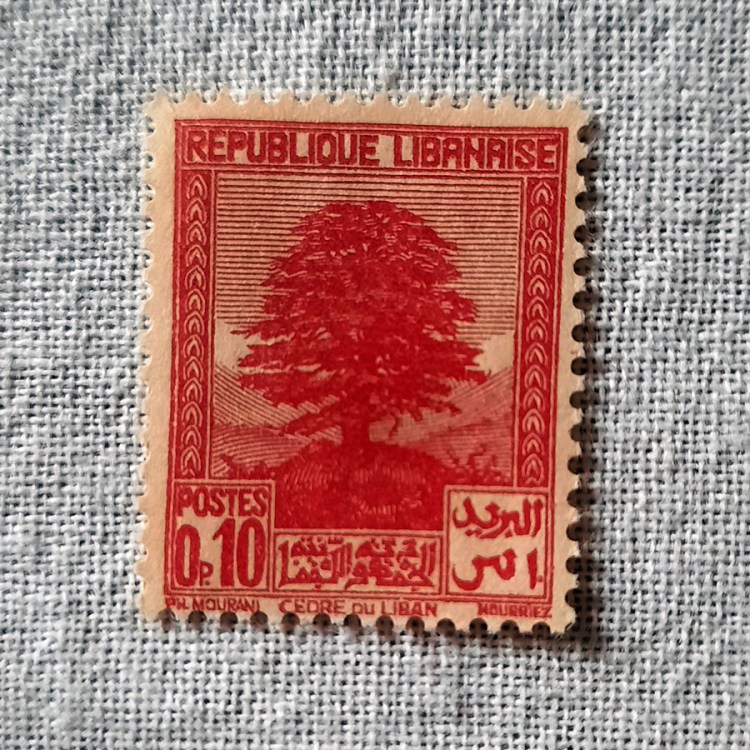
🇱🇧 Lebanon, 0.10p | Issued 1937 | Scott 137

🇱🇧 Lebanon, 0.50p | Issued 1952 | Scott 256
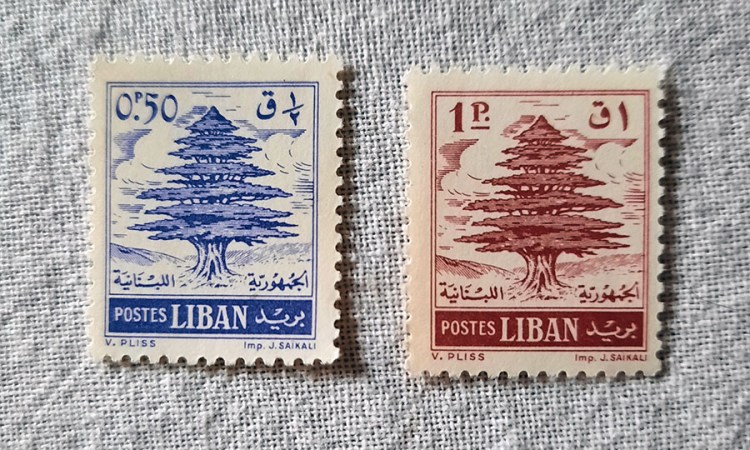
🇱🇧 Lebanon, 0.50p & 1p | Issued 1955 | Scott 287, 288

🇱🇧 Lebanon, 2.50p | Issued 1955 | Scott 298

🇱🇧 Lebanon, 0.50p | Issued 1958 | Scott 325
In addition to being a vital symbol of modern Lebanese culture, the Cedars of Lebanon are a verdant character in Middle Eastern history and tradition. They also serve as a striking stamp design, easily recognizable by all those who understand its significance. Let’s hope that the cedars are able to weather the globe’s current climatic changes and remain a proud symbol for all mankind for generations to come.
What do you think? Were you familiar with some of the stories behind the Cedars of Lebanon? Do you have some of these stamps in your collection? Let me know your thoughts!
 Armchair Philately


Leave a comment