

🇺🇸 United States, 10¢ | Issued August 26, 1937 | Scott 797
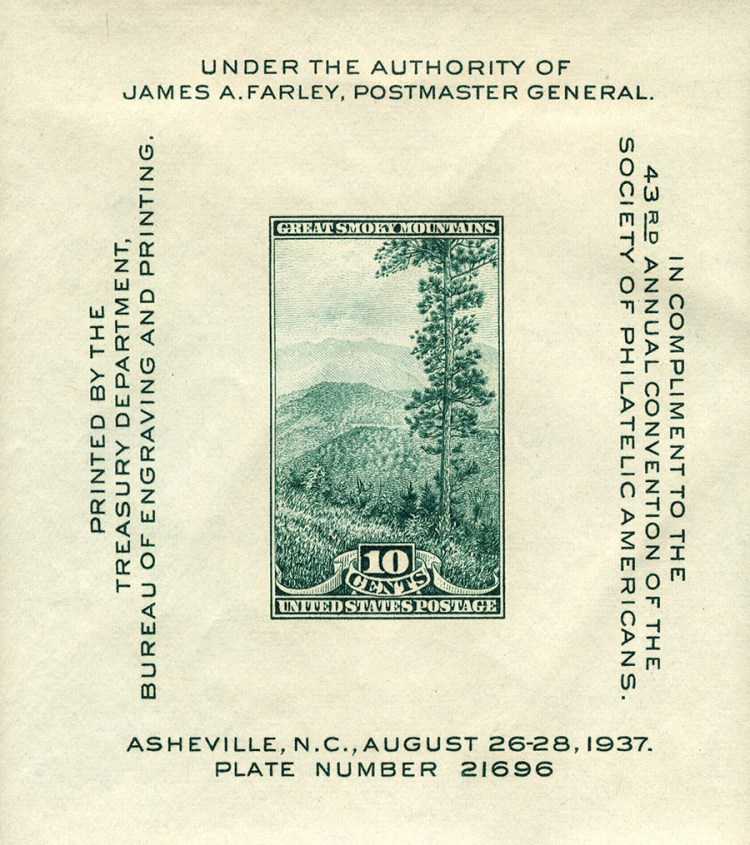
On this day in 1937, the United States Post Office Department issued a stamp minisheet that is close to my heart—because it’s close to my home. Let’s take a moment to celebrate and enjoy this attractive stamp and what it represents: the Great Smoky Mountains of Western North Carolina.
What’s on the stamp minisheet/souvenir sheet?
This small imperforate souvenir sheet, which I’m going to call a minisheet, was issued “in compliment to the 43rd annual Convention of the Society of Philatelic Americans.” The 10-cent stamp at the center of the minisheet is a reproduction of the National Parks stamp of 1934 in a blue-green color rather than the original gray-black. The stamp is surrounded by inscriptions giving the date and place of the convention, as well as authorization and production information for the issue.
The stamp shows a view of the ancient, rolling Smoky Mountains. The mountains are layered on top of each other, receding into the “smoky” views of distant peaks for which the range is named. In the foreground is an Eastern hemlock, standing tall over its scrubbier pine neighbors. (Sadly, since the 1930s, a beetle infestation has felled a great majority of these stately trees. So, what was a common view when this stamp was issued now serves as an historical record of an ecosystem that has since been devastated.)
Where are the Great Smoky Mountains?
The Appalachian Mountains run roughly parallel to the Eastern Seaboard, from Canada to the Deep South. The Appalachians are divided into several subranges, one of which is the Blue Ridge Mountains. The Blue Ridge is itself subdivided, and the Great Smoky Mountains describe the peaks that create the dividing line between Tennessee and North Carolina.
This region is among one of the most biodiverse areas on the planet. So much so that the Smokies are part of an International Biosphere Reserve. That makes it the perfect location for our nation’s favorite (or at least, most trafficked) national park, Great Smoky Mountains National Park (GSMNP). Along with its biodiversity, the Smokies have been designated a UNESCO World Heritage Site for the historic structures within the national park. GSMNP contains five historic districts and nine individual listings on the National Register of Historic Places.
What was the Society of Philatelic Americans?
Most American stamp collectors have heard of the American Philatelic Society as the national philatelic membership organization of the United States. However, you may not know that for many years, there were several competing regional organizations. In addition to the APS, there was the Trans Mississippi Philatelic Association (covering communities throughout the Midwest) and the Society of Philatelic Americans.
Originally called the Southern Philatelic Society, the Society of Philatelic Americans (SPA) was the go-to organization of choice for stamp collectors in the American South. This article discusses the triumph of the APS over the SPA in more detail. Suffice it to say that demographic shifts after the Great Depression and post-war years, along with poor management, would eventually bring down the regionally focused group.
However, let’s do some math based on what we see on the minisheet. If the 43rd convention was held in 1937, that means the SPA was started in the late 1890s. According to the source linked above, the group continued through the early 1980s. That means it existed for roughly half of the time there have been postage stamps. Not too shabby!
What else does the cover and stamp depict?
GSMNP was chartered by the United States Congress in 1934, and officially dedicated by President Franklin D. Roosevelt in 1940. This stamp and cover, postmarked in 1937, falls squarely in the middle of that period.
As evidenced by the clear postmark and text below the stamp image on the minisheet, this stamp was issued in Asheville, NC. Tucked within the Blue Ridge, Asheville has been the most populous metro in Western North Carolina for more than a century. The town was made famous by George W. Vanderbilt II, who built his grand Biltmore Estate outside the town center in 1895. Through the 1920s, and certainly to today, it has been a popular destination for visitors seeking the clear air and pristine vistas of our mountains. Thus, it is a natural location to associate with the Smokies, and it was a great place to host the 43rd annual Convention of the Society of Philatelic Americans.
The cover was postmarked at 9 a.m. on August 26, the first day of the three-day conference. The cancellation over the minisheet reads “S.P.A. Convention Sta.” (with two bars above and two below the text—standard for first-day covers), indicating either that there was a special postal station set up at or an existing station designated to the convention.

Who was Stanley Woods of the Bronx, NY?
As a beginning philatelist, one of my biggest shortcomings at the moment is my access to archival information. I currently don’t have subscriptions to resources like ancestry.com that would help one home in on individuals from the past.
That being said, it feels unlikely that the Mr. Stanley Woods of Bronx, New York to whom this cover was mailed was the contemporary famed Irish motorcycle racer Stanley Woods. However, that Woods, winner of 29 motorcycle Grand Prix races in the 1920s and 1930s, is himself the subject of at least two postage stamps. In 1974, Isle of Man issued a commemorative stamp highlighting his 1935 Tourist Trophy (TT) senior title aboard a Moto Guzzi. In 1996, his home nation of Ireland issued a similar design.
Just for fun, here is that Woods winning the Senior TT race in 1926:
In 1937, there were more than 1.3 million people living in the Bronx. Looking through old New York newspapers, I did discover several Stanley Woodses who died tragically in the first decades of the century, years before this cover was sent. I also discovered a well-regarded stage actor named Stanley Wood, as well as a book illustrator, Stanley L. Wood, also without the “s”. However, more research is needed to rediscover this particular gentleman.
His home, however, was much easier to find. Modern day 2701 Marion Avenue is located near Fordham University’s campus and the New York Botanical Garden in the Fordham Manor neighborhood. The block is located between E 195th Street and E 196th Street. The six-story building is rather nondescript. However, the front door does have some design around the frame and the transom window that would lead me to assume it would have been standing when Mr. Woods lived there in 1937. I guess some things never change.
So, there we have it! 84 years ago today, this cover was sent to Mr. Stanley Woods from the SPA convention in my hometown of Asheville. But even after all these years, there is still much to learn about the cover and the man who received it.
What do you think? Have you ever been to Great Smoky Mountains National Park? Do you have more info about the now-defunct SPA? Let me know your thoughts!
 Armchair Philately
Leave a comment