
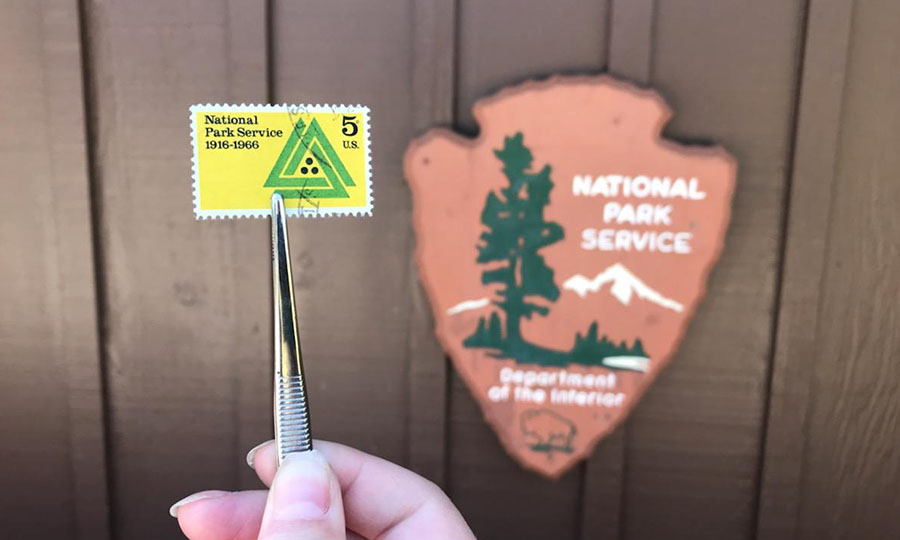
🇺🇸 United States, 5¢ | Issued August 25, 1966 | Scott 1314
Recently, my sister and I were trekking around the national parks of central California when we spotted an opportunity for #xtremephilately. She helped me take the image above, a shot of the 1966 National Park Service stamp in front of a National Park Service sign at one of the visitor centers. And then she asked me a very good question: “Why is the logo different on the stamp than it is on the sign?”
“I don’t know,” I told her. “But I will find out.”
Like many stamps, I found that this one is a snapshot to a past that no longer exists. Here’s a (very brief) history of the National Park Service and how the stamp fits into its history.
A very brief history of the National Park Service
America’s national park system traces its origins to 1832, when Hot Springs in Arkansas was declared America’s first federal reserve. Citizens were taking note of all the natural wonders our landscape had to offer, and were calling for their protection in real time and in perpetuity. But it would be nearly another century before the National Park Service would come into being.
In the middle of the 19th century, conservationists worried about the effects of commercial ventures in Yosemite Valley. In 1864, President Lincoln placed Yosemite under the protection of the state of California. This was the first time the U.S. government set aside park land specifically for preservation and public use. Similar concerns were soon voiced about Yellowstone when gold was discovered in the area. People worried that developers would come in and charge fees to see the area’s natural wonders, while not taking care to protect them. In 1872, President Ulysses S. Grant signed legislation protecting Yellowstone, making it the first national park.
Yellowstone was followed by Sequoia, Yosemite, and Mount Rainier national parks by the end of the century. Other national forests, preserves, refuges, and monuments were also given federal protection. However, there was not yet a unifying organization in place (or the required funding) to manage them. And because of this, there was no way to stop private companies from constructing hotels, railroads, ranches, and sawmills on the land—the very things national park status was meant to quell!
After a wide-reaching campaign that included everyone from schoolchildren to the National Geographic Society, the government took action, changing U.S. conservation efforts forever. On August 25, 1916, President Woodrow Wilson officially established the National Park Service as a bureau under the Department of the Interior. Today, the National Park Service includes more than 400 protected areas (including 63 national parks), covering more than 85 million acres across 30 states, American Samoa, and the U.S. Virgin Islands. The newest national park, Green River Gorge, was established in West Virginia last December (2020).
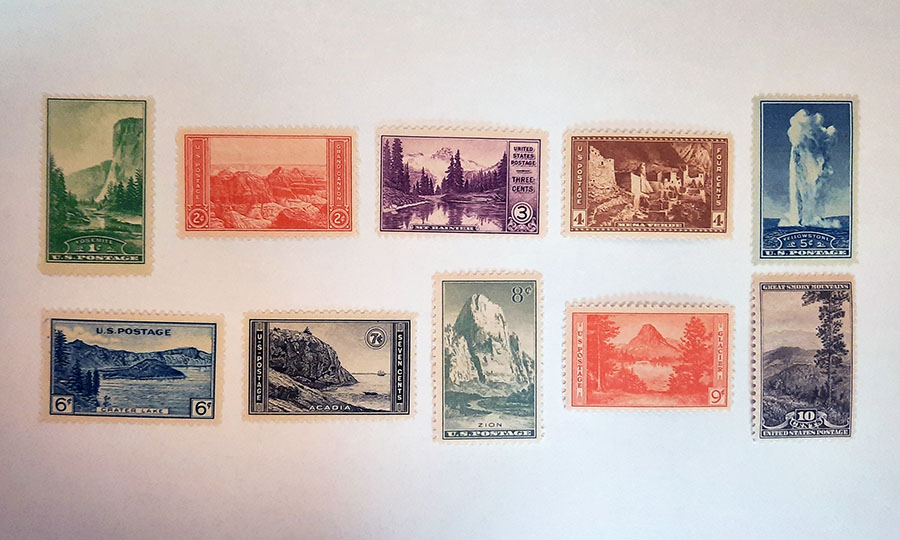
🇺🇸 United States, 1–10¢ | Issued 1934 | Scott 740–749
Other stamps celebrating national parks and monuments
According to my ATA checklist, there are currently 224 stamps featuring U.S. national parks and monuments. Surprisingly to me, only about half of these were issued by the United States. Over the years, the United Nations, Marshall Islands, and nations as far as Japan and Mozambique have issued stamps celebrating various U.S. parks and preserves. (Many national parks are also designated UNESCO World Heritage Sites or Biosphere Reserves, which appears to be the focus of many foreign stamps.)
Perhaps the best known and celebrated national park stamp series is the 1934 set issued to commemorate the reorganization and expansion of the National Park Service (Scott 740-749, pictured above).
On March 3, 1933, President Herbert Hoover signed the Reorganization Act of 1933, which made it possible for the president to reorganize the executive branch of government. Later in the year, newly inaugurated President Franklin D. Roosevelt issued two executive orders to transfer a number of federally controlled sites to the NPS. This included all of the War Department’s historic sites, as well as the Department of Agriculture’s national monuments, and parks in and around Washington, D.C. operated by an independent federal office. It was this expansion that the above stamp series celebrated.
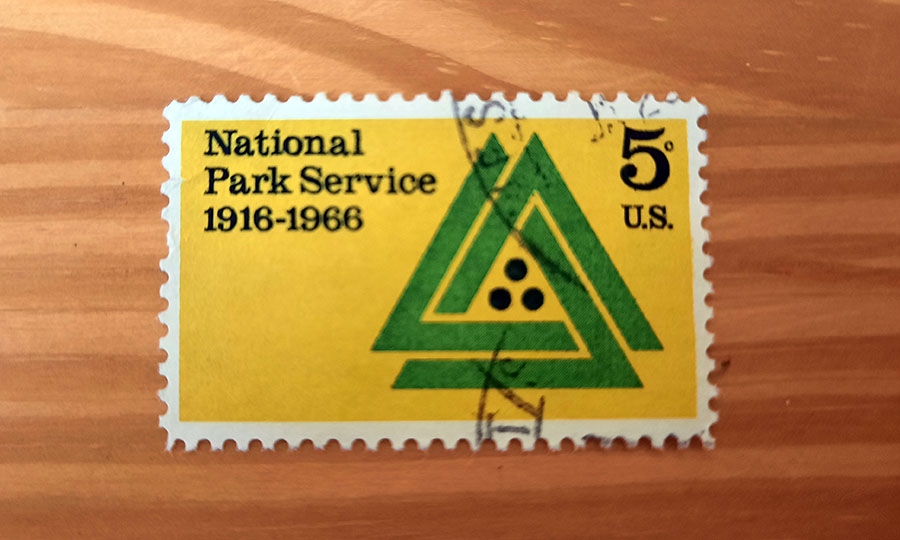
Where does this 5-cent stamp fit into the history of the NPS?
After World War II, America’s national parks became overtaxed by demands from visitors and local businesses. (I noticed a lot of historical signage to this effect across Yosemite and Sequoia while I was there recently.) Beginning in 1952, the NPS embarked on an ambitious “ten-year” effort to upgrade and expand park facilities before the NPS’s 50th anniversary in 1966. Five new parks were added to the NPS during this time, as well.
The post office issued this stamp on August 25, 1966—50 years to the day after the NPS was established—in Yellowstone National Park, WY. Since Yellowstone was the first-ever U.S. national park, it was fitting to release it there.
The arrowhead emblem we’re familiar with today (from the sign in the top image) is just one of several emblems the NPS has used or considered over the years. Authorized in 1951, the elements of the emblem symbolize the major facets of the National Park Service. George Hartzog, Jr., who served as NPS director from 1964–1972, proposed the emblem on the 50th anniversary stamp to replace the arrowhead design. The three triangles supposedly represent the outdoors (trees and mountains), enclosing three balls, which were the standard symbol for preservation.
Obviously, this attempt at abstract mid century graphic design did not suit the NPS in the long run. And today we still see the arrowhead emblem used to represent “America’s best idea,” the National Park Service.
What do you think? Do you have a favorite national park? Have you ever attempted “extreme philately”? Let me know your thoughts!
 Armchair Philately