

🇭🇺 Hungary, 3,000k | Issued October 16, 1923 | Scott 385
If you can think of an occupation, an avocation, or a location, there’s a good chance it has its own patron saint. Go ahead and check the list. There’s a patron saint of archaeologists and a patron saint of cats. A patron saint of thieves and a patron saint of danger from thieves. A patron saint of mail (Anthony of Padua) and a patron saint of stamp collectors (Gabriel the Archangel).
And for our self guided history lesson today, Hungary has its own sainted patroness.
I’ve loved this stamp set since I first discovered it. And I recently purchased a few specimens with particularly nice cancellations in a large lot from medalman497 on eBay. Ready to see what we can learn from those?
Why is the Madonna the “Patroness of Hungary”?
For those unfamiliar with Catholic dogma, patron saints serve as special protectors or guardians over groups of people. By invoking the name of a patron saint for your church or town or workman’s guild, for instance, you call for their protection against harm or other unforeseen evils.
A collection of nomadic Magyar tribes took up residence in the Carpathian Basin sometime around the ninth century. At the time, the surest way to establish your own sovereign nation was to be officially acknowledged as one by the Catholic church. According to legend, Pope Sylvester II granted such recognition on Christmas Day of the year 1000 and the Magyar leader, Istvan, was crowned His Royal Apostolic Majesty King Stephen I on the first day of the new millennium.
As the first king of the sovereign Catholic nation of Hungary, Stephen offered his country to Mary as the patroness of the Hungarians. In the millennium since, the Hungarian people have prayed to the Virgin for safety and support.
What connection did the Magyars have to the Blessed Virgin?
King Stephen I may have converted Hungary, as a nation, into Catholicism. However, it’s unlikely the Magyar people made the transition without resistance.
Before Catholicism, the Magyars had their own rich, ancient mythology built upon a number of deities, heroes, and spirits. Second only to Arany Atya, the “Golden Father,” was Boldogasszony, the Mother Goddess (translated “Blessed Lady” or “Blessed Queen”). Boldogasszony, also called Istenanya, was the goddess of motherhood who helped women in childbirth.
In addition, Hungary’s national creation myth featured an immaculate conception, of a sort. Emese, wife of Chief Ögyek (Ügek), was visited by the great Turul bird in a dream. The bird told her that from her womb a great river would begin, and flow westward over strange lands. After the dream, Emese became pregnant and later gave birth to a son named Álmos, meaning “the Dreamt One”. Álmos would lead the Magyars from the Asian Steppe to the Carpathian Basin—their own “promised land”, where Hungary was built.
Did King Stephen (later beatified as Saint Stephen) choose the Virgin Mary as Hungary’s patroness because of her parallels with his people’s most revered goddess and their national origin myth? We will never know for sure how deliberate his choice was. But politically, it would have been a very strategic move, taken to appease a polytheistic culture that would not have been quick to give up all of its gods and goddesses.
After the Magyars were Christianized, all of the old gods fell out of favor, including Boldogasszony. However, in later years, Hungarian Christians would again use the name “Boldogasszony” and “Nagyboldogasszony” (“Great Blessed Lady”), this time as a moniker for the Virgin Mary. On the occasion of Hungary’s millennial celebrations in 1896, Pope Leo XIII granted Hungarian Catholics permission to celebrate the feast of the patroness Boldogasszony.
What stamps feature the Patroness of Hungary?
Several of Hungary’s pre-WWII issues highlight the Madonna and Child along with the Latin phrase “Patrona Hungariae” (Patroness of Hungary).
The first of these was the “Madonna and Crown” issue of 1921–1925. Issued in ten denominations from 50–10,000 korona, the two-color stamps depict the Virgin and Child in a circle. The Virgin Mary is wearing Saint Stephen’s Crown and is holding the royal orb and scepter.
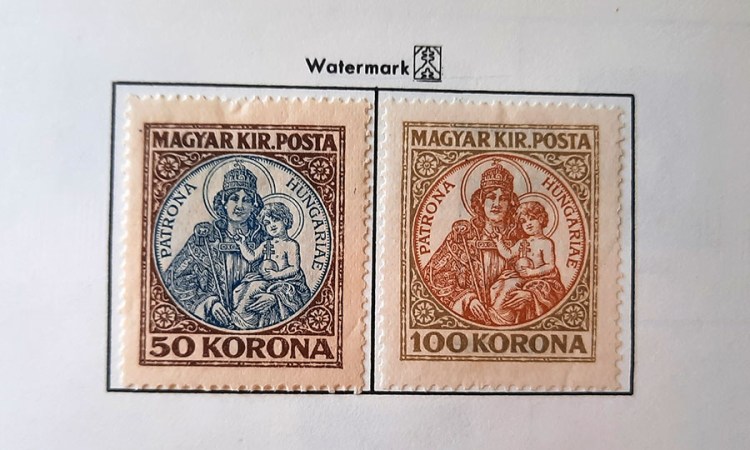
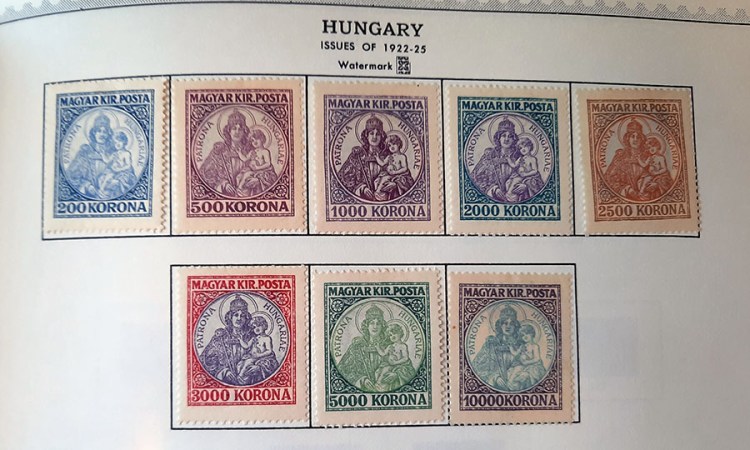
Other “Patrona Hungariae” stamps include:
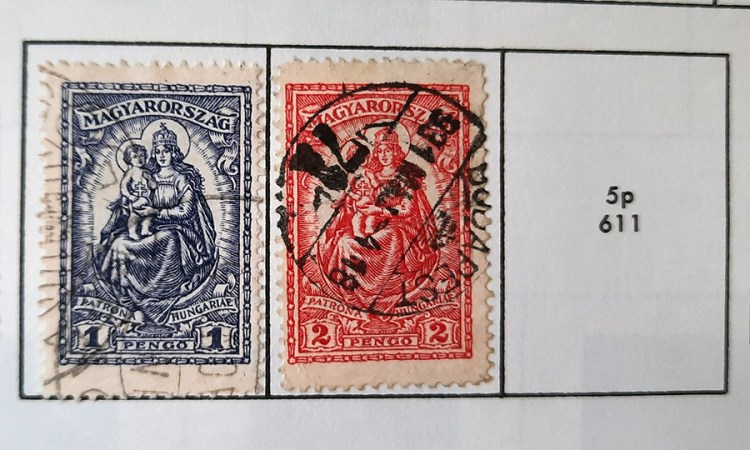
🇭🇺 Hungary, 1–5p | Issued 1926–1927 | Scott 415–417
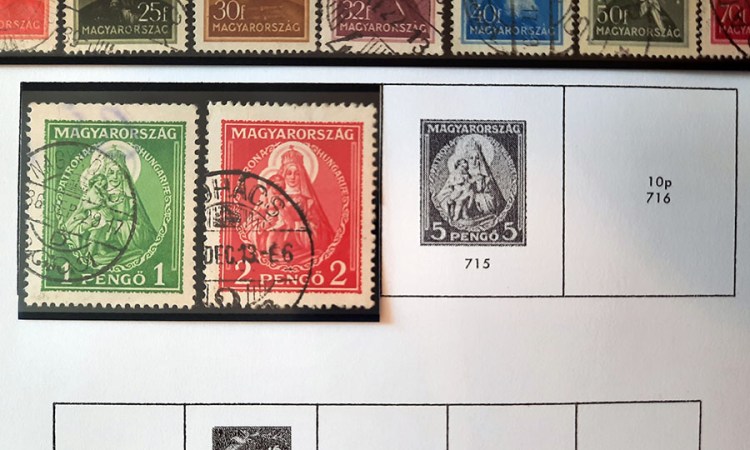
🇭🇺 Hungary, 1–10p | Issued June 1, 1932 | Scott 462–465
In addition, at least one stamp was issued outside of Hungary with the same Latin phrase, “Patrona Hungariae”. In 1971, Vatican City issued two stamps commemorating the Holy Millennium of Hungary. The 50-lire stamp features Saint Stephen, and the 180-lire stamp depicts the Madonna from a Venetian missal of 1511. (See Vatican City, Scott 514.)
What else can we learn from this particular stamp?
You’ll have to click through to find out! See part two of this post, here, for more details about this stamp’s design, cancellation, and where it traveled from.
What do you think? Do you have a preferred patron saint? Do you like the other Patroness stamps more than this one? Let me know your thoughts!
 Armchair Philately