

🇭🇺 Hungary, 3,000k | Issued October 16, 1923 | Scott 385
If you look at it in detail, there is so much you can learn from a single stamp. The technology of the printing process. The artist and symbolism behind the design. The story of its travel inked in the cancellation. And these things open up routes of discovery about the very world in which the stamp served its very brief logistical purpose.
In Part 1 of this post, I speculated about why the Virgin Mary was chosen as Hungary’s Patroness, as well as taking a look at other stamps with “Patrona Hungariae” on them. Today, let’s look at the stamp in question in more detail. Ready?
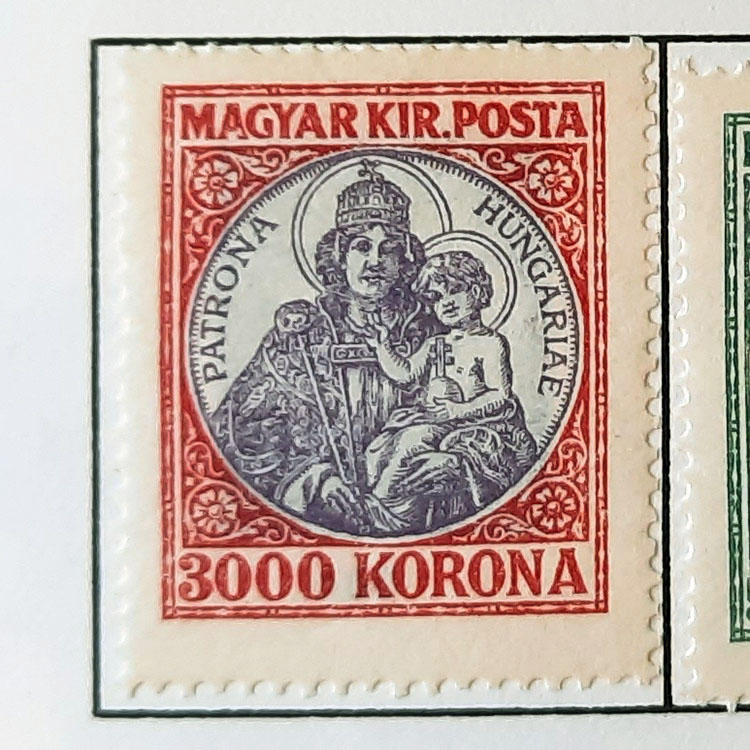
🇭🇺 Hungary, 3,000k | Issued October 16, 1923 | Scott 385
What are the details of the stamp design?
This set of ten two-color, typographic stamps depict the Virgin and Child in a circle (color one). The Virgin Mary is wearing Saint Stephen’s Crown and is holding the royal coronation scepter. The Baby Jesus has two fingers raised and is holding the royal orb, surmounted by the two-barred cross. Both the Virgin and Child have halos around their heads. Around their circular frame is a rectangular frame (color two) of four flowers, illustrated in a medieval style. It’s possible the flowers are periwinkles. Also named the “Virgin Flower”, its blue color connects it to Mary, who is usually depicted wearing blue.
The stamps read “Magyar Kir. Posta” (“Hungarian Royal Post”) at the top. Within the circle is the Latin phrase “Patrona Hungariae”, meaning “defender of Hungary” in the same color as the Virgin and Child. The stamp values are listed across the bottom in denominations ranging from 50–10,000 korona.
The individual stamp highlighted at the top of the post is in fair condition at best. It shows some visible wear and tear to the surface fibers on the top right. And the thin paper has been creased and crumpled repeatedly over the last century. But the clear cancellation mark, nearly socked on the nose, is where this individual stamp still shines (see below).
Rarities from this issue
One of the greatest error rarities in Hungarian stamps is the 5,000 korona of this design with an inverted center (Scott 386a). According to Spink, “There are less than 100 examples in existence, and at least 38 of these are tied up in museum collections and exhibitions.” A pair of this error sold in the Spink Shreves Galleries sale of June 18, 2009 for $37,500.00!
Who designed these stamps?
Curiously, Colnet lists the designer of the 50k and 100k denominations as Ferenc Helbing, while no designer is listed for the larger denominations (though Helbing can be assumed). Ferenc Helbing (December 25, 1870–January 28, 1958) was a prominent lithographer, graphic artist, and painter who created pioneering work in the field of Hungarian commercial graphics.
Helbing designed dozens of other Hungarian stamps between 1920 and 1935. Among them are the valuable sports series of 1925, and the iconic Crown of St. Stephen definitives. Interestingly, Helbing was also the designer behind the Madonna and Child of 1926 and the Patrona Hungariae series of 1932 (see part one of this post). The prize-winning artist also designed Hungarian banknotes and created posters, book illustrations, glass paintings, and murals. Outside of stamp and banknote collections, Helbing’s work can still be seen in the Hungarian National Gallery.

What does this stamp’s cancellation tell us?
This stamp was originally affixed to a philatelic item sent within Budapest, Hungary on Saturday, June 20, 1925. As Hungarians use 24-hour or military time, I am left to assume by the “18” on the date line that the item was posted at 6:00PM.
I did a slightly deeper dive into the numbers along the bottom of the cancellation, and I think they correspond to railway mail. The bold and stylized “62” denotes the route number, and the letters signify the railway line. I believe the mail was sent within Budapest, as railway mail cancellations from one town to another usually list both the beginning and end destination (e.g. “Graz – Budapest”).
Assuming that is all correct, it’s likely that the item this stamp was on was posted at the end of the afternoon (6:00PM) and transported overnight to its recipient.
What’s interesting about Budapest in 1925?
As seen in the footage above, Budapest of 1925 was a bustling city of trolleys, automobiles, motorcycles, and pedestrians.
Liberated from Austria after WWI, Hungary was the first Communist government formed in Europe after the October Revolution in Russia. In 1919, Budapest was declared the capital of the Hungarian Soviet Republic. After several series of violent uprisings and retaliatory uprisings, Hungary was put under the command of two regents in 1920. This form of government would last until 1944.
In 1925, Budapest was home to well over one million residents (1930 population: 1,442,869). The Hungarian National Bank was formed the year prior. And on December 1, 1925, Hungarian Radio (Magyar Rádió) began broadcasting. And though it would be years before he played for MTK Budapest FC in town, goalkeeper and Olympian Sándor Gellér was born that year in Veseuș, Romania.
What do you think? Did you like this two-part post style? Can you offer additional insight into the stamp’s design or cancellation? Is it interesting to put the stamp in context with what was happening in the nation around it? Let me know your thoughts!
 Armchair Philately