
Crimped hair. Pogs. Reebok Pumps. Nintendo Wii. “Gangnam Style.”
These fads charged into the zeitgeist and sacked public consciousness! Battalions of Garbage Pail Kids invaded lunch boxes all over the globe. Armies of JNCO jeans marched through the hallways of local high schools, defining the ranks of peer groups. “Baby Shark” wreaked havoc on the sanity of parents and gave no quarter.
And for a few brief years, legions of objects from one Hungarian puzzle maker broke through the fortifications of nearly every household in the developed world. This is the story about how Hungary briefly conquered the world.
Where did the Rubik’s Cube come from?
You’ve likely fought one of these puzzle cubes before. And you’ve either triumphed against it or surrendered to its surprising complexity.
The 3D combination puzzle, originally called the Magic Cube, was invented in 1974 by Hungarian sculptor and professor of architecture Ernő Rubik. You turn the rows along the X, Y, and Z axes to try to get each face to display only one color. And if you know what you’re doing, you can complete the puzzle pretty quickly.
The puzzle was licensed for sale in 1980 and quickly took the world by storm after winning the German Game of the Year special award for Best Puzzle. Within months, the Rubik’s Cube became an international sensation. According to puzzle mathematician David Singmaster, “it is estimated that in the period from 1980 to 1983, around 200 million Rubik’s Cubes were sold worldwide.” That’s one cube for about every 22 people on the planet at the time!
I’d like to see a frontal attack of Furbys with those kinds of numbers….
Why is the world’s largest Rubik’s Cube* in Knoxville, Tennessee?
At the height of the Rubik’s Cube’s siege of the market, Knoxville, Tennessee hosted the 1982 World’s Fair (May 1–October 31, 1982). These large international exhibitions are held every few years in order to showcase the achievements of nations. (Expo 2020 is currently underway in Dubai until April 2022.)
Knoxville’s theme was “Energy Turns the World,” a subject which inspired many creative exhibits. Among the inventions and concepts debuted at the fair were touch screen display screens, Tetra Pak boxed shelf-stable milk, and Coca-Cola’s Cherry Coke. Related to energy advances, oil corporation Texaco showcased the innovative new concept of paying at the pump. And related to technology, the arcade area featured video games of the era, including Pac-Man, Ms. Pac-Man, Space Invaders, Qix, Gorf, Scramble, and Donkey Kong.
More than 20 nations participated in the fair by sending exhibits of innovations and artifacts. Hungary sent the world’s largest Rubik’s Cube, six feet (1.83m) in diameter with rotating squares. The cube served as the vanguard to the Hungarian pavilion throughout the course of the fair. Today, the giant Rubik’s Cube remains in World’s Fair Park and is located inside the entrance of the Knoxville Convention Center.
*Side note: While the signage in Knoxville still calls it the “world’s largest,” in June 2021, Guinness World Records certified the largest Rubik’s Cube in the world at 2.5 meters in size at the NINA MALL in Hong Kong.
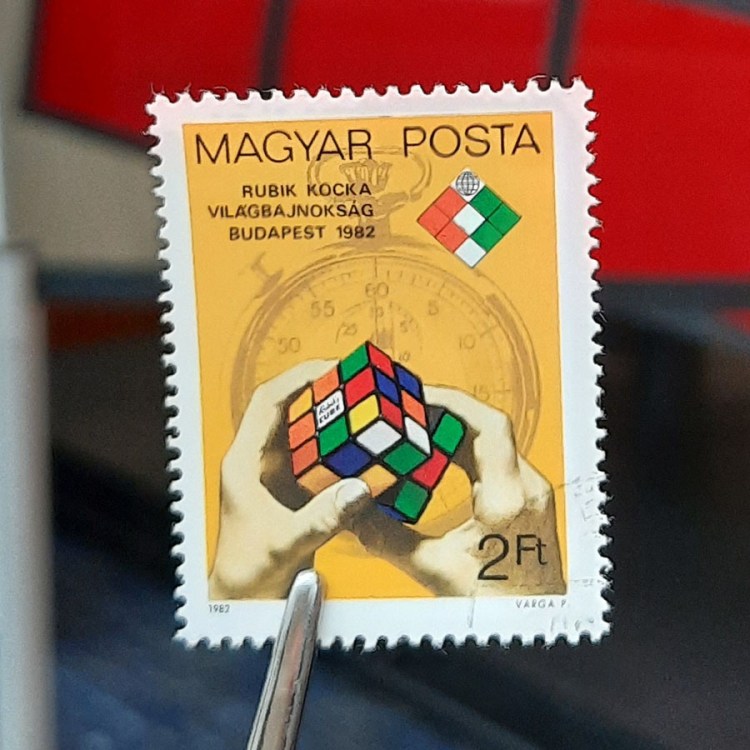
🇭🇺 Hungary, 2 Ft | Issued June 4, 1982 | Scott 2752
Why was this stamp issued?
When the stamp above was issued in June 1982, millions of children and adults around the world were overrun by the Rubik’s Cube craze. Not one, but three of the top ten best-selling books in the U.S. were about solving Rubik’s Cubes. And a tank-sized Rubik’s Cube was on display at the Knoxville World’s Fair.
But none of that was the primary reason behind this stamp issue.
Instead, this commemorative stamp, with a person twisting a Rubik’s Cube in the foreground and a stopwatch in the background, features the text, “RUBIK KOCKA VILÁGBAJNOKSÁG BUDAPEST 1982.” Translation: “RUBIK CUBES WORLD CHAMPIONSHIP BUDAPEST 1982.” According to Colnect, Hungary issued 3,204,300 perforate and 7,700 imperforate copies of the stamp for distribution the day before the competition.
The 1982 Rubik’s Cube speedcubing competition was not the first in the world, but was the first to crown a world champion. Contestants selected from 19 countries took part and were given three attempts each. The cubes used in competition were selected by Ernő Rubik himself. Hungary’s own Zoltán Lábas played a strong game, finishing in third place with a best time of 24.49 seconds. But America’s own Minh Thai took home the gold—literally, a gold-plated Rubik’s Cube—with a best time of 22.95 seconds.
Unfortunately, it appears that by the end of 1983, the popularity of the Rubik’s Cube retreated as quickly as it had appeared. An international Rubik’s Cube competition of this caliber would not be held again until 2003, when The Boston Globe remarked that it was “becoming cool to own a Cube again.”
What do you think? Have you ever been to World’s Fair Park in Knoxville, Tennessee? Can you solve a Rubik’s Cube in under a minute? Let me know your thoughts!
 Armchair Philately
Leave a comment