

🇭🇺 Hungary, 10f | Issued January 1, 1938 | Scott 516
America was famously born when the Second Continental Congress of 56 delegates agreed to adopt the Declaration of Independence in 1776. But according to history, the birth of Hungary as a nation was thanks to the actions of two men: Pope Sylvester II and the Magyar leader, Istvan.
Today, on the anniversary of this stamp’s cancellation, let’s take a look at one of the more beautiful depictions of the reign of St. Stephen from this 1938 commemorative stamp series. And (joy of joys!) I’ll share a recent discovery about Hungarian handstamps that I’ve been wondering about for quite some time.
Who were St. Stephen and Pope Sylvester II?
In the ninth century, Magyar tribes were pushed from their ancestral lands in the Central Asian steppe by invading forces. They migrated to the Carpathian Basin, led by the mythical Turul bird, and settled the land soon to be known as Hungary. At the turn of the century, their leader, Istvan, knew that the best way to bring security to his people was to have the protection of the Catholic church. According to legend, Pope Sylvester II declared Hungary a sovereign, Catholic nation on Christmas Day of the year 1000, and Istvan was crowned His Royal Apostolic Majesty King Stephen I on the first day of the new millennium.
King Stephen ruled the new nation of Hungary for 38 years until his death in 1038. Hungary enjoyed a lasting period of peace during his reign, making it a safe and preferred route for pilgrims and merchants traveling between Western Europe, Constantinople, and the Holy Land. 50 years after his death, King Stephen was canonized by Pope Gregory VII as Saint Stephen, patron saint of Hungary.
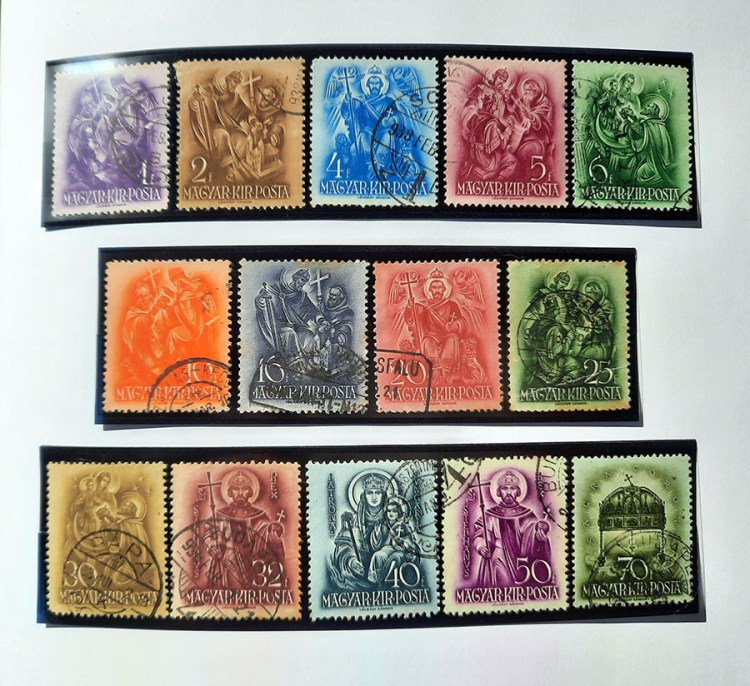
What’s depicted on this stamp series?
On the 900th anniversary of his death, Hungary commemorated St. Stephen in a series of 14 stamps. The eight intricate designs featured in this series include:
- Pope Sylvester II, Archbishop
- Stephen the church builder
- St. Stephen enthroned
- Sts. Gerhardt, Emerich, Stephen
- St. Stephen offering holy crown to Virgin Mary
- Portrait of St. Stephen
- Madonna and Child
- Crown of St. Stephen
Each stamp features the words “Magyar Kir Posta” (Hungarian Royal Post) under the denomination. And in tiny text, “Légrády Sándor,” the name of the artist, last name first per Hungarian norms.
I just love the rich colors and dramatic “lighting” of these monochromatic stamps. Instead of a hard border, each image fades out around the edges in a way that keeps the viewer’s focus on the central image and imbues it with a miraculous glow. But the stamp pictured at the top of the post has an additional feature worth exploring: a perfectly socked on the nose hand cancel.
What can we learn from this hand cancellation?
Sometimes in history and anthropology, it’s the most pedestrian facts that are lost to time. Why would Ancient Rome need to record something as common as the recipe for their most popular condiment when everyone just knew how it was made?
Similarly, I’ve been able to find a lot of literature about the evolution of 19th century Hungarian handstamp cancel designs. (When closed semi-circles became open semi-circles; the first instance of letters appearing within the stripes of the bottom semicircle; when the crown with the rounded bottom became a crown with a flat bottom, etc.) But no one has bothered to provide the novice with a simple diagram that says, “here, this is what these letters mean.”
So, I’ve put one together for this handstamp myself, shown here:

Let’s look at the middle date line first. In 19th century Hungary, years were listed by the last two digits. As of 1900, the Hungarian post used three digits (e.g. 1900 was represented as “900”). The year was followed by an abbreviation of the month (JAN = január = January), then the day. Numeric date elements are followed by a dot, as is traditional in Hungary. Then, the characters “É6” indicate the time at which the stamp was cancelled. Instead of AM and PM, Hungarians use “N” for nappal (daytime) and “É” for éjjel (night). This stamp, therefore, was cancelled on Tuesday, January 11, 1938, at 6:00 at night, ten days after this stamp series was issued.
Back up to the top of the circle, “VECSÉS” indicates the town from which this stamp was sent. In cases where the town name is very long, it would wrap from the top of the circle to the bottom, replacing the flourish. A Hungarian crown (the crown of St. Stephen) is present within the stripes in the top half of the circle. Within the bottom half is the letter “C”.
This “C” was the most difficult part of the postmark to track down. In fact, I’ve struggled with these handstamp features before. But I believe I finally found my answer! On page 439 of one document I explored, I discovered an earlier handstamp that matched this handstamp almost exactly in style. It refers to the “C” as a “check letter”. We reviewed check letters on stamps briefly in my post about Penny Reds, where they indicated an individual stamp’s placement on a sheet. But this check letter is on a handstamp, not a postage stamp, and has only one check letter. What could this mean?
I found the answer on page 398 of the same PDF:
As postal traffic increased, ever more offices were using more than one location-date handstamps [sic]. Usually, one handstamp belonged to each working station. For each mail handling operation, there was a specific indication on handstamps, such as ‘registered mail’, ‘letter’, ‘money transfer’, etc. But in most post offices, the majority of handstamps were identical…. With these identical handstamps, within single offices, individual responsibility could not be identified. For this reason, if there were several identical handstamps at an office, they were differentiated by letters (small and capital) which followed each other in alphabetical order. … The first handstamp of a post office did not contain a check letter, the second one received letter A, the third B, and so on, in alphabetic order.
There we have it! This “C” indicates that it was stamped by the fourth identical handstamp at the Vecsés post office.
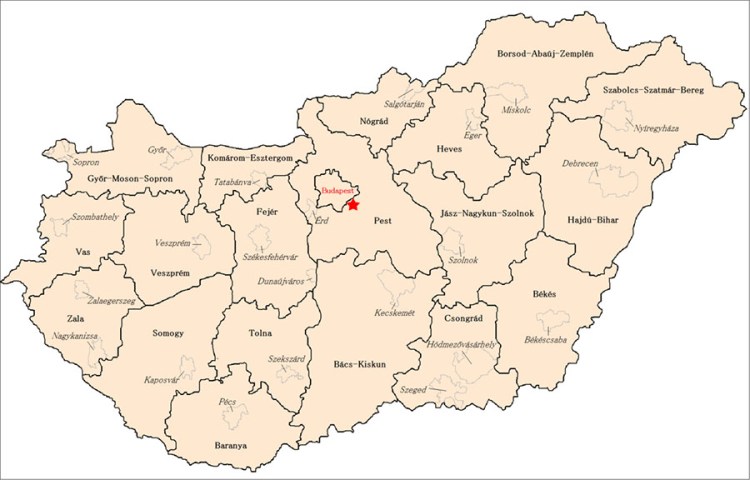
Where is Vecsés and what is it known for?
Hungary is divided into 19 counties, along with the capital city of Budapest, which is independent of Pest county. Vecsés sits just outside the borders of Budapest in Pest county, indicated by the star on the map.
The current population of Vecsés tops 20,000, but the town traces its history back to a collection of farming communities first mentioned in records in 1318. German-speaking Swabian settlers grew cabbage there in the 18th century, and the area is still famous for its sauerkraut production today.
The town’s borders envelop part of Budapest’s Ferihegy Airport. Unsurprisingly, one of the top attractions in Vecsés is the Spotterdomb, an observation deck that overlooks the airport’s landing strip. A short drive away, the Bálint Ágnes Cultural Center is a hotspot for theater, concerts, and community activities. Travel sites also recommend nearby Budapest landmarks on your trip to Vecsés, including St. Stephen’s Basilica. At 315 feet, it’s the tallest building in the capital city with an 8,500-person capacity.
That seems like a good place to end our tour of Vecsés and this stamp for today. 900 years after his death, the iconic St. Stephen was commemorated in this stamp series. And nearly another 100 years on, St. Stephen’s Basilica remains one of the most iconic destinations for locals and visitors to Budapest, Vecsés, and surrounding Pest County.
What do you think? Do you appreciate this series as much as I do? Was it helpful to see the elements of the handstamp in a diagram? Let me know your thoughts!
 Armchair Philately
Leave a comment