
It’s snowed out every “significant” birthday of my life so far. The day my mother went into labor, there were 17 inches of snow on the ground. So much snow, that my father and the EMT on duty had to hoist her four-foot-ten frame by the armpits and carry her the nearly-quarter mile down the unshoveled driveway to the ambulance waiting at the road.
Or so the story goes.
I, myself, can attest to well over a foot of snow ruining the plans for both my 13th and 16th birthdays. My 18th birthday, my first in Asheville, saw enough snow that they canceled the minor league hockey game I wanted to attend. (That proved to be the last season for the Asheville Aces, too, and I never got to see a single game.) There was enough black ice on the road for my 21st that several friends couldn’t make it to my house party. And while it didn’t snow on my 30th, my friends and I did have to navigate downtown Savannah in the middle of a full-on monsoon.
As I’m writing this—a few days shy of my next birthday and nearly two years into a global pandemic—there are still patches of white on the ground from a heavy MLK Jr Day snow. It feels unlikely that I’ll be able to celebrate my big day with family or friends this year. I know I certainly won’t be taking that trip I wanted or sharing a finger-licking plate of queso-drenched nachos at my favorite dive bar downtown.
Instead, I thought it would be fun to celebrate this birthday with fellow Aquarians—and some that just happen to be already social distancing in the house with me. I pulled out my 29th edition of The Postal Service Guide to U.S. Stamps and scoured it for 20th century stamps that, like me, have an issue date of January 24.
I found four. Here they are, along with a fun fact (or two) about each one:
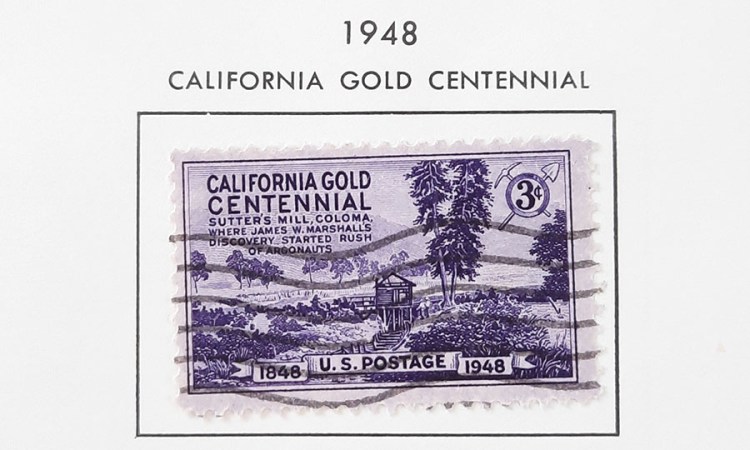
🇺🇸 United States, 3¢ | Issued January 24, 1948 | Scott 954
California Gold
What’s on the stamp?: This dark violet, horizontal stamp features an image of the famed Sutter’s Mill in Coloma, California, in front of a large tree with subtle mountains in the distance. Behind the 3¢ denomination inside a circle is a shovel and a two-sided pickaxe.
Why was this issued?: As it says on the stamp, this issue commemorates the 100th anniversary of the discovery of gold in California. The exact wording says “CALIFORNIA GOLD CENTENNIAL | SUTTER’S MILL, COLOMA, WHERE JAMES W. MARSHALL’S DISCOVERY STARTED RUSH OF ARGONAUTS”.
Fun Fact: As a school kid, you learn that the American gold rush started in 1848, attracting thousands of “Forty-Niners” to the West Coast the following year. But no one bothered to tell me it all started on my birthday! In fact, it all started on January 24, 1848 in the Sacramento Valley on land granted to pioneer-trader John A. Sutter. Sutter hired carpenter James W. Marshall to construct a sawmill, and it was Marshall who discovered the area’s first gold nuggets at the mill. By the end of 1849, the “rush” of gold miners to the area more than sextupled California’s population from about 15,000 to well over 100,000.

🇺🇸 United States, 6¢ | Issued January 24, 1968 | Scott 1338
Flag over White House
What’s on the stamp?: A red, white, and blue American flag flies in the foreground; the White House, surrounded by green trees, sits in the middle ground; and the Washington Monument can be discerned in the distance.
Were there other versions of this definitive?: The words “UNITED STATES” with the 6¢ denomination string across the middle of this stamp in dark blue. A later version of this stamp exists with an 8¢ denomination written in red.
Fun Fact: This stamp was printed with the Giori press. According to the Smithsonian National Postal Museum, the Giori press, named for inventor Gualtiero Giori, permitted two- or three-color engraving from a single plate, and in a single pass through the press. The press employed precisely cut rubber inking rollers that were able to each selectively ink parts of the same plate. The first U.S. stamp printed with this method was the 4¢ Project Mercury stamp issued in 1962 in honor of John Glenn’s orbit of Earth.
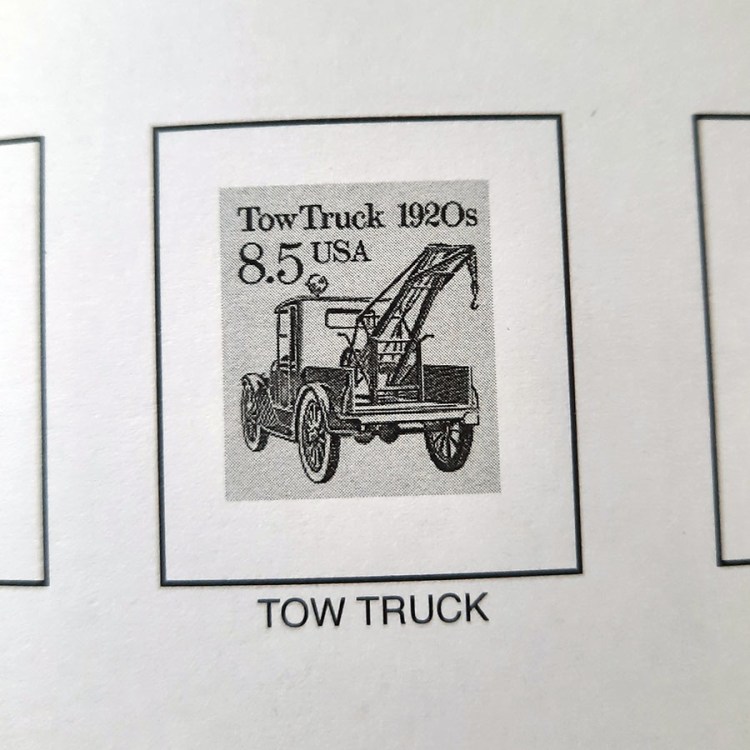
🇺🇸 United States, 8.5¢ | Issued January 24, 1987 | Scott 2129
1920s Tow Truck
What’s on the stamp?: Printed in dark Prussian green, this stamp features a 1920s-era tow truck, possibly a Chevrolet, pictured from behind with its boom and hook in view.
Why was this issued?: From 1981–1995, the U.S. issued a series of 50 coil stamps each “depicting a different conveyance of transportation.” Stamps in this “Transportation Series” range in denomination from 1¢ to 32¢, along with a $1 stamp. Many featured unusual decimal rates used by bulk mailers and other businesses who also used precancels.
Fun Fact: The first version of a tow truck was invented in 1916 by Ernest Holmes Sr. of Chattanooga, Tennessee. After Holmes needed blocks, ropes, and six men to pull a car out of a creek, this garage worker built a vehicle designed to do just that. Early tow trucks were often employed to pull automobiles out of mud, the number-one driving hazard of the 1920s.
Bonus fun fact: This tow truck was issued on the exact date of my birth, but surprisingly was the only stamp on this list not already in my collection. I guess my dad was a little too busy to stop by the post office that day….
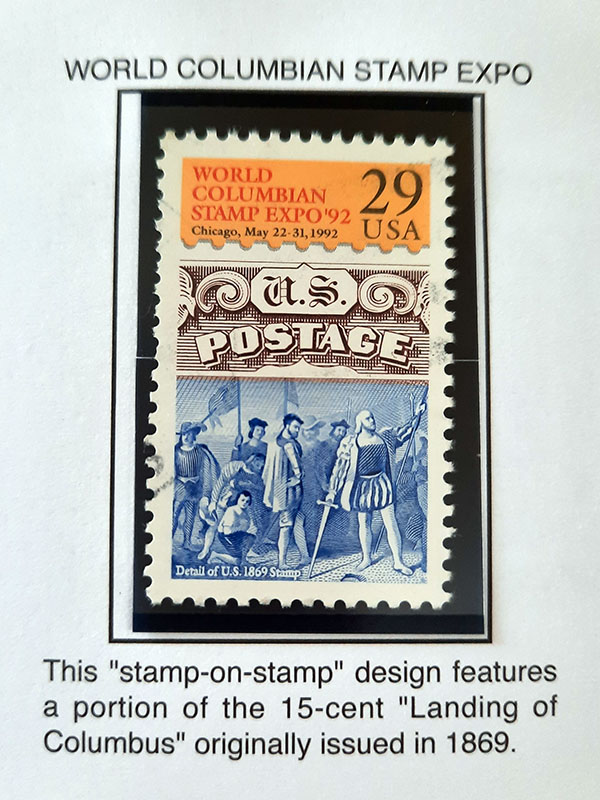
🇺🇸 United States, 29¢ | Issued January 24, 1992 | Scott 2616
World Columbian Stamp Expo
What’s on the stamp?: This vertical stamp features a stamp-on-stamp motif, with a description of the event it commemorates and the denomination at the top on yellow. The historical stamp featured is a portion of the 15¢ pictorial “Landing of Columbus” stamp design of 1869.
Why was this issued?: On May 1, 1893, the World’s Columbian Exposition opened in Chicago, Illinois. Just shy of a century later, the stamp event of the year, the 1992 World Columbian Stamp Expo, was held in Chicago from May 22–31, 1992. This stamp was issued in advance of that event.
Fun Fact: The 1869 “Landing of Columbus” stamp was based on American neoclassical artist John Vanderlyn’s painting of the same name. Vanderlyn (1775–1852) was commissioned by Congress in June 1836 to paint the “Landing of Columbus” for the Capitol Rotunda, where it hangs to this day. The 1869 stamp was the first bicolor stamp issued by the United States. The same image was featured on the 2¢ in the 1893 Columbian Exposition Issue.
What do you think? Do you know of other U.S. or international stamps issued on January 24? Did you enjoy this post format? Let me know your thoughts!
 Armchair Philately
Leave a comment