
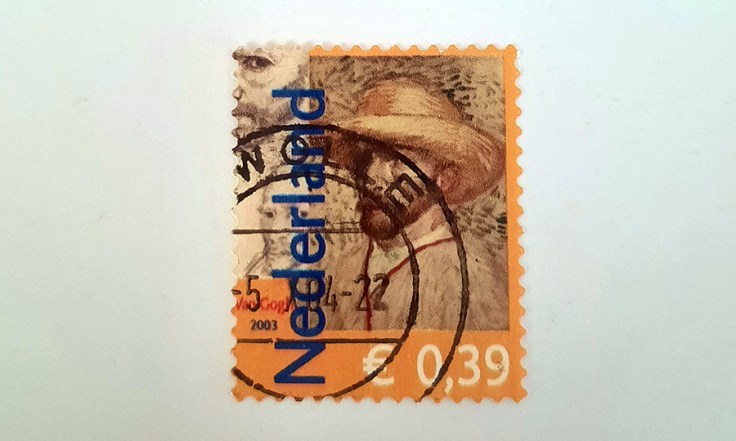
🇳🇱 Netherlands, €0.39 | Issued January 2, 2003 | Scott 1139, Michel NL 2083v
Behind every painting is a story. And the same can certainly be said of stamps. Postage stamps have long borrowed from fine art, from presidential portraits painted by American masters to great works of the world reproduced in miniature. Most recently, the USPS issued a commemorative stamp in honor of architectural painter and lithographer Emilio Sanchez.
But for more than a century, art novices and stamp aficionados alike have been captivated by the prolific output of one artist. A man who believed the future of art was color, and whose work brought that belief to fruition.
Today, let’s examine not one story, but three, behind a representative painting that illustrates much more than meets the eye. Here are three short tales about Vincent van Gogh’s “Self-Portrait with Straw Hat”.
The painter of the future will be a colorist in a way no one has been before.
—Vincent van Gogh
What’s the story behind the painting?
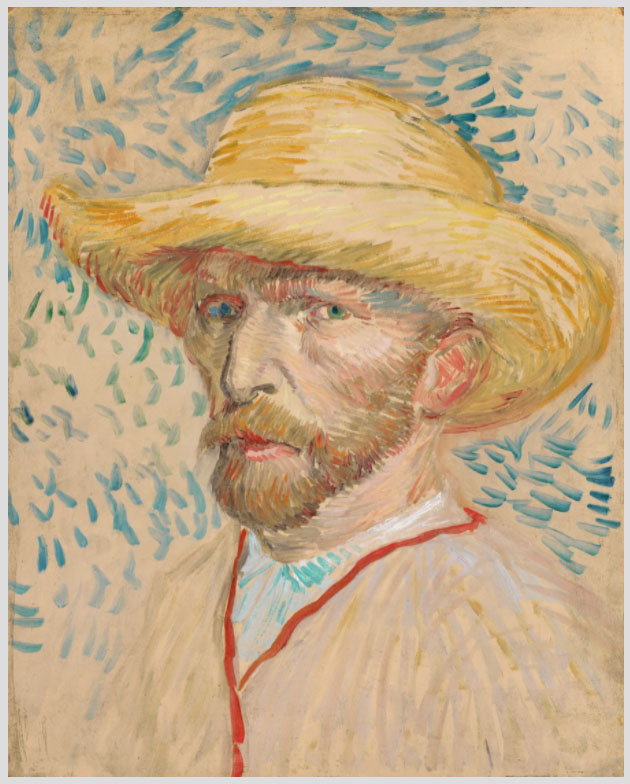
Vincent van Gogh believed that to paint something was to study it and understand it deeply. So it perhaps no surprise that one of his frequent subjects was himself. He painted many self portraits during his short and troubled life. In fact, he painted no less than five of himself in a straw hat.
The portrait shown above was painted in Paris between August and September 1887 and left at the apartment of Vincent’s brother, Theo. But the portrait Vincent painted is not the one we see today. According to the Van Gogh Museum,
Wearing light summer clothes, the artist examines us with one blue and one green eye.
For this self-portrait, Van Gogh used an inexpensive alternative to canvas: cardboard. He then applied a layer of priming with dashes of purple. But the pigment in that purple paint has largely faded over time. A few strokes of pink are still faintly visible in his shoulder. The original colours, carefully composed by Van Gogh, have therefore been lost. For instance, the purple background once contrasted with his yellow straw hat.
“Self-Portrait with Straw Hat” has been on permanent loan to the Van Gogh Museum in Amsterdam since July 1994. However, that hasn’t stopped the painting from traveling. Since that time, Vincent’s portrait has visited Hamburg, Tokyo, Atlanta, Seattle, Denver, Boston, Sapporo, Kōbe, Brescia, Seoul, and Vienna.
What’s the story behind the stamp?
Van Gogh’s original portrait may have toured several countries in recent years. But it’s possible its depiction on a stamp from the Netherlands in 2003 has reached every corner of the globe.
Vincent Willem van Gogh was the first of six children born to a Dutch Reformed Church minister and his wife in 1853. After a childhood he described as “austere and cold, and sterile”, Vincent tried his hand as an art dealer, supply teacher, and minister’s assistant. Finally in his late 20s, with the encouragement of his siblings and friend Paul Gauguin, Vincent took up art—first as a pastime, and then in earnest as a career. After years of mental illness, poverty, and conflict, Vincent died of infection from a gunshot wound at age 37.
Van Gogh famously only sold one of his more than 900 paintings during his lifetime. But had he lived, he would have quickly seen his star brighten among the sky of contemporary artists. Before his death, his reputation was already growing steadily among artists, art critics, dealers, and collectors. Over the next several decades before the outbreak of WWI, Van Gogh’s mythology would only add to his influence among Post-Impressionists and their followers.
On the anniversary of his 150th birthday, the nation of his birth released a series of stamps depicting his paintings, as well as the stamp pictured at the top of this post, his “Self-Portrait with Straw Hat”. The stamp itself was designed by Dutch artist and graphic designer Gracia Lebbink (born 1963). According to one site, Lebbink “designed for the Gemeentemuseum many publications and posters and build (sic) a prestigious agency on the way, ‘designing’ for many cultural institutions and museums. Always recognizable, simple, beautiful designs and with a typography that invites reading the texts.”
I agree with the author’s assessment, and I hope Lebbink was happy to see 45 million of these stamps in circulation.
What’s the story behind the exhibit?
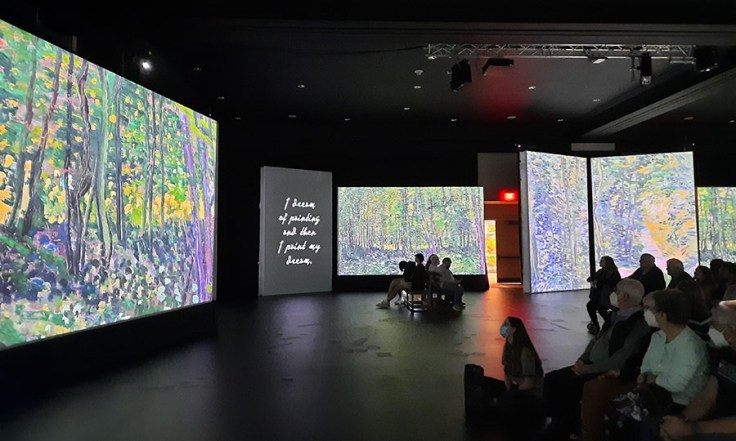
Though I have been privileged to see some of Van Gogh’s paintings in person, this particular self portrait was not one of them. So, I was eager to experience the Grande Experiences multi-sensory exhibit recently hosted by the Biltmore Estate, in Asheville, NC (November 5, 2021–March 5, 2022). So far, the “vibrant symphony of light, color, and sound” (and scent!) has reached more than 70 major cities, and I couldn’t pass up the opportunity to see it while it was in my own hometown.
Inside the exhibit was a traditional gallery space, outfitted with panels taking the viewer through Van Gogh’s life and each period of his work. There was also a full-scale recreation of his room in Arles. But it was the next room wherein the SENSORY4™ magic was made. Dozens of full-wall panels displayed a 45-minute loop of 3,000 images of Van Gogh’s art, set to a classical Modernist score. Elements of some paintings moved off the walls and into adjacent panels. Quotes from Van Gogh’s letters set the tone for each shift of imagery. And wafts of floral fragrance filled the room with his still life vases and apple blossoms. At the exit, viewers moved through a simulated field of sunflowers, created by a room of mirrors.
It was the whole-body experience of art and nature that Van Gogh lived during his life. And it proved that the artist of the future will paint with colors, sure, but with motion and sound, as well.
Find the Van Gogh Alive exhibit near you.
What do you think? Are you a fan of Van Gogh’s art or a collector of his stamps? Have you visited one of these multi-sensory art exhibits? Let me know your thoughts!
 Armchair Philately
Leave a comment