
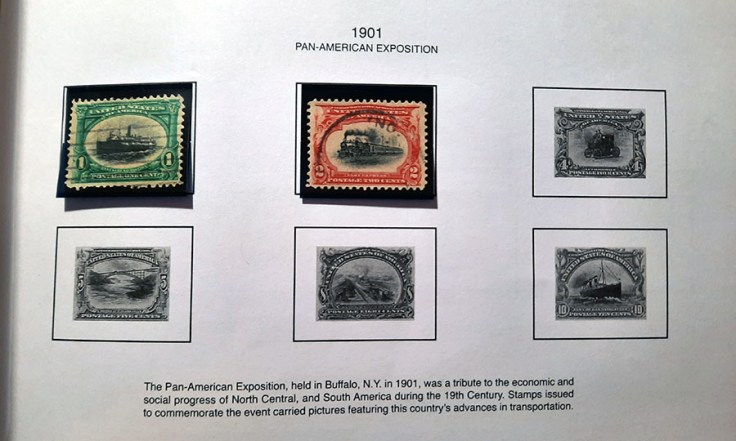
🇺🇸 United States, 1–10¢ | Issued May 1, 1901 | Scott 294–299
When you start to gain a grasp on early American commemorative stamps, you begin to pick up on certain series names: Columbian Exposition, “the Trans-Mississippis”, et cetera, et cetera. So, sure, I understand quality specimens can be very valuable. But what’s the story behind the stamps, themselves?
In my exploration, I want to start with a series that’s slightly smaller in physical scale, but no less intricate in design. Let’s scratch the surface of the Pan-American Exposition Issue and the occasion behind these stamps.
What was the Pan-American Exposition?
The Pan-American Exposition was the first World’s Fair of the 20th century, organized to celebrate the independence and progress of the nations of the Western Hemisphere. It was held from May 1–November 2, 1901. Buffalo, New York, was chosen for the 350-acre Expo because of its size (it was the 8th largest city in America at the time) and its established railroad connections. More than 40 million people in America and Canada were within a day’s rail journey to the city. Over the course of the Expo, eight million people would visit and pay the $0.50 entrance fee.
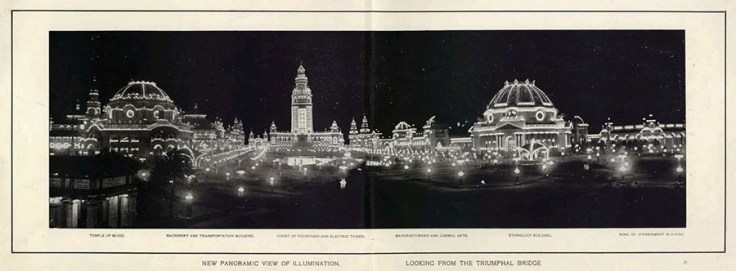
The Pan-American Expo was initially famous for its illumination after dark. The advent of AC electrical current in the U.S. meant that designers could light the event well into the evening. In fact, power for the Expo was generated 25 miles (40 km) away at Niagara Falls. Thomas Edison’s film company filmed the Expo during the day and took a famous pan of it at night.
The theme of the Expo was the economic and social progress of North, Central, and South America during the 19th century. Thirteen brightly colored buildings featuring a number of exhibits were constructed for the Expo, giving the grounds the nickname “Rainbow City.” Many featured Spanish-style architecture as an homage to the countries of Latin America. Among the buildings were an Electric Tower, Electricity Building, Temple of Music, and Woman’s Building. Of those, nearly all were actively demolished after the event to make way for residential housing. The only one still standing is the New York State Building built of Vermont marble, which now houses the Buffalo History Museum.
Other attractions at the Pan-American Expo included the Court of Fountains, the central court to the Expo; the Great Amphitheater; and the Triumphal Bridge, which was positioned over the “Mirror Lake”. Some of the new inventions on display included the electrograph, a mechanical mowing machine, mutoscopes, a typesetting machine, telautograph, voting machine, an x-ray machine, and—surely of note to local philatelists—an envelope-making machine.
Joshua Slocum had recently returned from setting a record as the first person to sail alone around the world. His sloop, the Spray, was also on display. A Trip to the Moon, the first electrically powered mechanical “dark ride”, was a hit at the Expo and was later moved to Coney Island. The vaudeville song, “Put Me off at Buffalo” was written to promote the event.
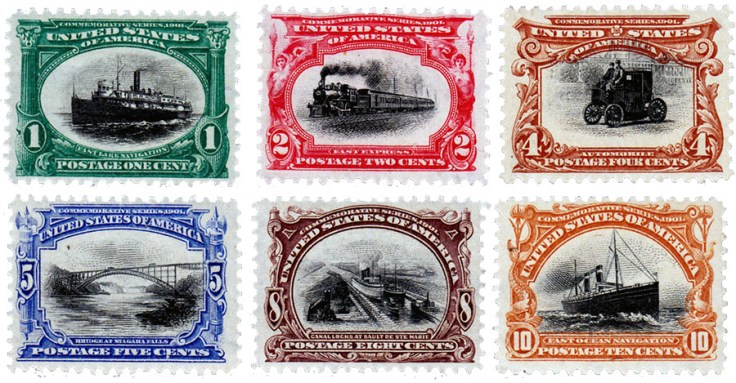
🇺🇸 United States, 1–10¢ | Issued May 1, 1901 | Scott 294–299
What stamps are featured in this issue?
On May 1, the first day of the Expo, a series of six stamps went on sale. In addition to being beautiful flat plate designs from the Bureau of Engraving and Printing, this series was also the company’s first example of bi-colored postage stamps and the first multicolored stamps in the U.S. since the 1869 Pictorial Issue. They were also noteworthy for not only having unique vignettes, but unique frames, as well.
There was a rule in place that the postal service could not issue stamps for advertising purposes. And stamps issued in conjunction with a World’s Fair came awfully close to breaking that rule. So, to tie the designs together and to get around rules, each bears the inscription “Commemorative Series 1901”, making no direct mention of the Expo.
The Expo was themed around social and economic progress in the Americas. So, the stamps depict recent advances in transportation in the United States. Those images include:
- 1c Steamship: Fast Lake Navigation – The one-cent stamp features the 917-ton City of Alpena steamer, which survived a collision with the Tecumseh on Lake Huron on May 2, 1887.
- 2c Train: Fast Express – The New York Empire Express inspired the engraving for the two-cent stamp. It was a natural choice to commemorate an event in Buffalo, New York.
- 4c Electric Car: Automobile – The electric car pictured on the four-cent was modeled after one owned and operated by the Baltimore & Ohio Railroad in Washington, D.C. In the background of the vignette, you can see D.C.’s Capitol building.
- 5c Bridge: Bridge at Niagara Falls – The Upper Steel Arch Bridge at Niagara Falls depicted here was completed in 1898. It was the largest single-span steel bridge in the world at the time, connecting the U.S. to Canada.
- 8c Canal Locks: Canal Locks at Sault de Ste Marie – Completed in 1895, the canal locks featured in the eight-cent were the largest and first electrically operated locks in the world. They were on the St. Marys River, north of Michigan’s upper peninsula.
- 10c Ocean Liner: East Ocean Navigation – The steamship St. Paul, completed in 1895, saw action with the U.S. Navy during the Spanish American War and heralded America’s technological advances in ocean navigation.
A popular set among collectors, all six denominations ranked in the top 50 in the book 100 Greatest American Stamps. They also produced several highly sought-after inverts in the one-, two-, and four-cent denominations. Sales of the stamps continued until the last day of the Expo, after which all remaining stamps were destroyed.

🇺🇸 United States, 25¢ | Issued December 2, 1938 | Scott 829
What else happened at the Pan-American Exposition?
Some presidential history buffs reading this may be ahead of me here. Embarrassingly, it was not until I had decided to write about this topic that I put two and two together.
Unfortunately, the wonders of the Pan-American Exposition have been overshadowed by one of the darker moments in American history. On September 5, President William McKinley announced at the Expo a change in his high-tariff isolationist trade policies, a topic relevant to the theme of political unity that ran through the event. The following day, on September 6, 1901, while shaking hands with people in a reception line at the Temple of Music, President McKinley was shot twice in the abdomen. Anarchist Leon Czolgosz had concealed a revolver under a rag or handkerchief. One shot grazed the president, but the other entered his abdomen and could not be recovered.
President McKinley spent two weeks in recovery from his wounds, and he even appeared to be getting better. But on September 13, his wounds turned gangrenous and he succumbed to his injuries the next day. He was the third U.S. president to be assassinated, after Abraham Lincoln in 1865 and James A. Garfield in 1881. Theodore Roosevelt was inaugurated as president of the United States in the Ansley Wilcox House’s library on September 14, 1901.
McKinley biographer Margaret Leech had this to say about the transition:
The new President was in office. The republic still lived. Yet, for a space, Americans turned from the challenge and the strangeness of the future. Entranced and regretful, they remembered McKinley’s firm, unquestioning faith, his kindly, frock-coated dignity; his accessibility and dedication to the people: the federal simplicity that would not be seen again in Washington … [After McKinley’s death,] old men came to the [White House] on errands of state and politics, but their primacy was disputed by the young men crowding forward. The nation felt another leadership, nervous, aggressive, and strong. Under command of a bold young captain, America set sail on the stormy voyage of the twentieth century.
No doubt, America’s advances in transportation would help them through those stormy seas.
What do you think? Do you have a full set of Pan-American stamps, new or used? Do you know additional stories about the Expo? Let me know your thoughts!
 Armchair Philately
Leave a comment