
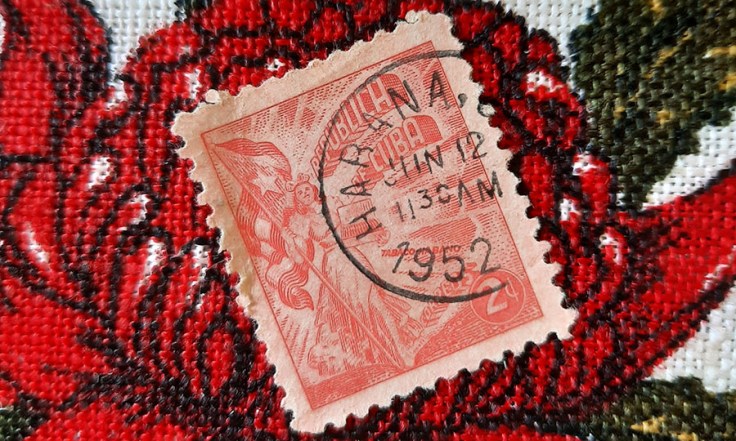
🇨🇺 Cuba, 2¢ | Issued December 6, 1948 | Scott CU 421
When I first saw this 2c stamp, I assumed it must have something to do with liberty, revolution, and national identity. Then I discovered it was just about cigars.
I say “just”, but after doing the research for this post, I think my first impressions were largely correct. The tobacco industry is at the very heart of Cuba’s international identity. Especially through the 1960s and ‘70s, tobacco production gave expatriated Cubans the freedom and opportunity to make a living throughout the Caribbean and Central America.
What follows is a brief snapshot of Cuban postal history, Cuban political history, and the Cuban cigar industry—and how they all come together on this one remarkable stamp.
What’s the history of Cuban postage?
Like all nations, Cuba’s postal history is rich and nuanced. So much so that there are stamp clubs devoted entirely to it. However, an overview of Cuba’s postal history shows that it can roughly be grouped into several eras:
- Pre-postal (before 1855)
- Colonial (1855–1898)
- Occupation (1898–1902)
- Republic (1902–1959)
- Socialist / Modern (1959– )
Cuba’s first separate stamps were issued in 1873, but “CUBA” did not appear on them until 1877. During the U.S. occupation of Cuba in 1899, America issued a series of six stamps known as the “Alegorías Cubana” or Cuban allegory stamps. These were the first Cuban stamps to depict distinctly Cuban themes. Few of these exist. Four of the five regular rate allegory stamps were reprinted in 1905 for the Cuban Republic, but with minor changes to make them distinguishable.
What’s the history of tobacco and cigars in Cuba?
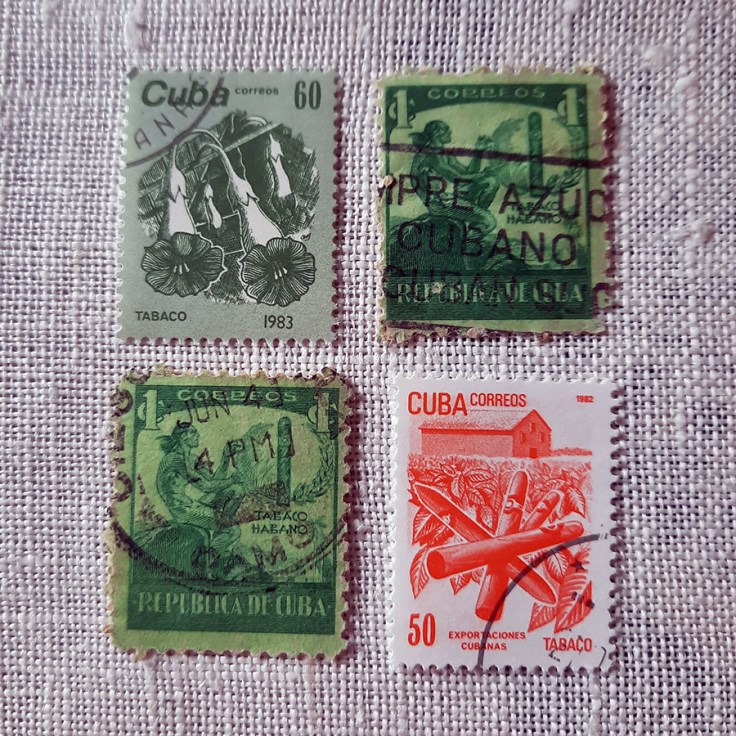
Tobacco smoking in Cuba long predates European colonization. (Some date tobacco’s arrival in Cuba to between 2000–3000 BC.) Indiginous Cubans called the tobacco plant “cohiba” and would roll its leaves in maize or palm leaves before smoking. Christopher Columbus would capitalize on these early forms of cigars by spearheading tobacco’s popularity in the Old World. By the late 18th century, Cuba would be acknowledged as the master of hand rolled cigars. Today, the country annually hand rolls around 100 million premium cigars.
However, the popularity of cigars dipped from the 1920s–1940s. Cigarettes became more popular in the 1920s; G.I.s had smoked them during WWI and extensive marketing further boosted their fashionable appeal. In addition, machine-made cigars utilized by producers outside of Cuba further hampered Cuba’s cigar industry. By 1948, when these stamps were issued, cigar sales in the U.S. were flat, and only 2% of cigars consumed were hand rolled.
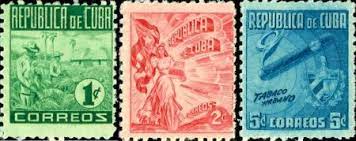
🇨🇺 Cuba, 1–5¢ | Issued December 6, 1948 | Scott CU 420–422
Photo via CubaCollectibles.com
What does this commemorative stamp represent?
Stamps of the Cuban Republic depict allegories, notable Cubans, maps, landscapes, history, and architecture. Agriculture is another common theme. In 1948, the country issued a set of three stamps commemorating the tobacco industry.
This series would generate national support and international attention for Cuba’s most iconic industry. The green 1c stamp depicts workers in hats picking tobacco in the fields with thatched huts and palm trees in the background. The 2c in carmine rose shows an allegory of “Freedom” holding the Cuban flag in one hand and a box of cigars in the other. It reads “TABACO-HABANO”. The bright blue 5c stamp with the same inscription depicts a lit cigar over a bulls eye motif with the Cuban coat of arms.
I love the design of the 2c stamp. The flag pole that seems to part the ground at Freedom’s feet. The 3D lettering backed by active diagonals that comes right off the paper toward the viewer. The jaunty little bow in the figure’s hair. It’s no wonder that this design would stick around for several years.
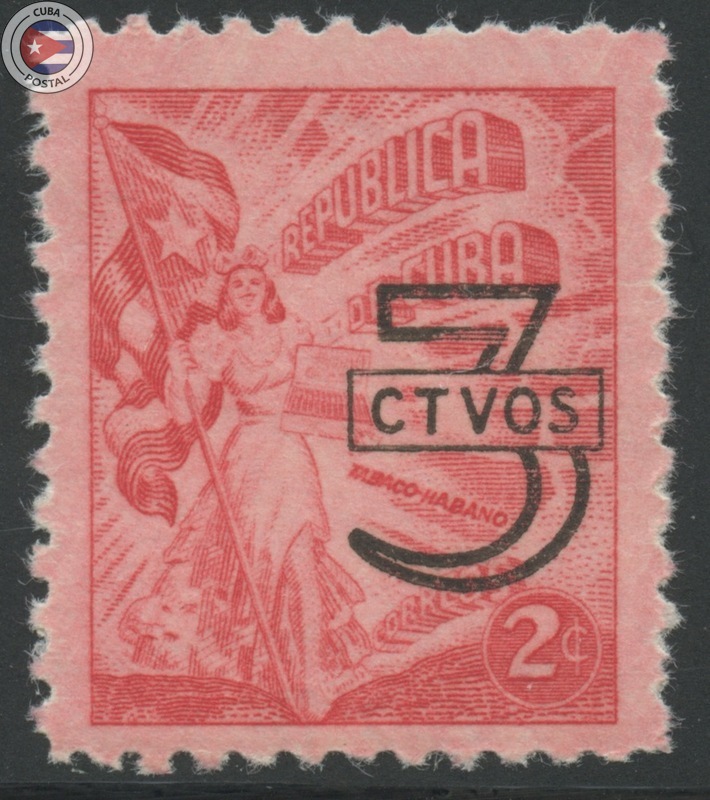
🇨🇺 Cuba, 3¢ | Issued June 16, 1953 | Scott CU 512
Photo via CubanPostal.com
What variations of this stamp exist?
Even though this stamp is initially listed as a commemorative, Cuba would issue several color variations and overprints over the next several years. For instance, the nation issued a bright red version in 1950 (Scott CU 446). Colnect also lists a 1950 overprint announcing the opening of the Cuba National Bank (Scott CU 448), as well as one for the 75th anniversary of the UPU (Scott CU 450). But the most interesting to me is the 1953 surcharge overprint.
By 1953, Colnect lists this stamp as a definitive (Scott CU 512). A final iteration was printed in scarlet and has a graphically interesting surcharge of a large three (3) with a box on top that reads “CTVOS” (centavos). Further research is needed to determine the reason for the surcharge.
A note about the postmark
While not exactly socked on the nose, the postmark on this stamp is clear and easy to discern. It was canceled in Habana (Havana) on June 12, 1952 at 11:30 AM. At first, I was concerned that I was missing an element of the cancellation mark (other than the country name, which we can infer follows “HABANA,”). That concern stemmed from the fact that the year looks off center to me—positioned too far to the left on the circle. But I found another contemporary example of a Havana postmark with the year also positioned off center, and that shows no other elements in the mark.
What was happening in Cuba on this date?
Since this stamp has long become detached from its cover, it’s impossible to say anything about the message it carried. However, Cuba was at an interesting moment in its history at this time, so we can speculate.
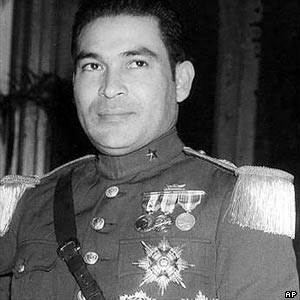
In mid 1952, it would still be nearly seven years until the climax of the Cuban Revolution led by Fidel Castro. However, the year would show that the nation’s political foundation was already on rocky ground. The country had experienced eight years under democratically elected presidencies and was due for another election cycle. Fulgencio Batista, leader of the Cuban Constitutional Army, was one of the candidates in the 1952 election, scheduled for June 1. But polling that spring showed him in a distant third place.
On March 10, 1952, Batista staged a coup d’état and overthrew President Carlos Prío Socarrás. Now in control of the government as “Provisional President,” Batista canceled the summer election and established a de facto military dictatorship in the country. His rule was formalized after the 1954 election, and he would remain in power until he was overthrown by revolutionaries on January 1, 1959, and forced into exile.
This stamp, mailed not two weeks after the elections were to take place, may have ferried a letter describing life under this new rule.
What do you think? Are you as captivated by this stamp design as I am? Do you know more about Cuban history (postal, political, or agricultural) that adds to the story of this stamp? Let me know your thoughts!
 Armchair Philately

Leave a comment