
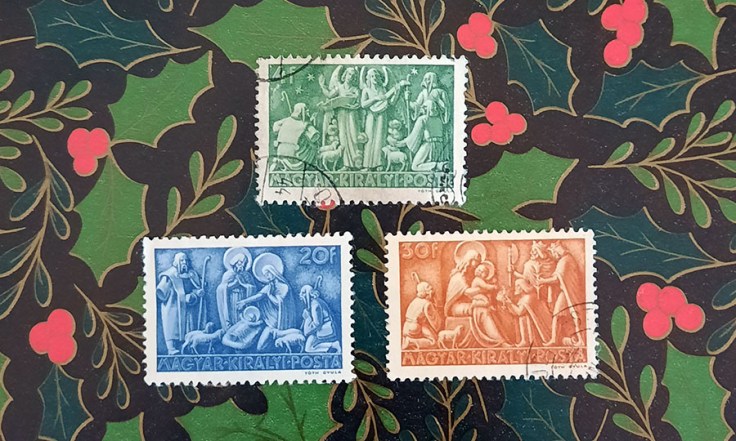
🇭🇺 Hungary, 4–30f | Issued December 1, 1943 | Scott 617–619
There are many ways to approach stamp collecting: by topic, by nation, by volume. But in any collection, primacy is a key component.
What came first?
The issue of what was the first Christmas stamp issue seems obvious at first. But with a little thoughtful inspection, what we initially see clearly becomes more opaque. First of all, it depends on what we mean by “Christmas stamp.” In my collection, I would consider it an official postage stamp (not a Christmas seal or other Cinderella) issued for the Christmas season and depicting Christmas-related imagery. So, using that criteria, what counts as “first”?
Let’s look through the options. Barring any holiday miracles, it’s unlikely that I’ll be the one to resolve any lingering philatelic controversies. But I’ve written this list, and I’ve checked it twice, and I think I make a good case.

🇺🇸 United States, 4¢ | Issued November 1, 1962 | Scott 1205
What was the first Christmas stamp issued by the U.S.?
When it comes to determining the first Christmas stamp in the U.S., the answer is pretty straightforward. And the date is pretty surprising, considering that Christmas cards were first popularized in the U.K. in 1843.
It wasn’t until 119 years later, in 1962.
Despite years of requests from the American public, the U.S. didn’t issue any stamps specific to Christmas until the Kennedy administration. But in anticipation of their interest that year, the U.S. Post Office Department printed 350 million of the red and green, 4-cent stamps featuring a wreath, two candles, and the words “Christmas 1962”. Even that wasn’t enough to satiate holiday card senders. By the end of the season, one billion of these little guys had been distributed to post offices around the nation.
One of the reasons it took so long for the Post Office Department to issue holiday stamps was because there was so much pushback from people who believed the stamps broke the separation of church and state. There were even legal actions seeking to bar the stamps. In order to reflect the diversity of American culture, today the U.S.P.S. issues a religious and a secular Christmas stamp each year. They also issue less frequent, but regular, new designs for Hanukkah, Kwanzaa, and Eid.
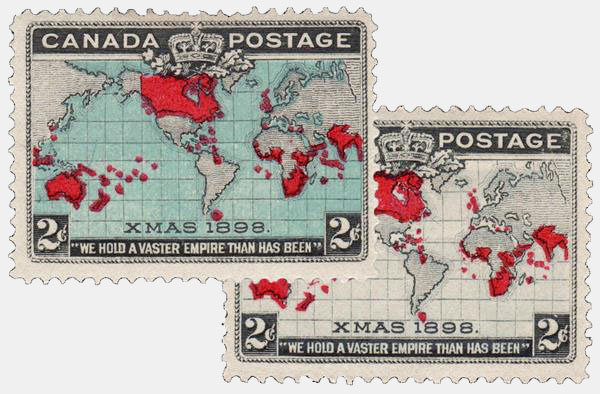
🇨🇦 Canada, 2¢ | Issued 1898 | Scott 85–86
What was the first Christmas stamp in the world?
Philatelists generally agree that the first Christmas stamp ever issued was an 1898 2-cent stamp from Canada. The horizontal stamp features a blue or lavender Mercator map of the world topped by Queen Victoria’s crown, with the nations and colonies of the British Empire highlighted in red.
Wait, you’re saying to yourself. That doesn’t sound very Christmassy.
Well, above the phrase “We hold a vaster empire than has been” it says “XMAS 1898.”
There you have it. “XMAS” front and center. Surely Canada was proud to use the issue to celebrate Christmas, right?
The APS says there’s “little doubt” that this is the first Christmas stamp. But then, in the same sentence, they say “the stamp was not intended to specifically celebrate the holiday.” That sounds like doubt, doesn’t it? (It sure does to me.) In fact, the stamp was actually issued to mark the inauguration of the Imperial Penny Postage rate, which just happened to go into effect on Christmas Day of that year. And the mention of “XMAS” was added at the last minute, anecdotally as the result of a quick save from a political blunder.
What are the other contenders for the first Christmas stamp in the world?
For the sake of argument, let’s say the Canadian Christmas stamp doesn’t count. You know, since its issuance had nothing to do with celebrating Christmas as a holiday and the image doesn’t reflect the season at all. What stamp would have been first, then?

In 1935, British Forces troops stationed in Egypt were issued stamps with an overprint that read “Xmas 1935”. However, it was nearly 30 years before Stanley Gibbons classified these as postage stamps in their catalogues, rather than “seals”. And in any case, the image overprinted was the Sphinx, hardly a holiday icon. Strike one.

Some claim that Austria’s 1937 two rose and zodiac stamps were issued for “Christmas greetings”. But a recently found first day cover from the issue states they were to be used on “birth-day (sic) congratulatory letters”—hence the zodiac signs. Another strike.
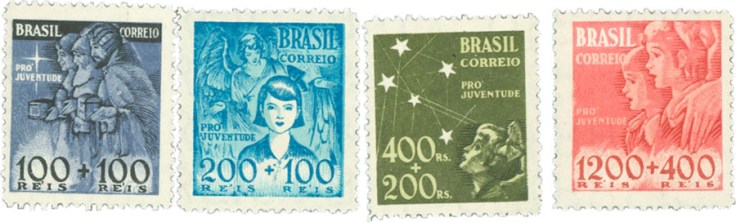
The next contender in line, and the best so far in my opinion, is the set of four semi-postal stamps issued by Brazil between December 20, 1939 and February 26, 1940 to raise money for charitable causes. The stamp designs feature the three Wise Men and a star, an angel and child, the Southern Cross and a child, and a mother and child. Each stamp reads “PRO JUVENTUDE” (“for youth”), and the series was called “For the children.” So, on the one hand, the Three Wise Men stamp—the first in the series—was issued around Christmas time and has obvious Christmas imagery. On the other hand, that only makes one of the four stamps with Christmas imagery, and the series as a whole has no specific tie to the holiday. According to the Christmas Philatelic Club, “the Brazilian Post Office did not begin ‘issuing commemorative Christmas stamps’ until Dec. 8, 1966.”
Strike three. All these stamps are out.
So far, we’ve seen stamps that commemorate a Christmas rate change, have overprints that connote holiday usage, and use Christmas imagery to pull at philanthropic heartstrings. But no official postage stamp issued for the Christmas season depicting Christmas-related imagery. Could it be that the first “true” Christmas stamp has yet to be found?
And have I had it in my collection this whole time?
Could Hungary have issued the first TRUE Christmas stamp?
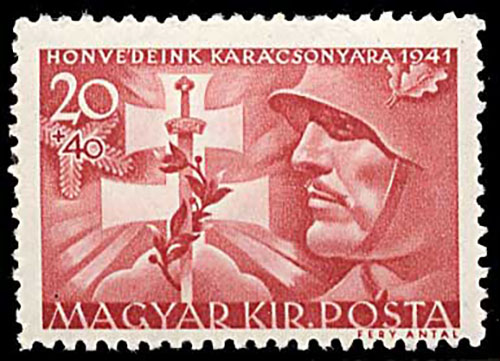
🇭🇺 Hungary, 20f+40f | Issued December 1, 1941 | Scott B139
In 1941, Hungary issued a semi-postal stamp (B139) in dark red depicting a soldier and the Hungarian double cross with a sword. The surtax was used for soldiers’ Christmases during the war. However, in keeping with the rules we’ve established above, the stamp didn’t specifically depict or commemorate Christmas as a holiday.
Those stamps came on December 1, 1943.
At the tightest knots of their entanglement in the war, Hungary’s postal service issued a set of three Nativity-themed stamps, just in time for use at Christmas. The single color stamps told the story of the birth of Jesus and featured the message to the shepherds (4f, dark green), the Nativity (20f, dull blue), and the adoration of the Magi (30f, brown orange).
Huzzah! Official postage stamps, issued in December, depicting Christmas imagery.
And to clinch their position on the list:
A letter from Philatelia Hungarica states “the first Christmas stamp in Hungary was issued in December 1943. The curiosity of this issue was that this was the first stamp in the world which depicted [an] expressly Christmas scene.”
So, Hungary—recently crushed by the Soviets at the Battle of Voronezh, preparing to be invaded by Germany the following spring—was the first nation whose postal service invoked the spirit of Christmas in a stamp design. And more than one stamp, it was a set of three telling the story of a young couple, confined to a manger, struggling against odds to create a better world for themselves and their child. What image could be more inspiring at the holidays during a time of war?
It’s possible that all the stamps I’ve mentioned here have primacy of some sort. First mention of “XMAS”, first holiday-related overprint, first depiction of Christmas figures, etc. But to my mind, Hungary’s holiday series of 1943 are the first true Christmas stamps.
What do you think? Do you topically collect Christmas stamps? Which one do you think was first? Let me know your thoughts!
 Armchair Philately