

If you wanted to, you could celebrate a new holiday every day.
In addition to regular government and church holidays, there are an assortment of lesser “holidays” throughout the year. There are industry holidays (e.g., Employee Appreciation Day, March 3). There are days celebrating causes (World Wetlands Day, February 2; Cancer Survivors Day, June 3). And of course, there are as many food-based holidays as items in a well-stocked pantry (National Pizza Day, February 9; National Burger Day, May 28; National Pumpkin Cheesecake Day, October 21; to name just a few).
Personally, I enjoy celebrating literary holidays. Dates like Dr. Suess Day (March 2), Talk Like Shakespeare Day (April 23), or National Frankenstein Day (last Friday of October) let me celebrate my bookish side in addition to the authors at hand.
One literary holiday that’s big in its country of origin is Burns Night. While not a staple (yet) in the U.S., Burns Night is nevertheless celebrated by millions around the globe. Here’s a quick introduction for those adventurous enough to give it a try this year.
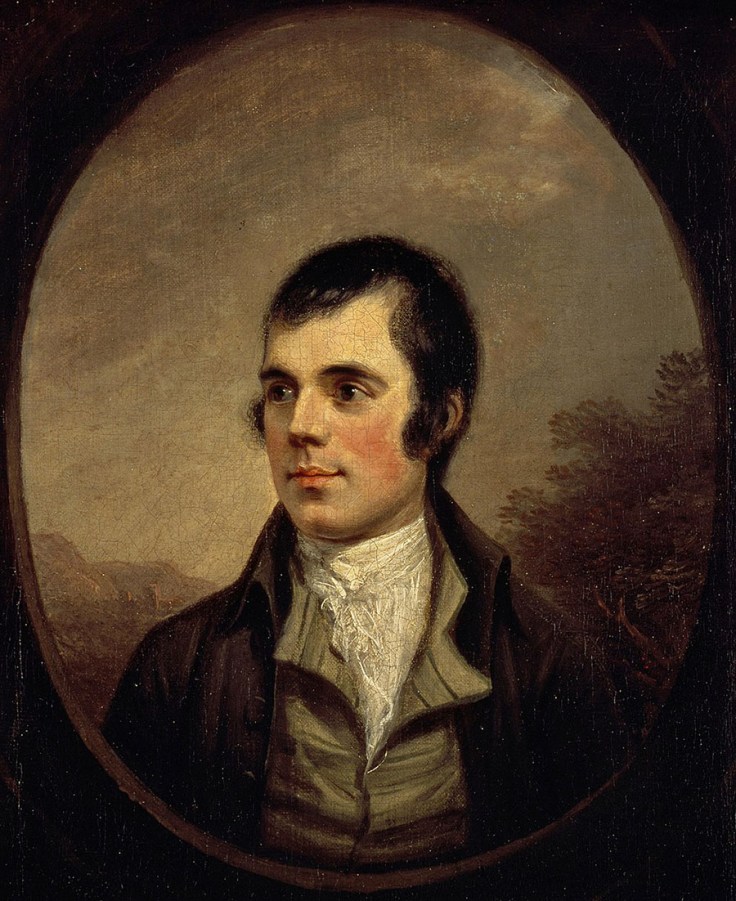
When and what is Burns Night?
Burns Night is celebrated on or around January 25 each year in honor of Scottish poet Robert Burns. Born on that day in 1759, Robert Burns is widely regarded as the national poet of Scotland. Scots affectionately call him “Rabbie Burns”.
Why do people celebrate Robert Burns?
In addition to serving as a pioneer of the Romantic movement, Burns is best known for writing in his native Scots dialect. He also collected and adapted folk songs from across Scotland. And popular topics among his poems included Scottish patriotism, class inequalities, gender roles, Scottish cultural identity, poverty, and socializing. For these reasons, he’s considered a “people’s poet”—and not only in Scotland.
Americans who have never heard of Rabbie Burns are still familiar with at least one of his famous poems (and songs): “Auld Lang Syne”, the New Year’s Eve song.
Burns may also be inadvertently responsible for giving European Americans one of our slang nicknames. One Burns scholar tells the story of soldiers in the Mexican-American War of the 1840s. American troops would march in time to Burns’s poem “Green Grow the Rashes” because the meter of the poem was so perfect. Mexican troops could hear the Americans coming from a mile away, and their chant of “green grow” was interpreted as “gringo”.
How do you celebrate Burns Night?
It’s said that close friends of the poet held the first Burns Night Supper in 1801, five years after his death, as a memorial. Today, an estimated 9.5 million Scots and other Burns fans celebrate the poet each year on his birthday.
There are many ways to celebrate Burns Night. But traditionally, one celebrates with Scottish food, Scotch whisky, and poetry. Burns Night Supper typically consists of haggis, what Burns called “great chieftain o’ the puddin’-race,” as well as neeps and tatties (mashed turnips and potatoes). It’s also common to enjoy leek soup as a starter and a Clootie Dumpling or something similar for dessert. But whatever you choose to eat, pair it with a dram of malt whisky. And don’t spill any on your tartan as you sing along to the bagpipes and toast the evening with a supper poem. At the end of the night, finish with a round of “Auld Lang Syne”.
How many Robert Burns stamps are there?
Now, on to the philatelic portion of today’s post! The ATA has a Robert Burns topical list with seven items on it. But a quick Google search will bring up at least three times that many designs. However, not all of them were ever postally valid.

🇷🇺 USSR, 40 kopek | Issued August 27, 1956 | Scott 1861
Perhaps surprisingly, Russia was the first nation to issue a commemorative stamp of Rabbie Burns, in 1956. Burns’ egalitarian poetry was a source of inspiration for the oppressed residents of Imperial Russia. During Soviet rule, when the stamp was issued, “he was elevated as the archetypal poet of the people.” He remains popular in Russia today.
As far as I can tell, the August 27 issue date is unimportant, but 1956 was the 160th anniversary of Burns’s death. According to Colnect, two other variants were later issued, both with a dark blue frame and Burns’s face in dark brown. The second variant, issued the 200th anniversary of the poet’s birth, also has a red overprint of the year of Burns’s birth (1759) and the year the variant was issued (1959).

🇬🇧 Great Britain, 4d | Issued January 25, 1966 | Scott 444
In the U.K., the Royal Mail has issued at least three sets of Burns stamps. Two stamps issued in 1966 marked the 170th anniversary of his death. According to the Dalry Burns Club, “The stamp designs are based on Skirving’s chalk drawing (4d value, pictured above) and the Nasmyth portrait (1/3).” The one priced at one shilling and threepence shows young Burns facing the opposite direction on an orange background with his name in a script font. There were, apparently, phosphor versions of both stamps.
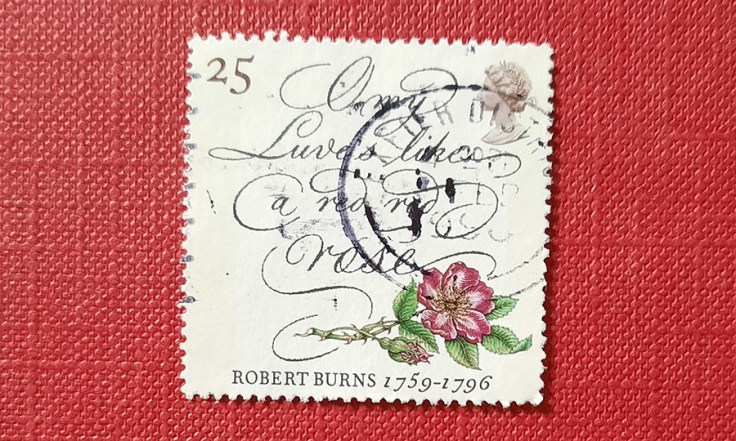
🇬🇧 Great Britain, 25p | Issued January 25, 1996 | Scott 1640
In 1996, a set of four square stamps was issued to commemorate the 200th anniversary of Burns’s death. (It should be noted that they were released on Burns Day, not his death day, July 21.) Each featured a quote from Burns’s most popular poems, in different fonts, with a small illustration. These stamps, including the one pictured above, were priced 19p, 25p, 41p, and 60p. The poems featured were “To a Mouse”, “O my Luve’s like a red, red rose”, “Scots, wha haw wi Wallace bled”, and of course “Auld Lang Syne”.
Other Burns stamps include one from Romania, issued in 1959. In 2009, the Royal Mail issued a souvenir sheet with two 1st class stamps to commemorate the 250th anniversary of Burns’s birth. And a number of “unissued” designs are floating around, as are some Cinderellas from Scotland. (If I ever find any of these Cinderellas, I suspect they’ll be worth a post of their own!)
So, I’m off to pull my copy of Burns’s poetry off the shelf and dust off my best bottle of Scotch. If you hear someone in the direction of the Blue Ridge Mountains this Burns Night wailing “Auld Lang Syne” off key, stop in to sing wi’ me.
What do you think? Are you a fan of Robert Burns? Would you enjoy celebrating a traditional Burns Night? Let me know your thoughts!
 Armchair Philately