
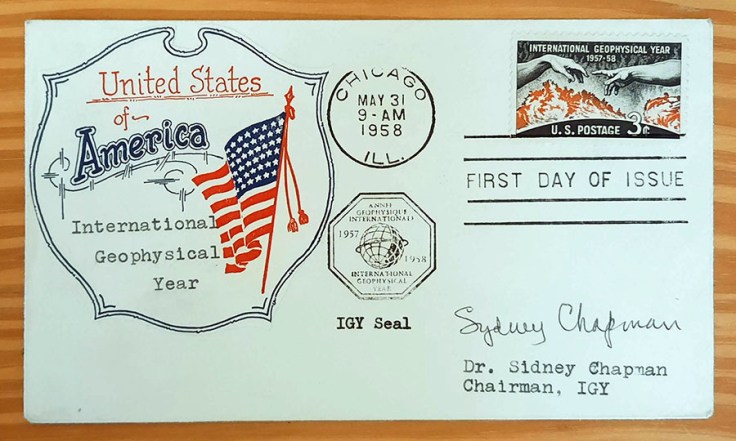
🇺🇸 United States, 3¢ | Issued May 31, 1958 | Scott 1107
One of my central topical philatelic interests is the International Geophysical Year. I’m fascinated by these nascent days of space science and global cooperation. The IGY also marks a period when the last few empty spots on our map of Earth were filled in. So, to me, it signifies the point at which the European Age of Exploration crossed into the global Space Age.
I’ve written a primer to the IGY here. This 18-month year of scientific study was hugely consequential to the world as we know it today. Yet even those who lived through it remember little about it.
My IGY collection already includes a variety of stamps, souvenir sheets, rocket mail covers, books, and memorabilia. But one of my most recent finds—a birthday gift I bought for myself this year—is something truly special. I present to you an IGY first day cover signed by the president of the special committee for the program, himself.
What’s on the cover?
Many different first day cachet designs were issued for the U.S. IGY stamp. This one features a circular date stamp (CDS), first day of issue cancellation, and IGY seal—all common for this stamp’s FDCs. The CDS reads “Chicago, Ill. 9 – AM May 31 1958”, denoting the date of the stamp’s issue and the city where the first-day ceremony took place. The first day of issue cancellation has two bars above and two below the text; the topmost bar ties the stamp to the cover. And the official IGY seal, positioned below the CDS and in the center of the cover, is a double-lined octagon enclosing a lined globe ringed by a satellite and the words “Annee Geophysique Internationale / International Geophysical Year 1957–1958”. Someone has typed the words “IGY Seal” under the seal.
The cachet for this cover was printed separately, trimmed carefully, and pasted on. It is a double-lined blue shield that reads “United States of America” in red and blue with many flourishes. “International Geophysical Year” is typed below that, still within the shield. And an American flag, printed in red and blue, hangs on a pole with tassels and flows to the left.
Most significantly, the name in the address corner of the cover reads:
Dr. Sidney (sic) Chapman
Chairman, IGY
And Dr. Chapman’s signature appears just above the typed name.

Who was Sydney Chapman?
Born in 1888 in Eccles, Greater Manchester, Sydney Chapman was a British mathematician, accomplished geophysicist, and Sedleian Professor of Natural Philosophy at Queens College, Oxford. In fact, in 1950 when James A. Van Allen invited him to speak to a small group of American scientists, he was regarded by some to be “the greatest living geophysicist”1. In his book covering the development, activities, and results of the IGY, Walter Sullivan posits that the IGY developed from conversations that occurred that evening. In talks to develop a Third Polar Year, Chapman suggested that studies move beyond the poles to additional geophysical experiments. Thus, the concept of an International Geophysical Year was born.
The Special Committee for the IGY (Comité Spécial de l’Année Géophysique Internationale, or CSAGI) met initially in Amsterdam in October 1952, then again from June 30–July 2, 1953. At the latter meeting, Chapman was elected president of the special committee, which would come to comprise five members from the world’s four greatest powers: France, the Soviet Union, the United Kingdom, and the United States.
The CSAGI, led by Chapman, along with a separate Advisory Council, would set the 18-month window for the IGY (July 1, 1957–December 31, 1958), coordinate scientific efforts by the 67 participating nations, and arrange for “the free exchange of data” captured during this period.
Is this Chapman’s signature?
So, indeed, Dr. Sydney Chapman was a pivotal figure in the development and success of this massive international scientific endeavor. But was this cover actually signed by him? Or was I duped?
The Antarctican Society was founded in 1960 by scientists who had been in Antarctica during the IGY. Today, the nonprofit organization is dedicated to furthering interest in the continent. Members include veterans of the IGY, Operation Deep Freeze, Antarctic stations (e.g. Amundsen-Scott South Pole, Byrd, Little America, McMurdo, etc.), and a number of international science bases—including those currently living in Antarctica.
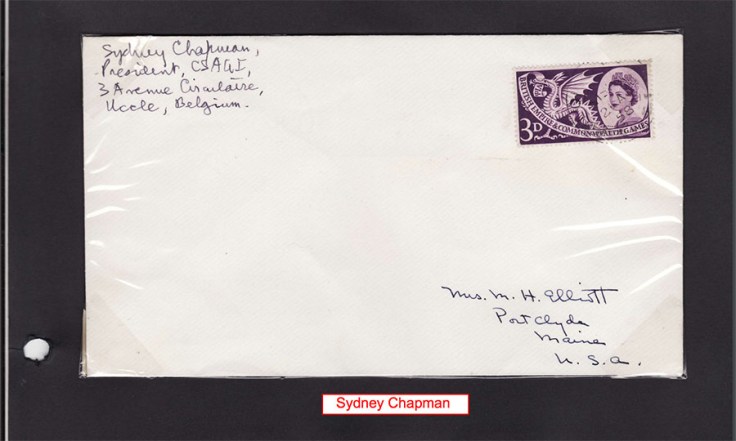
According to the Antarctican Society’s Philatelic Corner, the organization’s collection of covers and cachets was originally collected by IGY participant Paul Dalrymple as a deliberate attempt to “collect cachets from all of the stations in Antarctica during the IGY”. Among the items digitized on the site are covers signed by the executives responsible for the IGY, including Sydney Chapman, James Van Allen, Lloyd Berkner Laurence Gould, and Harry Wexler.
Based on the cover for which Chapman filled out the return address, my signature is a match!
What do you think? Do you collect famous signatures on covers? How do you confirm that signatures are authentic enough for your collection? Let me know your thoughts!
- Sullivan, Walter. Assault on the Unknown (New York: McGraw-Hill, 1961), p. 20.
 Armchair Philately