
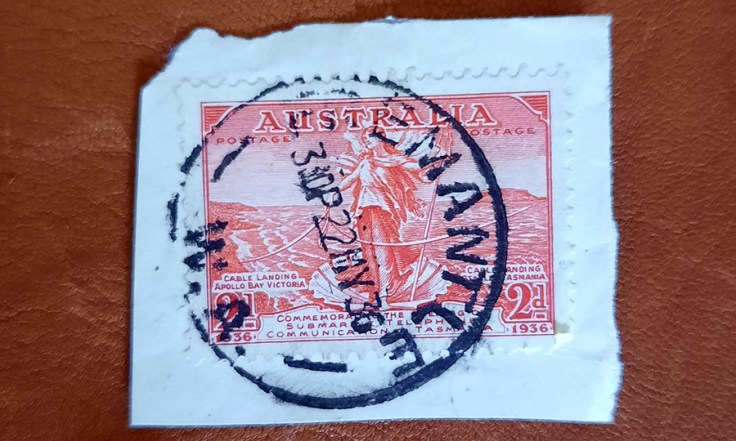
🇦🇺 Australia, 2d | Issued April 1, 1936 | Brusden-White AU 169A
1936 was an astoundingly eventful year around the globe, just as nearly every year was in the first half of the 20th century.
The UK’s George V died in January after years of declining health. The nation and its dominions would see not one, but two new kings by the year’s end, thanks to Edward VIII’s abdication. In America, the Hoover Dam was completed, and the San Francisco–Oakland Bay Bridge opened to traffic, while the Sydney Harbour Bridge opened in Australia. And the RMS Queen Mary took her maiden voyage across the Atlantic.
That summer, the 1936 Summer Olympics opened in Berlin, Germany. Famously, this was the first live television coverage of an international sports event in world history. America’s Jesse Owens was the most successful athlete at the event, winning four gold medals in the sprint and long jump events.
It was also a year of deep political unrest. Italy annexed Ethiopia. The Spanish Civil War began after a coup d’état in Africa. And Germany violated the Treaty of Versailles and Locarno Treaties by reoccupying the Rhineland. Thousands around the world would die from war, disease outbreaks, and Stalin’s Great Purge.
Meanwhile, on an island in the southernmost corner of the Pacific—no larger than Ireland or West Virginia—two important events would change local life for years to come.
Where is Tasmania?
Tasmania is a heart-shaped island located 240 kilometers south of the Australian mainland. It’s the 26th-largest island in the world, larger than Sicily and Taiwan, but smaller than Sri Lanka and Hispaniola.
Tasmania is also the smallest of Australia’s six states. The state of Tasmania includes its namesake island, as well as 1,000 much smaller islands surrounding it across the Bass Strait. The largest of these include King Island, Flinders Island, Cape Barren Island, and Bruny Island. Forty percent of the state’s half-million residents live in the metro area of its capital city, Hobart.
Aboriginal Tasmanians have occupied the region for as many as 40,000 years. It wasn’t until 1642 when Dutch explorer Abel Tasman made the first reported European sighting of the island, and 1803 when it was permanently settled by Europeans.
Tasmania has had its share of hardships and conflicts. The devastation and aftereffects of the 19th century’s Black War between Tasmania’s Aboriginal and white inhabitants should not be glossed over, though this writer is not prepared to take it on. However, I would note that the island also has a more recent history of progressive development and technological innovation. Tasmania was the first place in the southern hemisphere to install electric lights. And the world’s first green party, the United Tasmania Group, was established there in 1972.
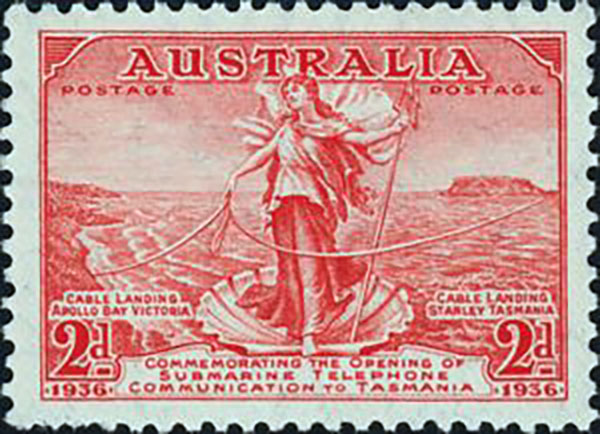
🇦🇺 Australia, 2d | Issued April 1, 1936 | Brusden-White AU 169A
What’s on the stamp?
On April 1, 1936, the Australian Post Office released identical 2d scarlet and 3d blue commemorative stamps.
These watermarked stamps depict a classical, Venus-like character standing on a scallop half shell and holding a trident in her left hand. In her right hand, she clasps a loop of cable that stretches from the landmass at the left (labeled “Cable Landing Apollo Bay Victoria”) to a tall island on the right (labeled “Cable Landing Stanley Tasmania”). Between the duplicate denominations, it reads “Commemorating the Opening of Submarine Telephone Communication to Tasmania”.
89 million of the 2d were printed, making it much more common than 3.9 million of the 3d. The 2d stamp featured a minor variation, of which the stamp above is Type A.
My stamp is on piece with a CDS (circular date stamp) from Fremantle, Western Australia. Fremantle is a suburb of Perth, located on the nation’s west coast where the Swan River meets the Indian Ocean. The CDS is dated 3:30 PM, May 22, 1936. This means that whatever correspondence this stamp carried was sent approximately seven weeks after its date of issue.

What 1936 event does the stamp depict?
Amid all the global events listed at the top of the post, in March 1936, all eyes in the engineering world were on Tasmania. This remote island (in Western minds) was set to make history for the British Empire.
Tasmania was linked to mainland Australia by telegraphy cables as early as 1859. After the Commonwealth of Australia created its own constitution in 1901, the first Postmaster-General (PMG) was placed in charge of all postal, telegraphic, telephonic, and “all other” communications services. At the start of the century, there were already 33,000 telephones across Australia which would fall under the PMG’s purview.
Within a few decades, telephone service would be further popularized, and it became time to link Tasmania to mainland Australia. In November 1935, Messrs. Siemens Bros. and Co., of London employed their 5,000-ton cable steamer Faraday to lay out more than 160 nautical miles of cable. According to a report published in Nature in March 1936:
Its length of 161 nautical miles is divided into two sections. The northern section, 79 miles in length, joins King Island to Apollo Bay, Victoria, and then by overhead lines and underground cables joins the trunk exchange at Melbourne. The southern section from [Naracoopa,] King Island goes to the northern coast of Tasmania and then by land line to the Launceston exchange. Inter-connexion [sic] is thus effected with the existing network of communications in Australia and Tasmania.
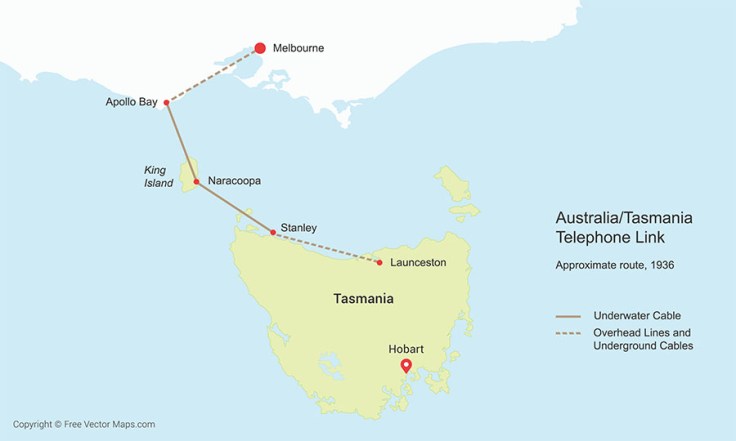
This was not the first undersea communication cable in the world; a 108-nautical-mile cable connected Key West, Florida with Cuba in 1930. However, it was the first of its kind for a British company. And it was both the longest in the world and the most robust to date:
This cable, although it has only one insulated conductor, allows no less than five telephone and seven high-speed telegraph channels to be operated simultaneously. In addition, it provides for the transmission of a broadcast programme.
The cable finally began operation after four months of backbreaking work, on March 25, 1936. As a result, telephone subscribers in Tasmania could now communicate directly with mainland Australia—and even Great Britain—by telephone. Tasmania was no longer a remote location, but simply a phone call away.
What else happened in Tasmania in 1936?
The undersea telephone cable was not Tasmania’s only significant moment of that year. Though, the other event is admittedly less upbeat and went largely unreported at the time.
On September 7, 1936, the last known thylacine died in the Hobart Zoo.
Tasmanian tigers were carnivorous marsupials originally native to the Australian mainland and the islands of Tasmania and New Guinea. By the time of European settlement in the region, thylacines were only found on the island of Tasmania, and they were already a rare species (5,000 estimated). Over the course of the 19th century, a number of factors led to the species’ demise, “including competition with wild dogs introduced by European settlers, erosion of its habitat, the concurrent extinction of prey species, and a distemper-like disease that affected many captive specimens at the time.” Not to mention, there was a period where local bounties were paid out for thylacines who attacked local livestock and poultry.
By the 1930s, public opinion about thylacines began to shift. However, even Tasmania’s new undersea telephone cable could not speed up conservation action quickly enough. “The species was granted protected status just 59 days before the death of the last known thylacine”.
The last captive thylacine was sold illegally to the Hobart Zoo in May 1936 and lived until her death that fateful September night. Her remains were transferred to the Tasmanian Museum and Art Gallery, where they were improperly recorded and not rediscovered until late 2022.
Today, on September 7, Australia commemorates the Tasmanian tiger by celebrating National Threatened Species Day. The animal has become a cultural icon in Australia, and the Australian Post has issued a number of thylacine stamps to date, including in 1959, 1981 (pictured), and 2008.

🇦🇺 Australia, 24c | Issued July 1, 1981 | Brusden-White AU 902
What do you think? Have you ever called someone in Tasmania by telephone? Did you know the Australian Post Office was also in charge of the nation’s telephone service for a time? Let me know your thoughts!
 Armchair Philately
Leave a comment