
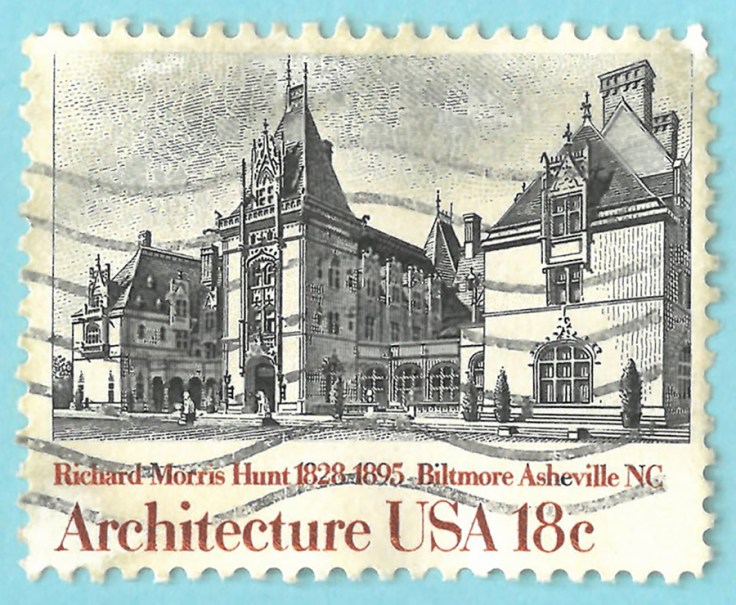
🇺🇸 United States, 18¢ | Issued August 28, 1981 | Scott 1929
We all know that postage stamps were invented as proof of postage paid. But philatelists understand that stamps have a greater value: They are an incredible conduit for travel across space and time! Long before the wonders of Google Earth, stamps gave people a tangible way of connecting with far off locales and exotic destinations. Today, let’s use stamps to explore one such spot that’s close to home for me: the Biltmore Estate in Asheville, NC.

The origins of “Biltmore”
Known as “the Commodore”, Cornelius Vanderbilt (1794–1877) spent much of the nineteenth century becoming one of the largest transportation magnates on the globe. From minor-league Staten Island ferry services to ocean-going steamships to a railroad empire, The Commodore amassed an estate of $105 million by his death at age 83—equivalent to $2.89 billion today!
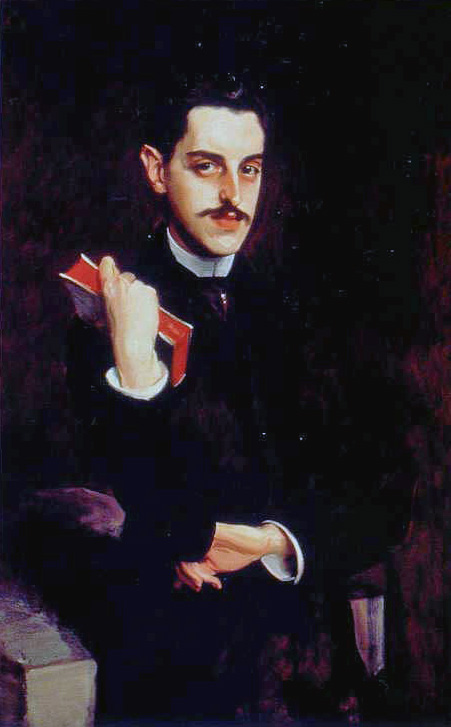
His grandson, George Washington Vanderbilt (1862–1914) reportedly received $2 million upon The Commodore’s death. He would go on to receive $1 million for his 21st birthday, and another $5 million (plus a $5 million trust fund) when his father passed away in 1885. What he didn’t receive was any limitations on how to spend it.
Bookish and introverted, George wasn’t interested in the cosmopolitan, high-society shenanigans of his Manhattan relatives. Instead, he was more inclined to travel abroad, collecting art and rare books and engaging in other intellectual pursuits. In the 1880s, Vanderbilt began traveling to the mountains of Western North Carolina (by train, of course), and he began acquiring as much of the surrounding woodlands as possible. By 1888, he had 125,000 acres of rolling Carolina hills to his name, and he decided to build a home.

🇫🇷 France, Lettre Verte 20 – No Face Value | Issued March 30, 2015 | Yvert et Tellier FR A1119
Building America’s largest private house
Like the typical mountain folk of Southern Appalachia, Vanderbilt decided to build within his means. However, unlike them, Vanderbilt had a fortune at his disposal. For his home, he chose for his model the Château de Blois in France’s Loire Valley, a 564-room palace that took four centuries to build and displays at least as many architectural styles.
In Vanderbilt’s mind, only one man was up for the task of building his limestone legacy. Architect Richard Morris Hunt helped build some of the most iconic structures in New York City, including the Great Hall of the Metropolitan Museum of Art and the pedestal of the Statue of Liberty. For Vanderbilt’s estate, he would design a building with four acres of floor space, possibly the largest private home ever constructed in the U.S.
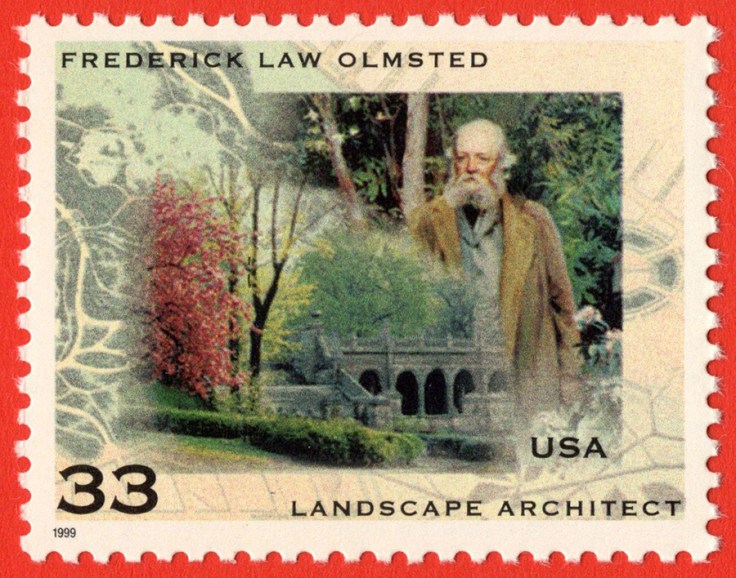
🇺🇸 United States, 33¢ | Issued September 12, 1999 | Scott 3338
To sculpt the rest of his acreage, Vanderbilt brought in Frederick Law Olmsted. The father of landscape architecture (he’s known for designing New York’s Central Park and the master plans for UC Berkeley and Stanford University, among others), Olmsted would travel back and forth between Asheville and Chicago during the construction of the estate. At the time, he was also overseeing the site design for the 1893 World’s Columbian Exposition—an event well known to philatelists.
During construction, Vanderbilt christened his estate “Biltmore”, a portmanteau of his family name and “more”, an Old English word for “rolling upland country”. The French Renaissance mansion took five years and $5 million to complete ($180 million today). The home contained a modest 250 rooms compared to its model, including 35 bedrooms, 43 bathrooms, and 65 fireplaces. The home opened to Vanderbilt’s friends and family on Christmas Eve 1895.
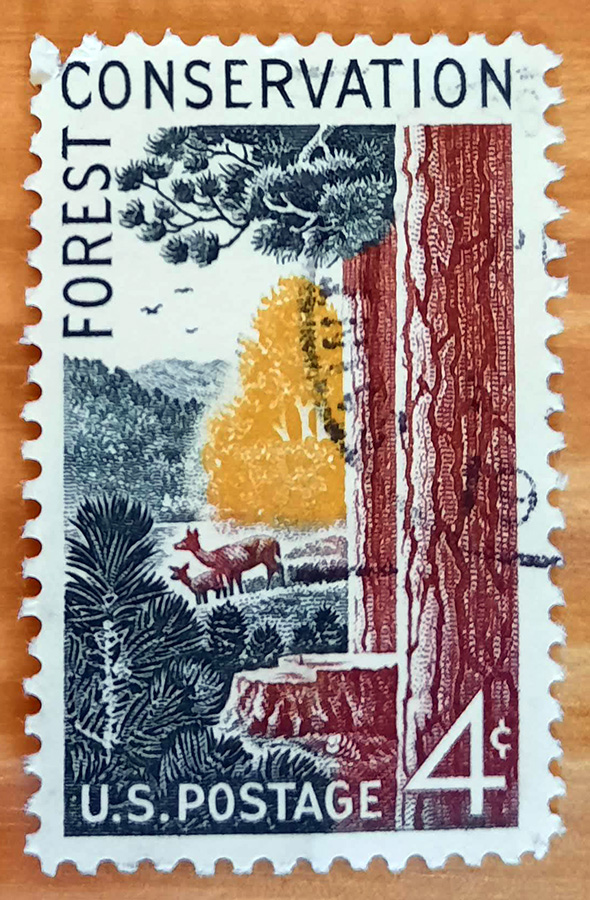
🇺🇸 United States, 4¢ | Issued October 27, 1958 | Scott 1122
A working estate becomes a family home
Vanderbilt’s dream was for his home to run as a self-sustaining estate. Adjacent to the home are 75 acres of formal and informal gardens designed by Olmsted. But Vanderbilt’s plans grew beyond ornamental plants. Vanderbilt had a deep interest in forestry and horticulture, which he parlayed into pioneering sustainable land use practices thanks to the help of Dr. Carl Schenck, the German forester he hired. For that reason, Biltmore is credited as the birthplace of American forestry.
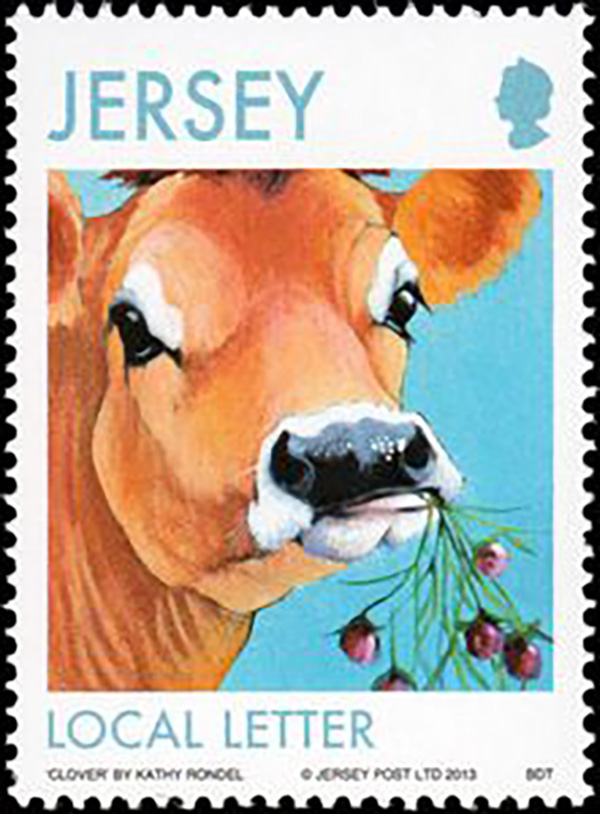
🇯🇪 Jersey, Local Letter – No Face Value | Issued September 20, 2013 | Stanley Gibbons JE 1783
Vanderbilt also began dairy operations on the estate. Biltmore Dairy would be one of the most financially advantageous endeavors in the estate’s history. Vanderbilt believed much of the appeal of his product was thanks to the prized herd of Jersey cows he imported. According to Biltmore’s website, “Of all major dairy breeds, Jerseys produce the richest milk—high in butterfat, protein, and calcium. They also produce a higher volume of milk per each pound of body weight than other types of cattle.” The dairy would run on the estate for nearly a century, until 1985.
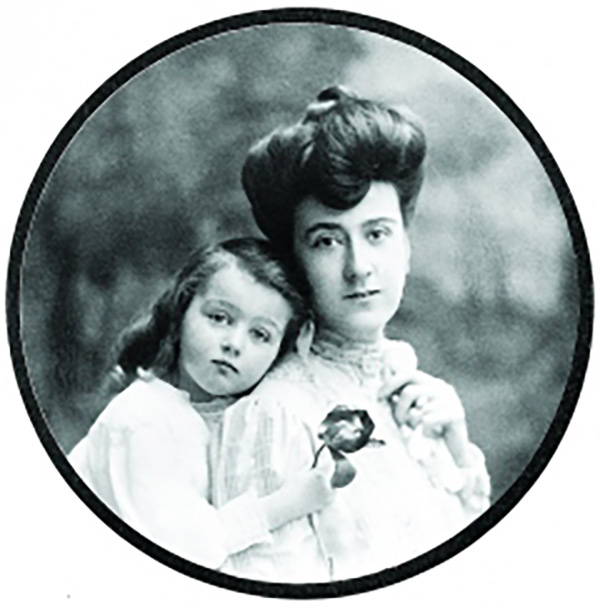
It wasn’t long before Vanderbilt turned his bachelor pad into a family home. In 1898 in Paris, he married the 25-year-old Edith Stuyvesant Dresser. Edith was a compassionate woman who quickly took to looking after both the estate and the people of the surrounding community. Their only child, Cornelia, was born in 1900.
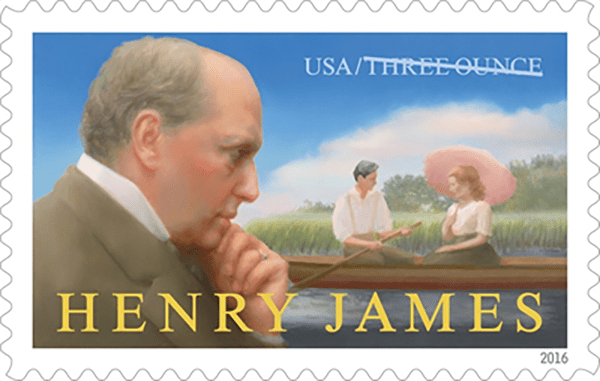
🇺🇸 United States, 89¢ | Issued July 31, 2016 | Scott 5105

🇺🇸 United States, 15¢ | Issued September 5, 1980 | Scott 1832
Over his 20 years in the home (he would die at 51 due to complications following surgery), George and Edith would host a number of famous guests. Among them were authors Henry James and Edith Wharton.

🇺🇸 United States, 7¢ | Issued March 24, 1927 | Scott 639
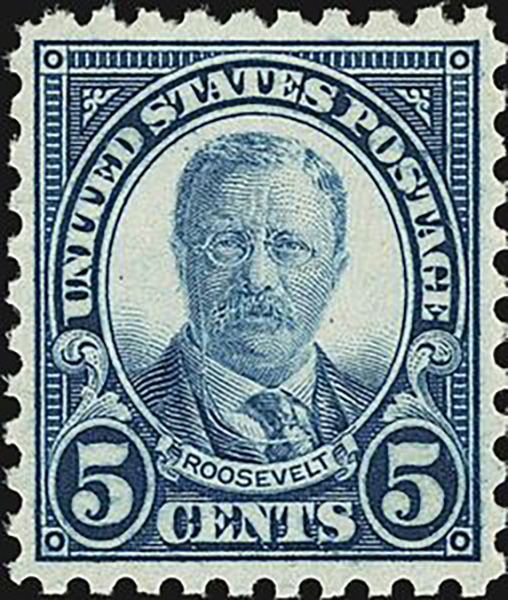
🇺🇸 United States, 5¢ | Issued April 4, 1925 | Scott 586
Presidents William McKinley and Theodore Roosevelt also visited during the home’s early years.
Vanderbilt’s legacy
Following George’s death, Edith sold much of the estate’s vast acreage (87,000 acres) to the federal government. The land would become Pisgah National Forest, one of the first national forests east of the Mississippi and where the Cradle of Forestry Historic Site now resides.
In 1930, George and Edith’s daughter, Cornelia Vanderbilt Cecil, and her husband, John A.V. Cecil, began opening the estate to the public. The move was designed in part to raise funds for the upkeep of the estate, and in part to drive much-needed tourism dollars into the economy during the Depression. This was a huge shift for a home that was previously only open to private guests. The estate was declared a National Historic Landmark in 1963.
Keep Reading: Biltmore gossip from the 1960s
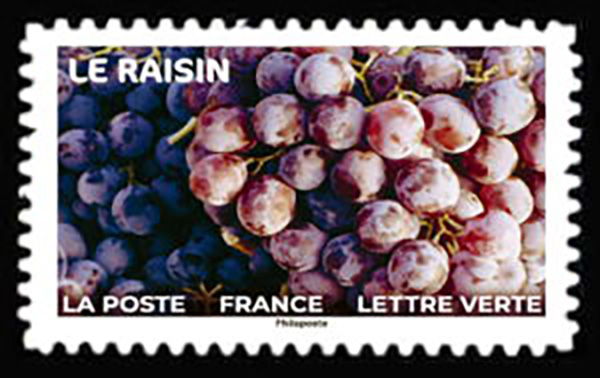
🇫🇷 France, Lettre Verte 20 – No Face Value | Issued June 5, 2023
It may surprise now, but it would be years before Biltmore ever profited from tourism, and that was thanks to Vanderbilt’s grandsons, George and William Cecil. In 1976, George chose to inherit Biltmore’s land and companies, including the dairy. That left William in charge of the house and grounds. William began planting French-American hybrid grapevines, and he converted the dairy’s main barn into the estate’s winery, which opened in 1985.

🇺🇸 United States, FOREVER | Issued May 13, 2020 | Scott 5467
Biltmore in the 21st century
Today, Biltmore is a thriving tourist destination, attracting 1.4 million people to Asheville each year to walk through the home and gardens, hike its trails, and sample vintages from the winery. Among the most popular annual events is Biltmore Blooms, when the estate’s gardens erupt with hundreds of thousands of colorful tulips, azaleas, daffodils, hyacinths, and more.

🇺🇸 United States, 8¢ | Issued November 7, 1973 | Scott 1508
But perhaps the most popular time to visit is during the home’s Christmas celebrations. Every room along the home’s tour route is festooned with holiday trees, garlands, ribbons, and lights. During one October tour of the home, I asked a staff member (already hard at work decorating trees) how long the endeavor takes. She said several staff work full time for eight weeks to get all decorations ready for display! At the center of the festivities is the Banquet Hall tree, a spruce fir which usually tops 35 feet in height.
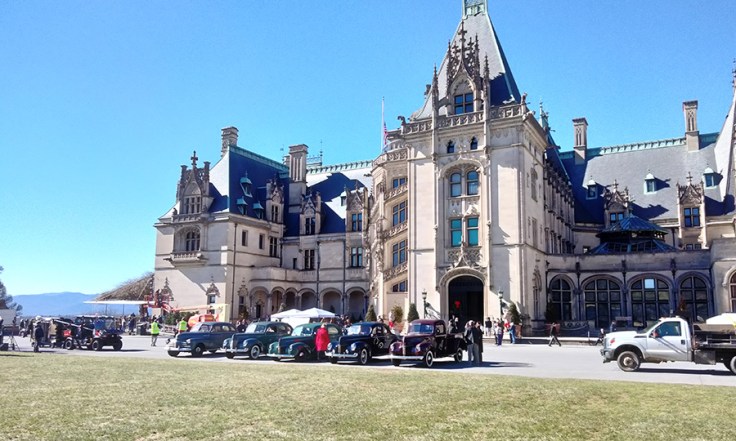
The Biltmore Estate offers visitors a multitude of things to do throughout the year on its 8,000 remaining acres, from horseback riding and falconry lessons to fine dining and high tea. It has also served as a backdrop for a number of films, including “Last of the Mohicans”, “Being There”, “Forrest Gump”, and most recently, this season’s upcoming Hallmark movie “A Biltmore Christmas”.
What started as one young man’s personal project has evolved over nearly a century and a half to become a national landmark and a source of local pride. As befitting of an estate its size, Biltmore has played an outsized role on Asheville’s history, influencing the development of the city to this day. Next time you sift through your stamp collection, I welcome you to take a tour of Biltmore with me.
What do you think? Do you indulge in stamp tourism? Have you ever visited the Biltmore Estate, or is it on your bucket list? Let me know your thoughts!
 Armchair Philately
Leave a comment