
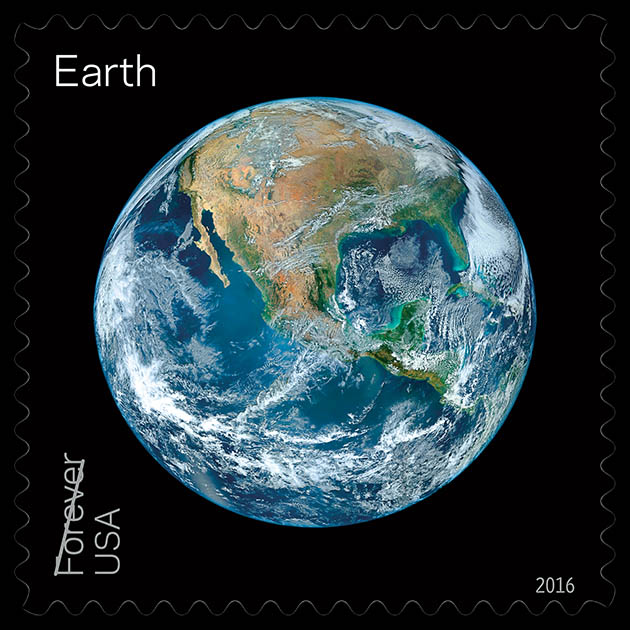
🇺🇸 United States, 47¢ | Issued May 31, 2016 | Scott 5071
Many “firsts” in postal history are well known. The first postage stamp was the Penny Black. The first postmaster general of the fledgling United States was Benjamin Franklin. The first Christmas stamps were issued by Hungary.
But who was the first postmaster of Earth? The very first human of Earth to distribute mail, supervise carrier routes, and hire and fire postal clerks. And when did he serve?
Unless you’re familiar with rural Texas community history, you may be surprised.
This is the story of my journey to Earth (metaphorically) and my quest for one particular snippet of knowledge. In keeping with the theme for this blog, I’ll share the full journey with you, despite the fact that the info I needed was right under my nose (e.g., a quick Google search away—assuming you know the right search terms).
Let’s begin the journey of discovering the first postmaster of Earth.

Where is Earth?
Located in the middle of a long arm of the Milky Way galaxy is an unassuming yellow dwarf star, around which twirl four gas giants and a number of other smaller rocky planets and planetoids. The third planet from this star is a rocky water world, covered by seas and ice. What land there is pokes above the water to encompass not quite a third of the surface area. And the whole tiny blue ball is teeming with largely primitive life.
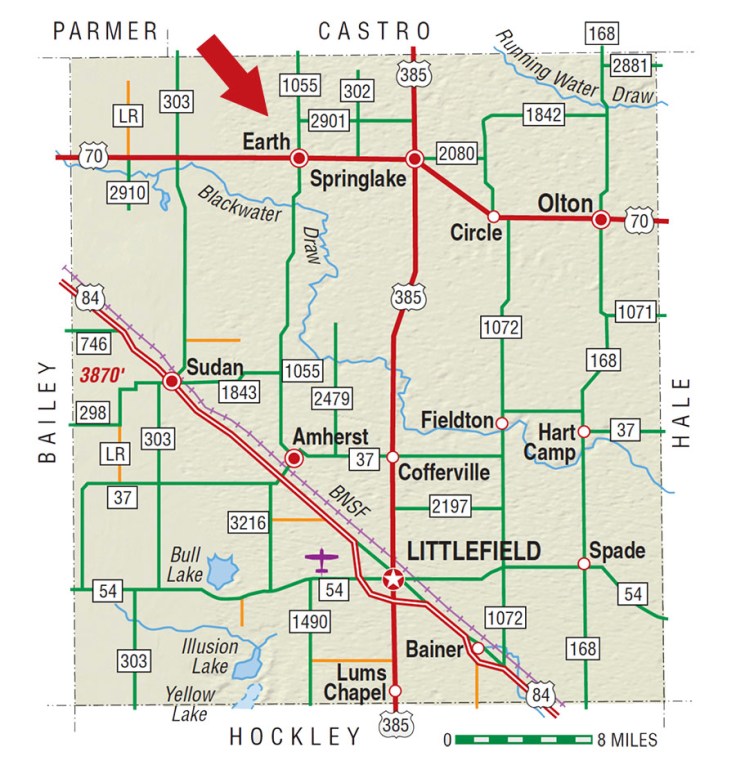
Someone visiting from afar would only need to zoom in to coordinates 34.23° N and 102.41° W to reach the scrublands of what is locally known as the American Southwest. And there, in the county of Lamb in the panhandle of the state of Texas—equidistant from the cities of Amarillo, Lubbock, and Clovis, NM—is the small rural town of Earth.
What’s the story of Earth?
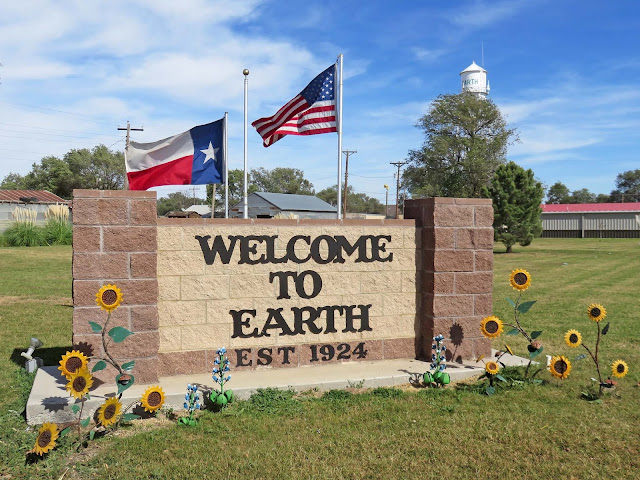
According to popular history, the square townsite of Earth, Texas was laid out by its founder, William E. Halsell. Halsell bought up 185,000 acres of the old XIT ranch in 1901 for $2 an acre. He devoted the land to raising cattle under the name “Mashed O Ranch” until 1923, when he decided to subdivide and sell the land. By August 1924, he had a town site platted and began selling lots. His company, The Halsell Land Co., also built a hotel, a cotton gin, and the first house in town.
Halsell wanted to call the town Fairlawn (or Fairleen), but another site in Texas beat him to it. A second choice, Tulsa, was also rejected. So, one origin story goes, the townspeople of can’t-be-Fairlawn sent in suggestions for a new name. Mr. Ora Hume (O.H.) Reeves submitted the name “Good Earth”, and the townspeople agreed it was the best name submitted. Reeves would become the owner of Good Earth’s city hotel.
So, how did “Good Earth” become just “Earth”?
Accounts vary. According to stories posted in Texas Escapes magazine, when the proposed postmaster was filling out the application for the town’s name, a sandstorm blew in. The postmaster described the storm in his application, and Washington replied, “Since the earth seems to move in that country, the post office shall be named Earth.”
By any account, Earth had a respectable population of 350 Earthlings by 1930. Today, Earth’s 1.2-square-mile boundaries feature arms that extend north and east, as if stretching out of their formerly square container. The town’s 900 residents (down from a high of 1,512 in 1980) enjoy recreating at Earth City Park, featuring the Earth Babe Ruth Baseball/Softball Field, and nearby Earth City Pool. Visitors to Earth, no doubt drawn in by the Earth Rodeo Grounds, stay at the Earth Motel & Cafe.
As an aside, Texas apparently has a number of extraterrestrially named towns, including Mercury, Mars, Saturn, and Pluto. But a basic internet search leads this author to believe that there is no other town—in Texas or across America—simply named “Earth”.
See as reference: U.S. Towns Named after Planets (SenseList)
Who was the first postmaster of Earth?
You would think a town’s history that hinges on the actions of its first postmaster would remember him by name. But while several locally focused webpages tell more or less the same story about Halsell, they each name a different “first postmaster”.
Contender 1: Frank Wesley Hyatt
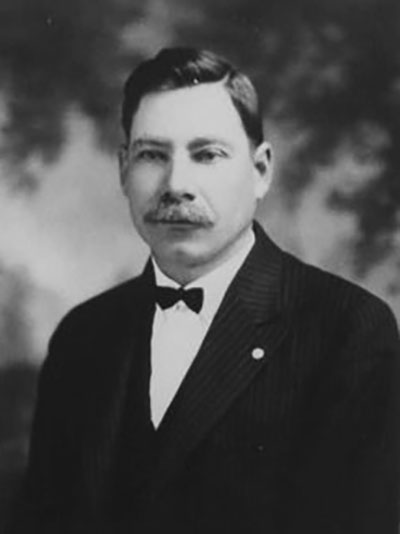
In one account, Mr. Reeves’ son-in-law, Frank Wesley Hyatt, was named the first postmaster of Earth. What we know about Frank Wesley Hyatt from his memorial page was that he was born on February 11, 1895 in Marietta, Oklahoma. He married Flossie Marion Reeves, daughter of O.H. Reeves, and together they had three children. Flossie died on April 18, 1935 in Earth at age 38. She was buried with their middle child, Joe Welsey, who died in infancy. Frank would remarry in 1960 to Willie Mae Myers and would live to the ripe age of 77. Frank Wesley Hyatt died on January 21, 1973 in Amarillo. He’s buried next to his second wife.
Contender 2: C.H. Reeves
In contrast, the Texas State Historical Association lists C.H. Reeves as Earth’s first postmaster. The hotelier Ora Hume Reeves had a number of children, none of whom are listed with the initials “C.H.” (according to lineage information on FindAGrave.com). Charles Elmer Reeves was born in 1885 and died in 1969 in nearby Muleshoe, making him the best contender for the role among Elder Reeves’ listed kin. In 1911, Charles married Rosa Alene Janes, who was 15 years his elder. Janes was a widow with four children at the time. Together, the couple had one child, Charles O. Reeves, who died in infancy. Nevertheless, Charles’ obituary lists his survivors as one grandchild and three great-grandchildren, likely descendents of his step-children.
Contender 3: Marshal Edwin Kelley
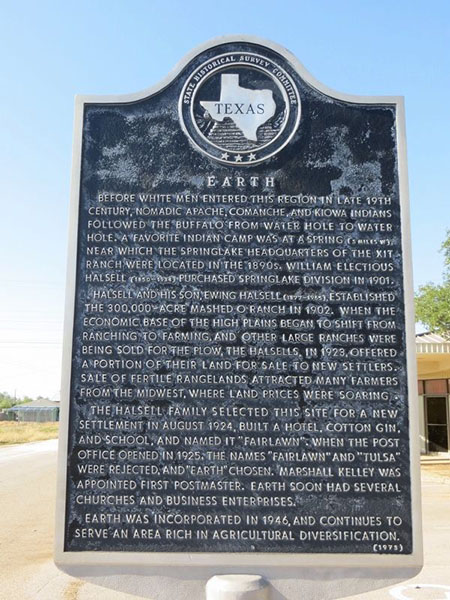
Meanwhile, the town’s very own historical marker places “Marshall Kelley” behind the postal counter. Marshal Edwin Kelley was born on September 28, 1904. He grew up the middle of three siblings and married Eula Maye Green in 1926. The two had one child, Gwyndene, the next year. It must have been a busy time for Kelly. According to his gravestone, he began his position as Earth’s postmaster in 1926 and served until 1960. Kelley would live until September 17, 1970 and was buried in Earth Memorial Cemetery.
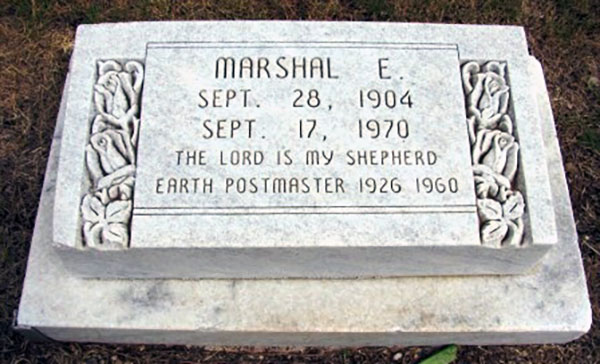
So, Kelley did, in fact, serve as postmaster shortly after the town was founded. But were any of these men actually the FIRST postmaster?
What do the National Archives say?
The personnel files of postmasters at the National Archives begin in 1929. That is several years too late for the purposes of this research. “Darn,” I muttered to myself.
However, among the post office records that are available are records of site locations and postmaster appointments. “Perfect!” I shouted out loud to myself. Postmaster appointment records prior to 1950 are available on microfilm at a cost. “Oh, geez.” But some records related to site locations have been scanned and are available online. “We’ll see…”
According to the site, from 1837–1950, the U.S. Post Office Department’s Topographer’s Office would send report forms to local postmasters. In these reports, local postmasters would provide site location data so that the post office could maintain accurate maps of all their locations. These forms record new post offices that were created during this time frame, as well as any that moved locations.
I rolled through the microfilm scans for Lamb County, Texas. And then I rolled my eyes.
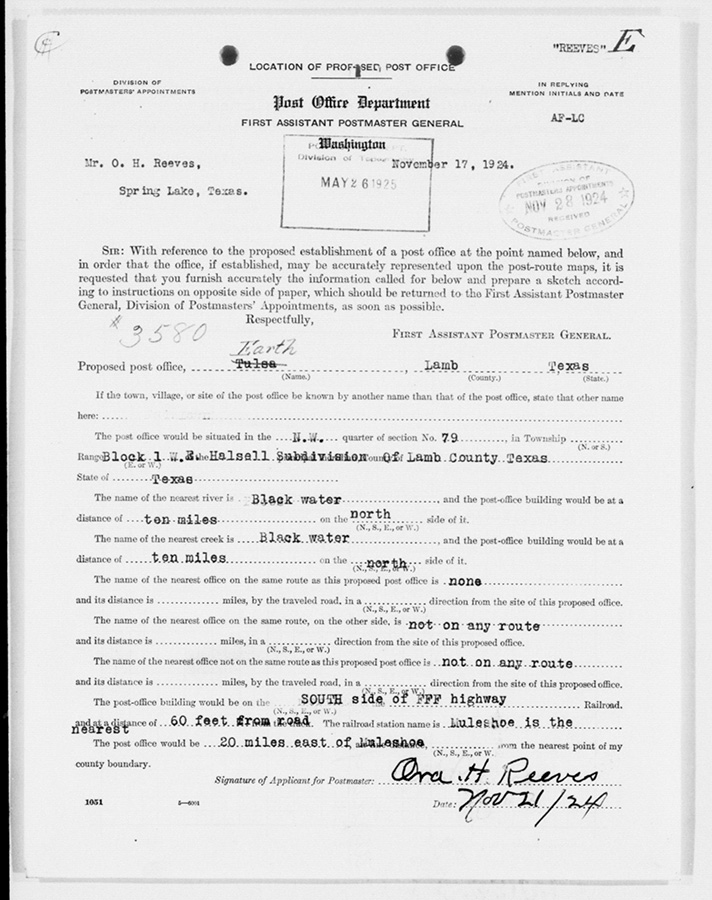
Yes, there was an application for a new post office filed in late November 1924 (and approved on May 26, 1925). And yes, as mentioned in the town’s origin story above, the proposed town name of “Tulsa” was crossed out and “Earth” was penciled in. But the name on the line labeled “Signature of Applicant for Postmaster” was none of the three contenders listed above. It was neither Frank Wesley Hyatt, nor Charles Elmer Reeves, nor Marshal Edwin Kelley.
Contender 4: Ora H. Reeves
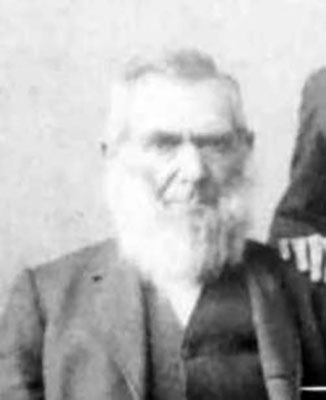
The name listed as “Applicant for Postmaster” was none other than Mr. Ora H. Reeves, owner of the town’s first hotel.
Ora Reeves was well traveled for a man of his time. He was born in Illinois in 1863 and lived in several exotically named locations, including Earth, Texas and Brazil, Indiana before being laid to rest in Calcutta, Indiana at age 89. According to his memorial, he was a “retired minister and farmer” who “engaged in farming in [the] Greencastle [Indiana] community before returning to Brazil to work in the local coal field.” His public memorial doesn’t list Earth by name, nor his profession(s) while in residence.
How do I determine which contender was ACTUALLY the first postmaster of Earth?
The deeper I dug into Earth’s history (pun absolutely intended), the more postmasters I found. Could the “C.H. Reeves” from TSHA records be a typo and actually represent O.H. Reeves? Why would Earth post a historical marker for the wrong man? And how long after when Earth’s application was approved (May 26, 1925) did the town’s first post office open?
I scoured Newspapers.com in vain. I reached out to the Lamb County Public Library to find that the local historical society had recently lost many of their records. The records of the Lamb County Leader-News only went back to the 1930s. Surrounding area newspapers did not respond to my pleading emails.
Surely, I thought, there must be early records of this post office. After all, philatelists keep meticulous records of everything related to postal history! Should I turn back to the National Archives and pay the $125 fee to review their microfilm?
And then I found the metaphorical smoking gun. I stumbled upon it, really—an absent-minded click on a byzantine back page of The Portal to Texas History.
Published in Bell County, Texas in 1974 by one James Lynn Wheat: “Postmasters and Post Offices of Texas, 1846-1930”.
Wheat’s collected data is based on his own microfilm research from both the National Archives and Library of Congress. (“Sweet! I don’t have to pay to see the records.”) Google Books didn’t offer a preview. But luckily, RootsWeb hosts a full copy of the book.
What does it say? What does it say!?!?!
POSTMASTERS & POST OFFICES OF
LAMB COUNTY, TEXAS*
1889–1930
EARTH (Lamb)
Hyatt, Frank W., 25 May 1925 (emphasis mine)
Kelley, Marshal E., 23 Feb 1926
So, there we have it! The honor of serving as Earth’s first postmaster goes to Contender 1, Frank W. Hyatt, son-in-law of Ora H. Hume, the man who applied for the town’s post office. Hyatt only served for 274 calendar days, compared with his successor’s nearly 35 years in the position. But we can say officially that he was the first postmaster of Earth.
Isn’t there an easier way to find this info?
As I mentioned at the start, my labyrinthine search occupied me for months (off and on). But another chance Google search inspired by this research led me to another, more direct, easy-to-navigate research.
I searched “who is my postmaster?” and was fed this link as the first result: https://about.usps.com/who/profile/history/postmaster-finder/
THE USPS HAS A WHOLE SITE DEDICATED TO LISTS OF POSTMASTERS!!
Cue eye roll. Geez…
As a test, I popped “Earth” into the city field and chose “Texas” from the dropdown menu of states. Yep, there it is.
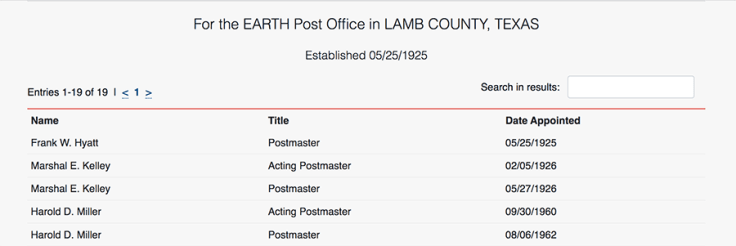
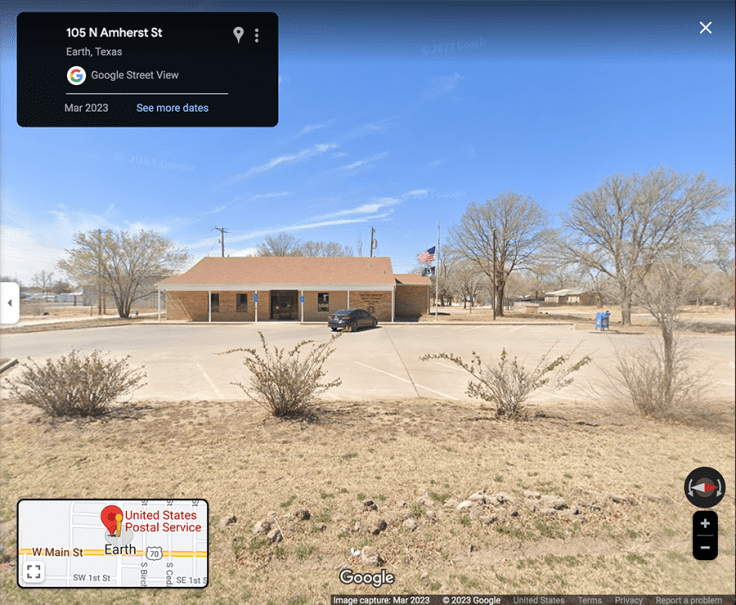
Where is the Earth post office now?
When he founded the town, William Halsell placed Good Earth’s city hall and post office near the geographic center of what was plotted. Located just a block off Main Street, today’s Earth post office (current postal code 79031) is a modest beige brick building that looks like it was designed to blend into the Texas scrublands.
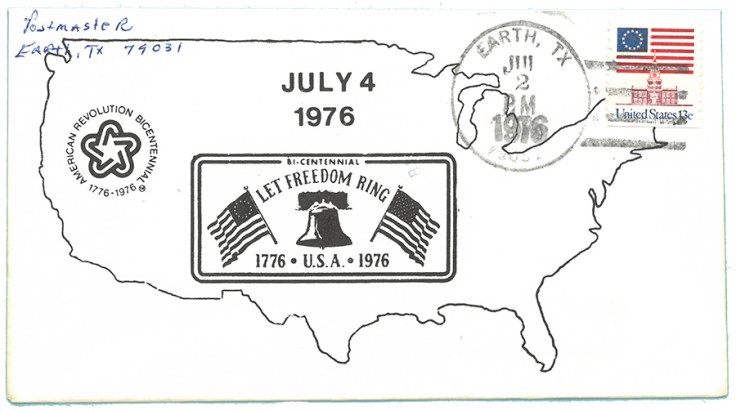
Featuring Flag over Independence Hall stamp (coil)
🇺🇸 United States, 13¢ | Issued November 15, 1975 | Scott 1625
Since Marshal Kelley’s retirement in 1960, there have been a number of other postmasters in Earth, Texas. When the Bicentennial cover above was signed by the postmaster in 1976, the position was held by Harold D. Miller, Kelley’s immediate successor. But since 1980, more than a dozen Earthlings have held the post.
Next time you’re in the center of Earth, stop in to take care of any postal needs. And be sure to say hello to Nancybeth Montemayor—who is for sure the current postmaster of Earth.
What do you think? Have you ever been to Earth, Texas? Do you like to collect postmarks from towns with interesting names? How do you track down hard-to-find postal history? Let me know your thoughts!
*Sources:
Record of Appointment of Postmasters, 1832 – Sept. 30, 1971;
National Archives microfilm M841, NNEB-20 (reels 1–3)
Pickett Papers, Confederate States of America, Volumes 98–99;
Library of Congress microfilm, reel 52
 Armchair Philately