
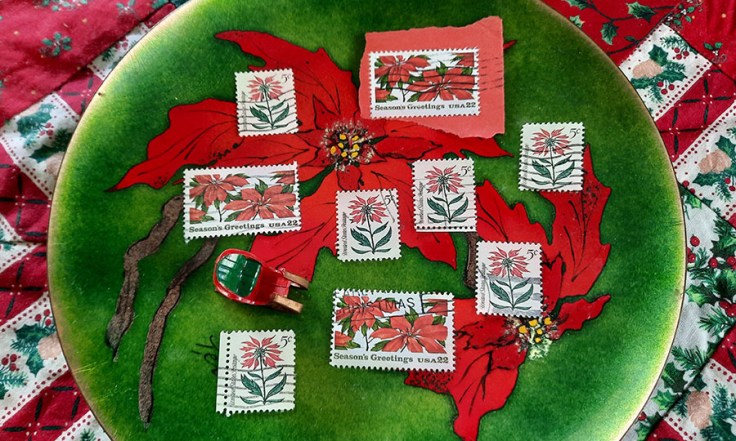
What’s red and green and cherished all over?
Every year, Americans purchase approximately 70 million poinsettia plants within a six-week period leading up to Christmas. That’s two and a half times as many live Christmas trees as are sold each year (25–30 million)!
Poinsettias help people the world over celebrate the holiday season. But a plant that beloved deserves to be celebrated in its own right. I’ve compiled a short and sweet (and probably incomplete) history of the poinsettia below, as well as its appearances on postage stamps.
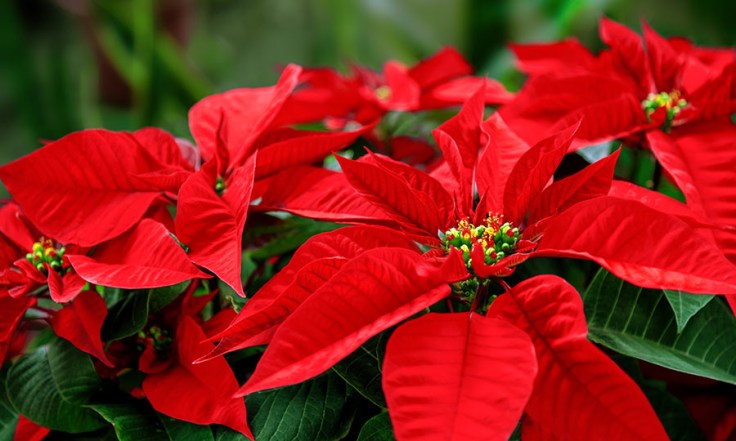
What is a poinsettia?
The poinsettia is a flowering plant within the Euphorbiaceae (“spurge”) family, which includes about 7,500 species. The Pará rubber tree plant, castor oil plant, cassava, Hercules club (a succulent), and white mangrove are all spurges related to the poinsettia.
Poinsettias are indigenous to Mexico and Central America, where they were first cultivated by Aztecs for use as a traditional dye and as medicine for treating fever. According to Wikipedia:
Wild poinsettias occur from Mexico to southern Guatemala, growing on mid-elevation, Pacific-facing slopes. One population in the Mexican state of Guerrero is much further inland, however, and is thought to be the ancestor of most cultivated populations.
Prior to poinsettia, the plant was known as “cuetlaxochitl”, “Mexican flame flower”, or “painted leaf”. In Mexico today, it is called “Flor de Nochebuena” (Christmas Eve flower) or “Catarina”. In Spain, it is “flor de Pascua”, meaning “Easter flower”. In Chile and Peru, the plant became known as the “crown of the Andes”.
Are poinsettias toxic to people or animals?
In the early 20th century, urban legends proliferated about the plant’s supposed toxicity to both people and pets. Rumors persisted well into the 1970s and ‘80s. But no experimental evidence has given any validity to those rumors. However, as its chemical composition includes two components of latex, the plant does cause “minimally bothersome” skin rashes, asthma, or hay fever in some people. Pets who ingest poinsettias may experience nausea, diarrhea, or vomiting.
How do poinsettias turn red?
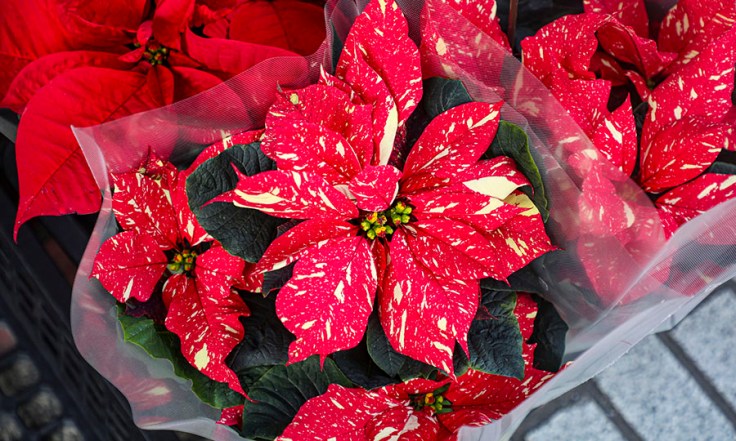
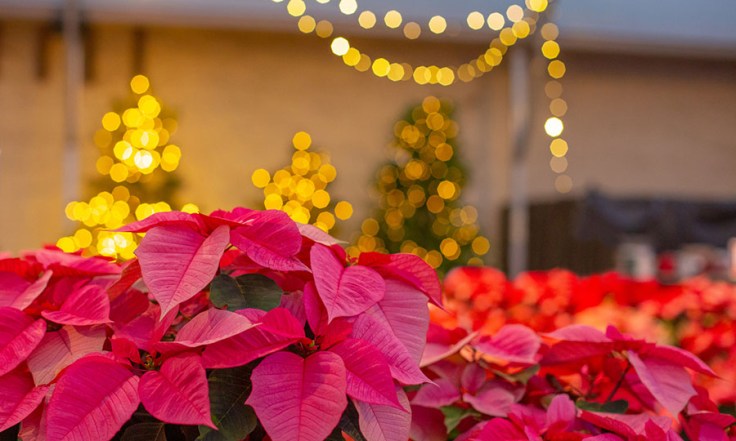
Poinsettias are best known for their vibrant red and green petal-like leaves, called bracts—a color combo that has helped define Christmas traditions in the Americas. Cultivars vary in bract size and color, ranging from pink to white, marble, orange, and even purple. But if you keep your potted plants past New Year’s Day, you’re sure to notice the red bracts fall off and the rest of the plant remain green. Why is this?
Poinsettias are photoperiodic. They require longer periods of darkness in the winter to stimulate the development of their flowers. The bracts do not contain much chlorophyll, so when exposed to darkness, their naturally high levels of anthocyanins will turn them red. If you’ve kept your poinsettia alive since last year, all you have to do is expose it to 12 hours of darkness and 12 hours of bright light each day for several weeks leading up to the holidays. The bracts will naturally turn back to their colored state. (Start in September/October for the maximum effect!)
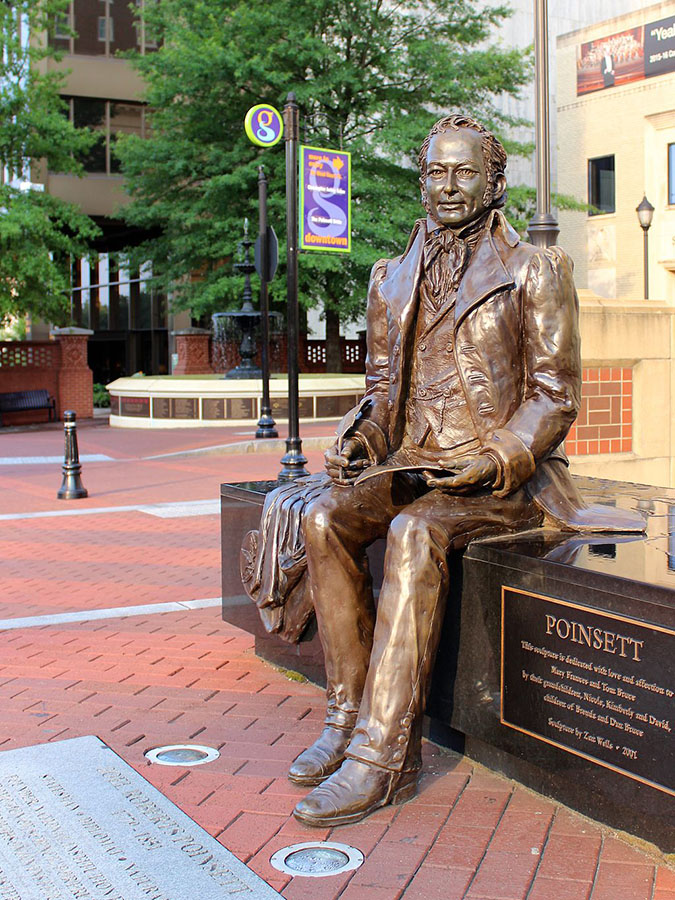
Who “discovered” poinsettias?
Wild poinsettias have likely grown throughout the Americas for thousands of years. Aztec peoples began cultivating them more than 500 years ago. And the first description of the plant as its own species was made by German scientist Johann Friedrich Klotzsch in 1834 based on samples gathered from a 1803–1804 expedition to Mexico.
But it was Joel Roberts Poinsett (March 2, 1779–December 12, 1851), the first United States minister to Mexico, who is (somewhat controversially) credited with “discovering” the plants when he introduced them to the U.S. in the 1820s. Poinsett made his career in politics, but he was also an avid amateur botanist. He brought back samples of the plant and began cultivating them in his Greenville, South Carolina greenhouses. He gave the plants as gifts to friends and associates in Charleston and Philadelphia. By 1836, the plant was widely known in the U.S. as the “poinsettia” and became a symbol of the Christmas giving season in America.
Today, more than 100 cultivated varieties of poinsettia have been patented in the U.S., reflecting its position as the most economically important potted plant grown in the world. December 12 is National Poinsettia Day, so chosen to mark the death of Joel Roberts Poinsett. Poinsett’s legacy in Greenville can also be seen in the Poinsett Bridge, Poinsett Club, and the landmark Poinsett Hotel downtown. The Poinsettia Christmas Parade has signaled the start of the holiday season in Greenville for more than 75 years.
Why are poinsettias associated with Christmas?
Aside from their iconic holiday-themed color combo, poinsettias have taken their place in Christmas celebrations because of local legends and larger religious symbolism.
It all began in 16th-century Mexico with the legend of a young girl commonly called Pepita or María. The girl wanted to participate in the celebration of the Nativity, but she was too poor to bring a gift to the church. Instead, she gathered weeds from the roadside to place in front of the altar. When inside the church, the plants turned bright red, which came to symbolize the blood sacrifice of the crucifixion.
Franciscan friars in Mexico began using the plants in their Christmas ceremonies around the 17th century. The star-shaped leaf pattern also came to symbolize the Star of Bethlehem, harkening back to celebrations of the Nativity.
In the U.S., the rise of the plant’s popularity can be attributed to a farmer named Paul Ecke (1895–1991). Ecke single-handedly created the “Christmas flower industry” in the first half of the 20th century. In the 1960s, Paul Ecke Jr. gave away potted plants as set decor for TV talk shows, Christmas musicals, and designer photo shoots. His media savvy helped make poinsettias synonymous with “the Christmas flower”.
Where can I find poinsettias on stamps?
It’s no wonder that the vibrant reds and greens of poinsettias have come to symbolize the Christmas season all around the world. The contrasting colors also look great in a small format like postage stamps.
Many countries have featured poinsettias on stamps, including Bermuda, Canada, Cayman Islands, Cuba, Finland, Germany, Guatemala, Monaco, Netherland, Nicaragua, Spain, Sweden, Turkiye, Yemen Arab Republic, and—of course—Mexico. In fact, the ATA lists 202 stamps on their list “Flowers / Plants – Poinsettias”.
In the United States, there are at least four instances of poinsettia stamps.
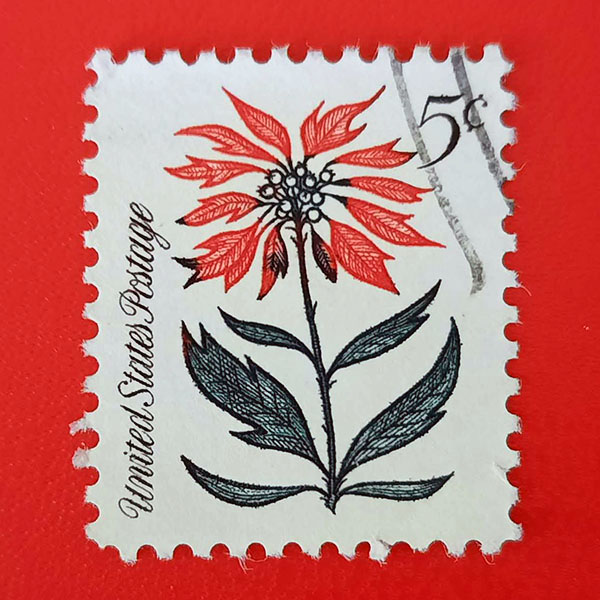
🇺🇸 United States, 5¢ | Issued November 9, 1964 | Scott 1256
This was one of four se tenant holiday stamps in 1964, the third year the U.S. issued Christmas stamps. The stalk and bracts look spindly compared to today’s fuller cultivated plants, but makes for a cheerful illustration. The other designs in the set include holly, mistletoe, and a sprig of conifer.
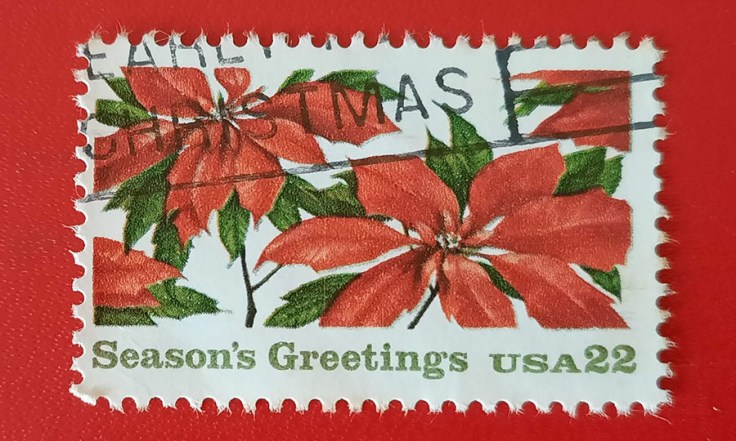
🇺🇸 United States, 22¢ | Issued October 30, 1985 | Scott 2166
In 1985, the USPS issued a horizontal holiday-neutral poinsettia stamp to pair with the year’s vertical religious Christmas stamp, an image of Luca Della Robbia’s “Genoa Madonna” terracotta sculpture. At least four stalks of red and green bracts are positioned on a white background with the words “Season’s Greetings”.
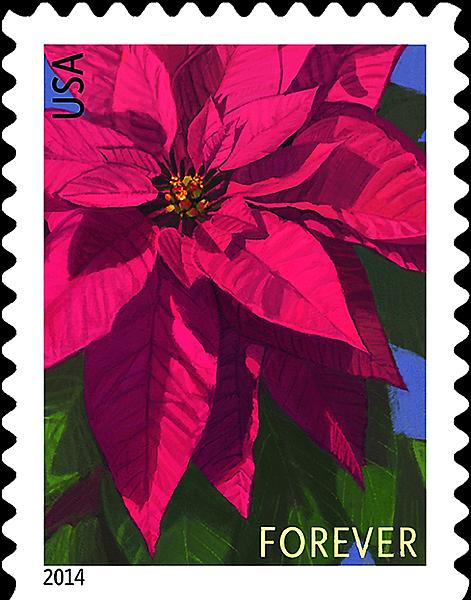
🇺🇸 United States, FOREVER | Issued August 21, 2014 | Scott 4816
(SOURCE)
The poinsettia served as the non-religious Christmas issue for 2014, paired against the Christmas Magi, shown in silhouette against a bright Star of Bethlehem. The pairing could have been an homage to the flower’s greater symbolism for the star, as mentioned above.
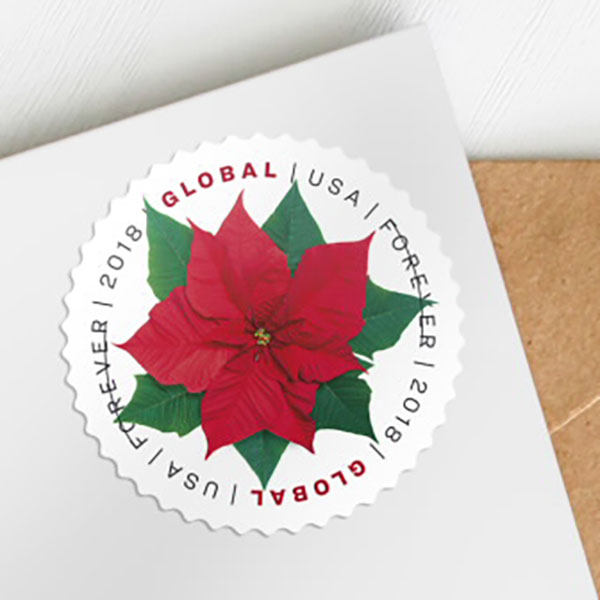
🇺🇸 United States, GLOBAL FOREVER | Issued August 26, 2018 | Scott 5311
(SOURCE)
Since at least 2013, the global letter rate stamps have been issued in circular designs, such as globes and wreaths. In 2018, the design was a bright poinsettia flower isolated against a white background. The words “GLOBAL | USA | FOREVER | 2018” ring the flower twice.
What do you think? Are poinsettias an important part of your holiday traditions? Do you prefer to buy fresh ones each year or keep yours alive until the next season? Let me know your thoughts!
 Armchair Philately
Leave a comment