

Here in Asheville, one of my avocations is leading a literary walking tour of downtown—guiding locals and visitors who want to take in the sights and sounds while learning about our city’s rich literary history. In that role, I help promote and participate in an annual spring festival honoring Zelda Sayre Fitzgerald, who was (among her many accomplishments) a published author.
There’s something special about literary festivals. Aside from boozy book clubs and stuffy classroom lectures, there are few regular opportunities for book lovers to share in the reading experience with others. Perhaps that’s why New Bedford, Massachusetts’s annual Moby Dick Marathon event attracts so many participants each year.
My travels have not yet taken me to New Bedford. But luckily, through stamp collecting, I’m able to engage in stamp tourism, an analog exploration of a place from afar. In anticipation of this year’s event, let’s learn a little more about the read-a-thon and related stamps and covers.

Who was Herman Melville?
Herman Melvill (the original spelling) was born August 1, 1819 in New York City. His father was a prosperous merchant, but his early death in 1832 meant a lot of belt tightening for his widow and eight children. Young Herman proved to be a bright scholar and a talented speaker, but his education was largely cut short because of his family’s poor finances. At age 15, Herman took a job manning a cap and fur store for his oldest brother, Gansevoort. The next few years of Herman’s life were filled with intermittent schooling for himself (and others, through his stint as a teacher) and shadowing his elder brother and role model, Gansevoort, in business pursuits.
On June 1, 1839, at the suggestion of his brother, Herman signed aboard the merchant ship St. Lawrence as a “boy” (a green hand). The ship cruised from New York to Liverpool, marking Melville’s first experiences at sea. On January 3, 1841, Melville set sail from the Port of New Bedford and Fairhaven on a whaling ship called the Acushnet. The ship sailed through the Bahamas to Rio de Janeiro, then around Cape Horn to the South Pacific and up to the Galapagos. While on board, Melville helped collect upwards of 750 barrels of whale oil. He spent the next several years jumping from island to island, working odd jobs and experiencing the cultures of Polynesia.
Melville fictionalized some of his early excursions through his 1846 book Typee. Over the next several years, the author married, bought a farm, and had a child. By fall 1851, around the time his second child was born, Moby-Dick was published in the U.S. Melville published a number of books, novellas, and collections of poetry over the course of his writing career, but he was never a commercial success in his lifetime. He supplemented his income by working other jobs, including as a customs inspector. He died on the morning of September 28, 1891 and was interred in Woodlawn Cemetery in The Bronx.

What is the legacy of Moby-Dick?
While Melville was never able to fully live off the proceeds from his writing career, many of his works were nevertheless appreciated by critics and readers of the time, with Moby-Dick considered to be his “masterpiece”.
In the novel, Ahab, captain of the whaling ship Pequod, embarks on a maniacal quest for vengeance against Moby Dick, the giant white sperm whale that bit off his leg on the ship’s previous voyage. Its themes of truth, perception, and a search for meaning resonate with readers still today. And its parallels with a true-life sea disaster (that of the Essex), paired with Melville’s first-hand knowledge of whaling, make it “the greatest book of the sea ever written”—at least, according to D.H. Lawrence.
I must confess, I have not yet embarked on the life-altering journey that is reading Moby-Dick. But thanks to the “Melville revival” of the early 20th century, along with myriad film adaptations and allusions in pop culture, I’m very familiar with the main thread of the story. And countless schoolchildren can quote the first line of the novel, now considered one of the most iconic in American literature.
A close friend who tackled the novel several years ago (and came out with both legs) says he has thought about the book every day since. And the community of artists and readers who have read Moby-Dick say “If you allow it to come into your life, you’re much the better for it.” Their fervor for the novel—and annual pilgrimage to New Bedford, Massachusetts—is even the subject of a documentary, Call Us Ishmael.

What happens at the annual Moby-Dick Marathon?
In the 19th century, New Bedford, Massachusetts “gained worldwide reputation as the greatest whaling port and the richest city per capita in the world”, according to the town’s tourism website. It was from there in 1841 that Melville and his oldest brother, Gansevoort, set sail on a whaling voyage aboard the Acushnet—kicking off the young man’s years at sea which would inspire his later novels. So, it comes as no surprise that the city would be the perfect setting to celebrate the greatest American novel about a great white whale.
Since 1997, the New Bedford Whaling Museum has marked the anniversary of Melville’s passage from the city’s famous port with a celebrational mid-winter literary voyage. The New Bedford Moby-Dick Marathon centers around a 25-hour read-a-thon from Saturday to Sunday in early January. The weekend is interspersed with fun Melville-inspired activities. This year, that includes opportunities to chat with the scholars from the Melville Society Cultural Project and a live performance of Chapter 40 by Culture*Park. The New Bedford Free Public Library also hosts craft-making and a scavenger hunt for young Melville enthusiasts. Most of the events are free to participate in.
Notably, during the Pandemic, the read-a-thon was performed live on YouTube. If you can’t make it to New England this weekend, you can follow along with this “re-imagined” version.

Is New Bedford the only place to celebrate Herman Melville?
Despite its centrality as an historically great whaling port, New Bedford is not the only American city to sponsor marathon readings of Moby-Dick in recent years.
From 1850–1863, Melville lived on a 160-acre farm in Pittsfield, Massachusetts, which he called Arrowhead for the arrowheads that would be turned up by the plows each planting season. Today, the farm is the home of the Berkshire County Historical Society, which is dedicated to preserving the history of Berkshire County and the Arrowhead. The historical society hosts its own annual reading of Moby-Dick, on the site where it was written. To date, there have been at least six annual events. Their event is not continual, but stops at 5:00 PM until the following day. A mix of in-person and Zoom participants take turns reading 10-minute blocks until the novel is complete.
In 2022, San Francisco Maritime National Historical Park, located at the west end of Fisherman’s Wharf in San Francisco, hosted its own 24-hour reading of the novel. A number of free events and lectures led up to the big event, while more than 100 readers added “their own voices to Melville’s musings, orations, and unforgettable characters.” The park was also a fitting setting for the reading, as it is surrounded by aquatic-themed WPA murals, and overlooking the Aquatic Park Pier and Cove.
How often has Moby-Dick been celebrated in stamps?
According to the American Topical Association, there are currently 18 postage stamps on their “Literary – Moby Dick” list. This list surely includes a few obvious depictions of the iconic whale on stamps from Sierra Leone, Niger, and Uruguay, along with Disney depictions of the story from the Maldives and Saint Vincent and The Grenadines. But I imagine it also includes “Moby Dick is sighted off Muriwai Beach”, a contemporary painting on a stamp from New Zealand. Moby Dick is also the name of a motor ship pictured on a stamp from Berlin, as well as a Porsche racing car highlighted by the Central African Republic.

🇺🇸 United States, 20¢ | Issued August 1, 1984 | Scott 2094
The United States Postal Service has honored Herman Melville and Moby-Dick in several ways. Melville was the fourth author highlighted in the ongoing Literary Arts stamp series, released in 1984. The 20-cent engraved stamp features a portrait of the author based on the painting near the top of this post, with a plain background, and was released on the 165th anniversary of his birth. Notably, the first-day city for the stamp was New Bedford, not Melville’s birth city of New York.
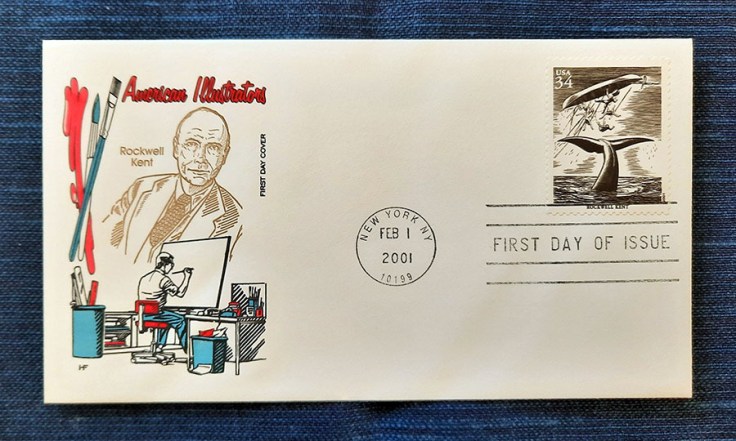
🇺🇸 United States, 34¢ | Issued February 1, 2001 | Scott 3502q
In 2001, the USPS released a sheet of 20 stamps honoring American illustrators. One stamp honored Rockwell Kent by depicting one of the artist’s illustrations for a 1930 reprinting of Moby-Dick. The 34-cent stamp shows a large whale tail tossing a small boat into the air while a handful of sailors fall out to their peril. I recently purchased a first-day cover of the stamp with a nice cachet of the illustrator. Kent (June 21, 1882–March 13, 1971), himself a sailor and adventurer, is best known for his stark, realistic landscape paintings.
But the most prolific Moby Dick items that I’ve come across at stamp shows and online are these: Stamped envelopes picturing an embossed white whale inside a blue oval. The oval reads “Herman Melville | Moby Dick | United States 6”. According to Mystic Stamp, it was “the first US stamped envelope that didn’t include a ‘c’ or ‘cents’ alongside the denomination.” The stamped envelope was released on March 7, 1970, with a first day of issue again in New Bedford.

🇺🇸 United States, 6¢ | Issued March 7, 1970 | Scott U554
From my experience, it’s pretty easy to find these covers, and they come with a variety of interesting and informative cachets. I’ve collected a number of them for my Moby-Dick friend. The most recent additions to the collection I am imposing on him are these two. First up is a dramatic illustration of a bearded Captain Ahab, fists raised in anger, giving side eye to a white whale tail emerging out of the swells. The illustration is signed “Marq”.

🇺🇸 United States, 6¢ | Issued March 7, 1970 | Scott U554
Second up is a large three-color cachet in blue, red, and black. In the design, there’s a violent struggle between sailors and whale in the foreground while the Pequod sits in the back with sails raised. Moby Dick sits nearly entirely at the water’s surface, smashing a small boat with his fin and sending two sailors flying into the water. Another sailor is trapped in his mouth. And Captain Ahab, identified by his wooden peg leg, stands poised to throw a spear at his foul beast while a rower strains against his oar. The text at the top of the cachet states the significance of the issue: “HONORING THE NEW ENGLAND WHALING INDUSTRY AND HERMAN MELVILLE, AUTHOR OF ‘MOBY DICK’.” The design is unsigned.
These newest cachets in our growing collection are some of the most interesting I’ve found yet, but—like whales in the vast southern oceans—there are surely many more yet to be discovered.
What do you think? Have you read Moby-Dick? Have you ever attended the marathon in New Bedford? Is the U.S. due for another Melville stamp? Let me know your thoughts!
 Armchair Philately
Leave a comment