

Small cover sent from Hungary to U.S., canceled June 16, 1912
🇭🇺 Hungary, 10f | Issued 1908–1913
When you begin studying philately, you’ll find easily accessible resources and great glossaries explaining the many ins and outs of the hobby. But every so often, you’ll come across something that’s more difficult to find an easy answer for. Sometimes even when it feels like there should be an easy answer.
That was the case when I began seeing covers with mysterious serifed Ts all over them. I’ve taken a liking to Hungary’s Turul series of the early 1900s, so I have saved searches for the stamp in my HipStamp and eBay accounts. But why did some Hungarian covers have a big T near the stamp at the top, or positioned under the address at the bottom, or—as in the case of this cover—in multiple locations?
As usual, when I dug into my simple question, I found a rich and rewarding answer—as well as more questions. Here’s the purpose of the big T on covers of the early 20th century.
What does this “T” mean?
As someone who focuses on Hungarian stamps, when I started seeing this T on Hungarian covers, I assumed it was a Hungarian thing. By doing some basic deduction work, I quickly figured out that the T is a handstamp representing postage due. That makes sense given the other markings on the cover shown above.
But my regular-issue Hungarian postage due stamps are generally marked by the term “portó”. Knowing that, what could the T translate to? Was it from an Austrian term? Did it represent something in addition to the basic postage due requirement I was thinking of? Should I call the A-Team for help?
After some additional sleuthing (scouring my meager Hungarian postal history sources, only to do a quick successful Google search on a whim), I discovered that the T is, in fact, NOT “a Hungarian thing”.
The problem of underpaid foreign mail was one of the issues addressed by the 1874 establishment of the Universal Postal Union. The U.P.U. arrived at the decision that mail with insufficient postage should be marked with a “T” and from April 1, 1879 the amount missing would also be indicated in black.
Awesome! So, now we know that the T was an international symbol of postage due, making it easily communicable on this Hungary-to-U.S. cover. But that still leaves the question, “Why a T?”

No but really, what does the “T” mean?
By now, you may be shouting your theories at me through the screen. “Of course the T means t__!” Don’t worry—I hear you. But the point of this exercise is that while you may think it’s common knowledge what the T means, that doesn’t mean it’s well recorded for beginning collectors to find. In fact, I even looked through the U.P.U.’s Convention Manual (updated 2019) and still couldn’t find it defined in their glossary, though they referred to the “T” handstamp several times.
Thankfully, I was able to find a few definitions from fellow philatelists.
From Janet Klug in Linn’s Stamp News (May 3, 2021):
… the letter “T” can be found on mail, standing for the French word “Taxe,” and indicating that money is due to the post office because of insufficient prepayment.
And this PDF from Richard Frajola posted to his website:
On unpaid and insufficiently prepaid mail from U.P.U. member countries the sending country was to mark the letter with a “T” (Taxe) handstamp to indicate postage due. Most exchange offices used a simple “T” while others included the name of their office.
So, there we have it: The T on my internationally bound cover stands for “taxe” or “taxé”, indicating that a postal tax is still due for the item in hand because postage paid was insufficient.
Was that so hard? Sheesh!
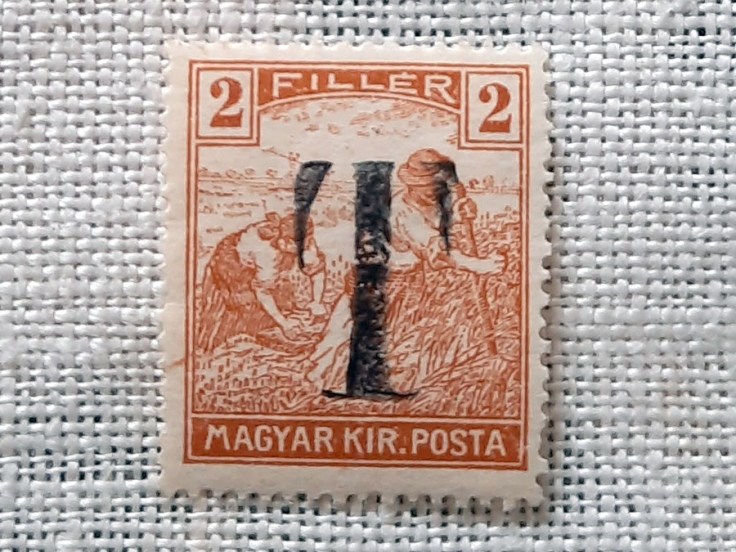
Harvesting Wheat (Issued 1916–1918) with hand stamped “T” postage due overprint
🇭🇺 Hungary, 2f | Issued 1918–1920
Why does this unused stamp have a postage due “T”?
Now that we have that solved, it has opened up one more question about my collection: If the T stamp was applied to covers in outgoing (used) mail, why do I have a mint Hungarian stamp with the T on it?
That doesn’t make sense! If these handstamps were specifically used on outgoing mail, why would it be on a mint stamp. Why would a “postage due” marking be used on a definitive stamp? And why would postmasters be applying their own (presumably provisional) handstamps to government-issued postage stamps?
The answers to those questions were surprisingly much easier to find.
Available stamps in post-WWI Hungary
Hungary’s Harvesting Wheat definitive series was issued in a large number of denominations from 1916–1920. If those dates are triggering an aha moment, it’s because they overlap nicely with the height and aftermath of the Great War, now known as World War I.
The Kingdom of Hungary suffered great losses from the war, as evidenced by the changes in their territory. Following the Treaty of Trianon (June 4, 1920), Hungary was left with “only 35,893 of the 125,641 square miles (92,962 of the 325,408 square km) that had constituted the lands of the Hungarian crown.” That meant that hundreds of towns situated well within the country’s borders before the war found themselves now part of Austria, Czechoslovakia, Romania, Yugoslavia, and even Poland or Italy.
Due to wartime shortages, Harvesting Wheat stamps were overprinted by many occupying governments. I have French, Romanian, and Serbian overprints in my collection. (Note: many of these are likely philatelic forgeries….) Within Hungary itself, Harvesting Wheat stamps were overprinted for the Hungarian Republic (Köztársaság, 1918–19), Hungarian Soviet Republic (Magyar Tanácsköztársaság, 1919), the anti-Bolshevik Hungarian National Government (Magyar Nemzeti Kormany, Szeged, 1919), and even to commemorate the evacuation of the Romanian army on November 16, 1919.
All of this is to say that there were boatloads of these Harvesting Wheat stamps, and post offices that had them in stock were using them wherever stamps were in short supply.
Postage due overprints of Harvesting Wheat stamps
Along with the postal uses mentioned above, the Harvesting Wheat stamps (and others) were also used in the years 1918–20 “to alleviate the shortage of postage due stamps”. Some sources narrow their window of use even further.
Rate changes were happening quickly with inflation, and stamp printing could not keep up for these new and changing territories. According to one online forum source (bold emphasis mine):
… as stocks of the `Postage due` stamps ran low (due to the constantly changing postal rate) Hungarian Post issued an order at 15.06.1915 allowing usage of postage stamps as `PORTO`. These stamps were marked with capital letters of `T` or `P` or with the inscription `PORTO`. Many post offices handstamped or marked postage stamps in advance. Different kind (sic) of markings were used, but these stamps … are not considered local overprint (sic), as thee (sic) were officially ordered by Hungarian Post.
Because of the short window for use of these stamps (mere months, in some cases), collectors assume that “most of the mint examples were fabricated as philatelic curiosities. The only ones of value are on genuine covers denoting their use as provisional postage due stamps.”
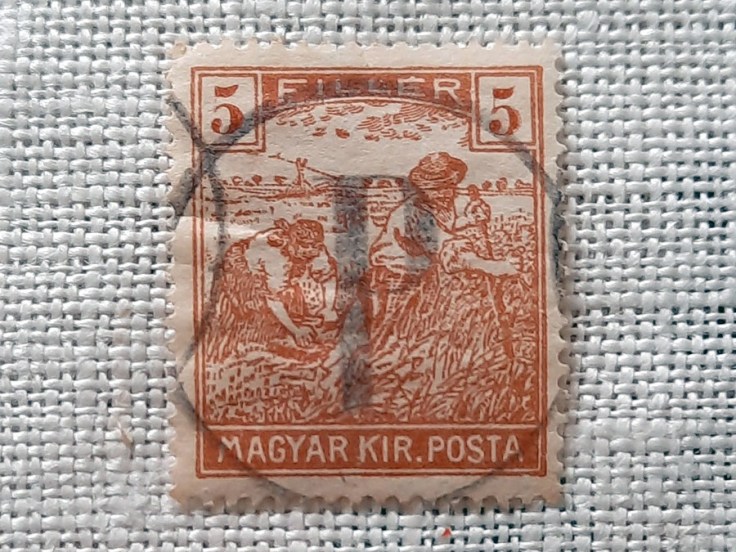
Harvesting Wheat (Issued 1920–1924) with hand stamped “P in circle” postage due overprint
🇭🇺 Hungary, 5f | Issued c.1920
What other Hungarian postage due handstamped overprints exist?
As mentioned above, the U.P.U. symbol for postage due is a T. However, Hungarians often used “porto” or a P for domestic mail, which was a more intuitive option for Hungarian language speakers. As you can see from these examples, there were many types of markings used for creating postage due stamps from the Harvesting Wheat stamps and others. Because these marks were applied locally and by hand, a wide variety of marks exist, as well.
In addition to my probably forged mint T, my collection also currently includes the used “P” hand stamped 5 filler stamp, shown above.
What did we learn today?
One of the great things about philately is the massive amount of documentation that exists about the hobby! There is more than a century and a half of great scholarship floating around, and much of that is accessible now via the internet.
However, sometimes it’s still hard to see the forest for the trees. Or to find that one specific tree in the middle of that forest.
With a little bit of persistence, we can navigate our way to the right answer for our specific questions. With luck, you can even find maps and trails and a guide to help you on your journey. But in some cases, those answers are harder to find than one would assume—likely because of the ubiquity of understanding among long-time collectors.
I know what I’m going to do with my journey through the philatelic forest. Every time I find a new tree, I’m going to mark it and post about it here so that others have an easier time finding it on their journey!
A personal note:
I just joined the Society for Hungarian Philately! Hopefully over time, my membership will help me answer more questions like this one—and more easily, at that. According to their site:
The Society for Hungarian Philately (APS Affiliate #34) is a nonprofit organization chartered under the laws of the State of Connecticut and is devoted to the study of every aspect of Hungarian philately. The society presently has members living throughout the United States and Canada and other countries worldwide.
If you are also interested in Hungarian stamps and postal history, perhaps you would also like to join. Learn more at hungarianphilately.org.
What do you think? Do you study postage due stamps and rates? Do you collect overprints or items related to the U.P.U.? Let me know your thoughts!
 Armchair Philately