

What is your hometown’s claim to fame?
Most of us could name at least a couple interesting things about our towns: City of Brotherly Love, largest ball of twine, highest point in the state, sister city to Edinburgh, Scotland, the only town in the country named “Earth”, etc. Everywhere has a couple monikers and at least one natural or contrived claim to fame. But dig a little deeper, and you might just find a few hidden stories—perhaps about a few missed superlatives. A few ways in which your hometown wasn’t the first, but maybe the second.
Many people can name the town where Colonel Sanders opened his first fried chicken restaurant (or at least get the state right). But can you name the second?
Here’s a quick account of Sanders Court and Cafe in Asheville, NC: America’s second KFC.

“Sanders Court and Cafe” illustrated postcard
🇺🇸 United States | circa 1939–1942 | Unused
What’s the (early) history of KFC?
In 1890, a boy was born on a farm outside Henryville, Indiana, and named Harland Sanders. To earn money for his widowed mother and siblings, young Harland learned to cook and worked a variety of jobs. By 1930, Sanders took over a Shell filling station at an intersection outside of North Corbin, Kentucky. He converted a storeroom into a small eating area using his own dining table, and served meals to travelers, including steaks and country ham. In 1934, Sanders took over the Pure Oil filling station on the opposite corner (for better visibility) and added fried chicken to his dining menu. The booming business caught the eye of the governor, who bestowed upon Sanders the honorary title of colonel.
By 1937, Colonel Sanders’ reputation was drawing regular crowds. At this time in America, automobile ownership was growing, highways were improving, and thousands of people were hitting the road across the nation! The entrepreneur built the Sanders Café, which seated 142 people. But Sanders always had an eye for growth. With business booming, he thought of expanding the business to include a second location and chose Asheville, NC. The Sanders Court and Cafe in Asheville opened in 1939.
In 1940, a fire destroyed the flagship restaurant in Corbin. Sanders’ business wasn’t down for long. He built the present Sanders Court and Cafe complex, which included an attached motel, parking, gas, and homestyle meals in the diner to cater to travelers’ needs. The newly rebuilt business patriotically reopened on July 4, 1940. The new restaurant even featured a model of the motel rooms to tempt customers into staying the night.
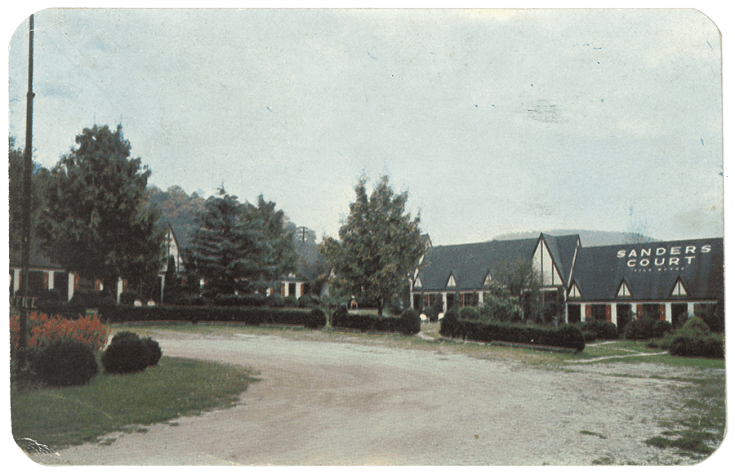
“Sanders Court and Cafe” postcard
🇺🇸 United States | postmarked Asheville, NC, July 14, 1950 at 8:00 PM
What do we know about Sanders Court in Asheville, NC?
Asheville’s Sanders Court and Cafe opened on August 13, 1939 as one of the town’s first modern motels with around 50 guest rooms. Local history has it that it was here in 1940 that the Colonel perfected his “11 herbs and spices” recipe and the use of a pressure fryer instead of a pan—”the trademark ‘Original Recipe’ at the core of the KFC/Kentucky Fried Chicken legacy”. In fact, the quality of the food was well known even before the recipe was solidified. The Asheville postcard above reads “Recommended by Duncan Hines” on the back. And indeed, the Corbin location had garnered a spot in Duncan Hines’ popular U.S. restaurant guide, Adventures in Good Eating.
As with the Corbin location, the motel rooms featured the latest “complete” amenities for the time: “tile baths, (abundance of hot water), carpeted floors, ‘Perfect Sleeper’ beds, air conditioned, steam heated, radio in every room, open all year, serving excellent food.”
Sanders’ earliest restaurant concepts were stymied by the effects of the Great Depression. And unfortunately, Sanders Court and Cafe in Asheville also fell to the effects of global forces. The U.S. entered World War II after the bombing of Pearl Harbor in November 1941. By the next year, gasoline rationing would come to America and the flow of tourists who made up the majority of the motor court’s patrons dried up. Colonel Sanders had no choice but to close the Asheville cafe and motor court in 1942.
Luckily for Asheville’s history, the motor court buildings took on new life after the war. In 1948, Lee and Helen Roberts (parents of local author Terry Roberts, who grew up on the property) took over operation of the business. However, a large fire destroyed the restaurant in the winter of 1956–57. After that, the couple ran the facility as a motel until they sold the business in 1975.
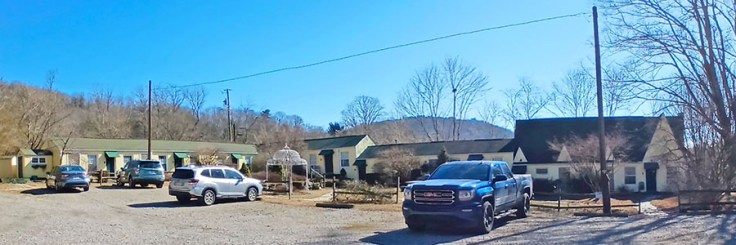
Today, Asheville’s Sanders Court still stands at 375 Weaverville Highway. The living spaces were renovated by Asheville Rentals in the mid-2010s and converted into eight fully furnished apartments. The rental company advertises them as “ideal for corporate rentals, visiting nurses, or a short-term stay if you are building or new to Asheville”. The exterior of the buildings retained the look of the old motor court, with small dormers on the roof. The complex was for a time known as Sander Court, supposedly after the “s” was mistakenly painted over some years ago.
Are there fried chicken stamps?
Such an interesting postcard should naturally pair with an equally interesting stamp. There are surely a few stamps depicting chicken dishes on the American Topical Association’s “Food and Beverage (Miscellaneous)” stamp list. In my broad search on Colnect, I only came across a few that could be considered “fried chicken”. But I discovered a few related notes of interest, as well.

Centennial of the American Poultry Industry
🇺🇸 United States, 3¢ | Issued September 9, 1948 | Scott #968
Poultry Industry Centennial
Arguably, there could be no fast food fried chicken without the chicken industry. Issued in 1948, the above stamp commemorates 100 years of the poultry industry. It features the oldest chicken breed in America, the Light Brahma, and was the first U.S. stamp to feature an egg (located behind the denomination).
Much ado was made of the stamp at the time. It was issued in New Haven, at the center of Connecticut’s $3.5 billion poultry industry. And yet many Americans still see “the chicken stamp” as an example of how “frivolous” commemorative topics can be. According to the Smithsonian National Postal Museum:
“Many considered it inappropriate to issue a stamp promoting private industry. Others complained that the design of what one called a ‘giant chicken’ was poorly conceived and realized.”
In fact, the stamp kicked off such a period of complaints about special interest stamps that the USPS created the Citizens Stamp Advisory Committee (CSAC) in 1957. To this day, the 15-person committee oversees and determines U.S. stamp topics.
Fried chicken stamps
The best example of fried chicken on stamps that I have seen come from Asia.

Local Delights: Crispy Fried Chicken
🇸🇬 🇲🇴 Singapore and Macao, 1st Local | Issued July 4, 2008 | Scott #SG 1318d
In 2008, Singapore and Macao released their first joint issue, “Local Delights”. The release happened in conjunction with the Singapore Food Festival. The set of eight stamps featured different dishes arranged on quarters of two plates. “Crispy fried chicken” was one of the dishes highlighted by Macao.

Delicious Japan (Series 2): Zangi (Fried Chicken Hokkaido Style)
🇯🇵 Japan, 84 ¥ | Issued November 11, 2020 | Scott #4457i
In 2020, Japan issued the first set in its series of “Delicious Japan (Oishii Nippon)” stamps. Each series features 20 prepared foods, ingredients, and seasonings for a given city or region in Japan. The set is divided into 10 square stamps at the standard postcard rate and 10 round stamps at the basic domestic letter rate.
Series 2 celebrated dishes of Sapporo, the capital of the northern Japanese island of Hokkaido. One stamp shows Zangi (fried chicken with a lemon wedge on a bed of lettuce). Zangi is Hokkaido prefecture’s version of karaage, a Japanese style of foods that have been marinated before being lightly coated in a combination of flour and potato starch or cornstarch, and then deep fried in oil. Sapporo’s regional take is made with a marinade and served with a spicy dipping sauce.
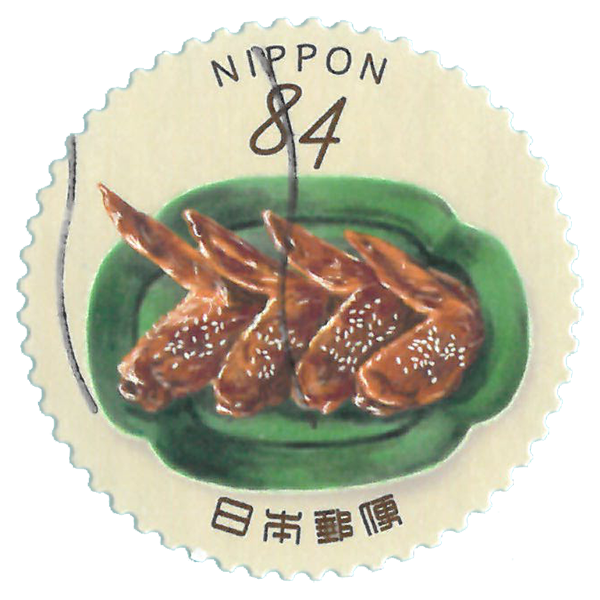
Delicious Japan (Series 3): Chicken Wings
🇯🇵 Japan, 84 ¥ | Issued November 11, 2021 | Scott #4560d
Series 3, released in 2021, honors Nagoya, the largest city in the Chūbu region and the fourth-most populous city in Japan. Chicken wings, pictured above, are among the dishes highlighted for this region. According to online recipe sites, Nagoya-style wings are also a form of karaage. These, however, are “dredged in starch, twice deep-fried to perfection, and then coated in a sweet soy sauce.”

Colonel Sanders
But what about the big man, himself? In 2006, the Kentucky Fried Chicken corporation (now KFC) petitioned the USPS for a stamp honoring Colonel Sanders. According to a Fast Company article at the time:
“‘The Colonel’s entrepreneurial spirit and hospitable nature made him an American legend,’ said James O’Reilly, interim Chief Marketing Officer for KFC said in a statement. ‘We believe that a postage stamp in his honor would be a fitting tribute to his memory”.
While the company’s efforts have not (yet) come to fruition, it would be interesting to see a series honoring the uniquely American mid-century phenomena of fast food franchises.
A legacy of good food
For a few months in 1940, while Sanders was rebuilding the Corbin restaurant that burned down, Asheville’s Sanders Cafe was the only KFC in the world. Though it would be years before Sanders opened a restaurant under the name “Kentucky Fried Chicken”, he was already using his “original recipe” and serving great fried chicken to tourists driving through the Blue Ridge Mountains.
Asheville’s culinary scene has largely forgotten its connection with one of the biggest fast food franchises in the world. But the legacy of serving up great dishes to locals and travelers persists.
What do you think? Are you a fan of KFC? Did you know that Colonel Sanders ran a set of motor courts? Let me know your thoughts!
 Armchair Philately
Leave a comment