

🇭🇺 Hungary, 3Ft | Scott #2033 | Issued August 19, 1970
There are those in our hobby who believe that stamp collectors merely accumulate and organize old postage stamps, whereas philatelists use stamps to better understand global history and cultures. Assuming that distinction has any validity, then there must be a way to get from the “lesser” of the two avocations to the “higher”. As a relatively new collector of Hungarian stamps and a novice in Hungarian history, this new series is my attempt to bridge that gap. Instead of taking a deep dive into these characters and moments of Hungarian history, let’s just dip our toes into the pool.
Read more entries of Hungarian 101.

Who was Stephen I?
The best place to begin a story is often the beginning. And in popular Hungarian history, their national origin story begins with the initiative of a single man at the turn of the last millennium.
Stephen I was the last Grand Prince of the Hungarian tribes and the first King of Hungary from Christmas Day 1000 (or New Year’s Day 1001—accounts vary), until his death in 1038. Though the nation saw peace during his reign, his death was followed by civil wars of succession which lasted for decades. He was canonized by Pope Gregory VII in 1083. Saint Stephen is Hungary’s patron saint, and he remains one of the most revered leaders in Hungarian history.
Stephen I Fact Sheet
| Hungarian Name | I. István |
| Alternate Names/Titles | Saint Stephen, Vajk |
| Lifespan | c. 975–August 15, 1038 |
| Title and Reign | Grand Prince of the Hungarians(Reign, 997–1000 or 1001) King of Hungary(Reign, 1000 or 1001–1038) |
| Coronation | 25 December 1000 or 1 January 1001 |
| Dynasty | House of Árpád |
| Predecessor | Géza of Hungary (father) |
| Successor | Peter, King of Hungary (nephew) |
| Spouse | Blessed Gisela of Bavaria (m. 996) |
| Issue | Otto (before 1002)Saint Emeric, Prince of Hungary (c. 1007) |
| Legacy | Last Grand Prince of the HungariansFirst King of HungaryAdopted Christianity as the state religionCanonized by Pope Gregory VII in 1083His feast day (August 20) is also a public holiday known as State Foundation Day |
Making a nation and crowning a king
The land that we now call Hungary has been inhabited by various peoples for 30,000 years. In the mid-ninth century, the seven Magyar tribes that would eventually form the nation of Hungary were pushed from their ancestral lands in the Central Asian steppe by invading forces. According to national history, they “arrived” to the area along the Danube River in the year 896, notably through their own series of conquests.
Sometime in (or after) 975 in Esztergom, a child was born to Hungarian Grand Prince Géza and his wife, Sarolt, and given the pagan name Vajk. The date of the child’s baptism is unknown, but afterward he was known as Stephen (Hungarian: István). Although both of his parents were baptized, Stephen was the first member of his family to become a devout Christian. The young man was given an education befitting his station, and he was married to Gisela, daughter of Henry II, Duke of Bavaria, in or after 995.
Upon the death of Grand Prince Géza in 997, Stephen was crowned the sixth Grand Prince of the Hungarians based on the principle of primogeniture. However, a cousin, Koppány, Duke of Somogy, declared his own claim to the throne based on the traditional idea of seniority in the Árpád dynasty. Stephen won the right to the crown after defeating Koppány in a decisive battle.
Stephen wished for peace and security for his people, and he realized that the most expedient solution was for his country to be recognized as a legitimate nation by the other European powers. This could never happen without the approval of the Catholic Church. According to national history, Pope Sylvester II declared Hungary a sovereign, Catholic nation on Christmas Day of the year 1000, and István was crowned His Royal Apostolic Majesty King Stephen I on either Christmas Day or the first day of the new millennium.
King Stephen ruled the new nation of Hungary for 38 years until his death in 1038. Hungary enjoyed a lasting period of peace during his reign, making it a safe and preferred route for pilgrims and merchants traveling between Western Europe, Constantinople, and the Holy Land. Less than 50 years after his death, King Stephen was canonized by Pope Gregory VII as Saint Stephen, and became the patron saint of Hungary. His feast day (celebrated on August 20) is also a public holiday commemorating the foundation of the state, known as State Foundation Day.
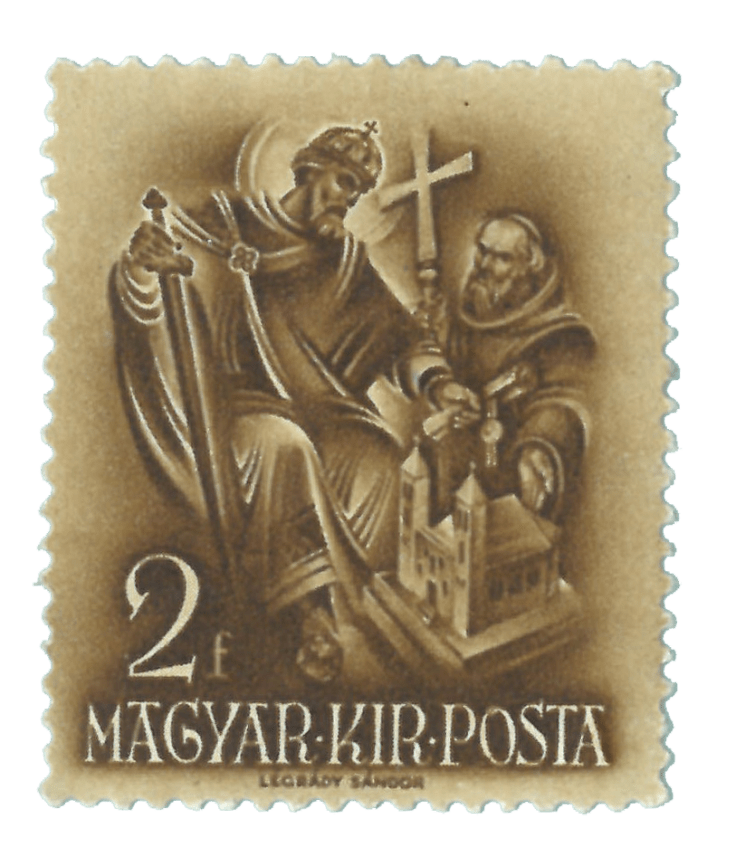
🇭🇺 Hungary, 2f | Scott #512 | Issued January 1, 1938
The lasting legacy of Stephen I
As one of the most important statesmen in Hungarian history, it should be no surprise to learn that King Saint Stephen has appeared on various Hungarian coins and banknotes. There’s even a Hungarian stamp depicting one of these coins. He has also received other national honors in modern years. SMS Szent István (His Majesty’s Ship Saint Stephen) was the last of four Tegetthoff-class dreadnought battleships built for the Austro-Hungarian Navy, launched in 1914.
In the arts, he has been a popular theme in Hungarian poetry since the end of the 13th century. Early religious hymns gave way to secular poetry over the years, but followed the pattern of describing Stephen as the symbol of national identity and independence. Stephen also represented Hungary’s ability to survive historical cataclysms during the Communist regime between 1949 and 1989. He continues to inspire authors, poets, and artists.
Stephen was also a well known historical figure outside of Hungary and throughout Catholic Europe. Ludwig van Beethoven composed his King Stephen Overture for the inauguration of the Hungarian theatre in Pest in 1812. Hungarian composer Ferenc Erkel named his last complete opera István király (“King Stephen”, 1885). And musical interpretations of Stephen’s story continued into the 20th century, including the 1983 rock opera, István, a király (“Stephen, the King”), about the early years of his reign.

🇭🇺 Hungary, 24f | Scott #586 | Issued 1941–43
King Saint Stephen on stamps
Stephen may be one of the most prolific figures featured on Hungarian stamps (with the exceptions of various Communist figures). The following is likely an incomplete list:
| Scott# | Date Issued | Scott Description |
| 422–427 | 1928–29 | 890th death anniversary of St. Stephen, the first king of Hungary |
| B89 | 15 May 1930 | 900th anniv. of the death of St. Emerich, son of Stephen I, king, saint and martyr: Sts. Stephen and Gisela |
| 511–524 | 1 Jan 1938 | 900th anniv. of the death of St. Stephen |
| B94a | 16 May 1938 | Eucharistic Cong. in Budapest, May 1938: St. Stephen |
| 528 | 22 May 1938 | 3rd Hungarian Phil. Exhib., Budapest: St. Stephen enthroned (518) |
| B95–B97 | 12 Aug 1938 | Death of St. Stephen, 900th anniversary |
| 535 | 1938 | St. Stephen enthroned (518) overprinted in blue for the restoration of the territory ceded by Czechoslovakia |
| 544 | 1 June 1939 | St. Stephen |
| 560 | 21 April 1941 | St. Stephen (Type of 1939) overprinted for return of the Bacska territory from Yugoslavia |
| 585–586 | 1941–43 | St. Stephen (Type of 1939) |
| 2033 | 19 Aug 1970 | Millenary of the birth of Saint Stephen, first king of Hungary |
| 2109 | 10 Dec 1971 | Founding of Obuda Church by King Stephen I and Queen Gisela |
| 2157, 2159 | 20 Aug 1972 | Millennium of the town of Szekesfehervar; 750th anniv. of the Golden Bull granting rights to lesser nobility:St. Stephen, first King of HungaryKing Stephen dictating to scribe (legal organization) |
| 2769–2770 | 30 Nov 1982 | Works of art in Hungarian Chapel, Vatican: St. Stephen, first King of Hungary (1001–1038)Pope Sylvester II making donation to St. Stephen |
| 3041 | 10 Dec 1986 | Portraits of Hungarian Kings in the Historical Portrait Gallery: St. Steven (sic), 997–1038 |
| 3702 | 18 May 2000 | 73rd Stamp Day: King Stephen I in coronation gown |
| 3723a | 18 Aug 2000 | Hungarian History: King with orb, knights |
| VA 513 | 30 June 2009 | |
| 4293c | 14 Aug 2013 | Paintings from Cathedral of St. Martin, Spisska Kapitula, Slovakia: St. Stephen, denomination at bottom center |
| TBD | 18 Aug 2023 | Saint Stephen’s Hall, Budapest |
NOTE: The Crown of St Stephen, the Holy Crown of Hungary, is not featured in the list above except in cases where the figure of Stephen is also featured. It likely deserves its own entry in Hungarian 101.
 Armchair Philately

Leave a comment