

Are you newly interested in collecting the stamps of Hungary, but are having trouble deciphering the text on the stamps? I’ve created the file linked below for myself as a cheat sheet when examining my Hungarian stamps—and I hope it can be helpful to you, as well!
Sections/tabs in the glossary include:
- Common philatelic terms (e.g. air mail, postage due)
- Time and date terms (days of the week, months of the year, etc.)
- Colors
- Famous figures common on Hungarian stamps
Access the Glossary – To view the glossary, click the link below. A Google spreadsheet will pop up in a new browser tab in “view only” mode. Take note of the tabs you can toggle through along the bottom of the page.
Copy the File – Follow these instructions to copy the glossary file to your own computer and/or Google Drive account. From there, you can make edits to the duplicated file. Note: Any changes or additions made to my file after you duplicate it will not appear in your duplicated file.
This glossary remains a work in progress. Check back for additions (and probably some corrections) along the way.
>> VIEW THE GLOSSARY <<
Editor’s note: I’d like to give credit to my friends at the Society for Hungarian Philately for creating the foundation for my list! They have a wonderful cross-reference dictionary for English, Hungarian, and German terms upon which I built the list above. I have further tailored my file to suit my individual needs as a beginning collector.
A few notes about the Hungarian language:
Origins – If you’re wondering why your high school Spanish lessons don’t help you with your Hungarian stamp collection, there’s a good reason. Unlike nearly every other European language, Hungarian is not an Indo-European-based language. In fact, it’s from a subgroup of the Uralic language family called Finno-Ugric. Among the closest language relatives to Hungarian are Finnish and Estonian.
Other languages spoken within Hungary’s boundaries – Hungary’s official national borders have waxed and waned over the last millennium. While the vast majority of Hungarian citizens speak Hungarian as their primary language (98.9%), other language speakers do reside there, including Armenian, Boyash, Bulgarian, Croatian, German, Greek, Polish, Romani, Romanian, Rusyn, Serbian, Slovak, Slovenian, and Ukrainian.
Surnames – In Hungary, people are listed by surname (what American English speakers know as last names), then given (first) name. So, where Americans would list Hungary’s national poet as Sándor Petőfi, in Hungarian, you’ll see his name listed as Petőfi Sándor.
What are semi-postal stamps?
The USPS has only issued semi-postal stamps for the last 25 years or so, and sporadically at that. But European nations (and others around the globe) have regularly issued semi-postal, or charity, stamps for well over a century. These stamps are sold at an upcharge from the regular postal rate, with the balance going to a designated charitable cause. On Hungarian stamps, you can regularly spot these by the dual amounts listed on the value, most often separated with a plus (+) sign. For example, the stamp below paid for 20f postage, with an additional 40f going to support soldiers at Christmastime.
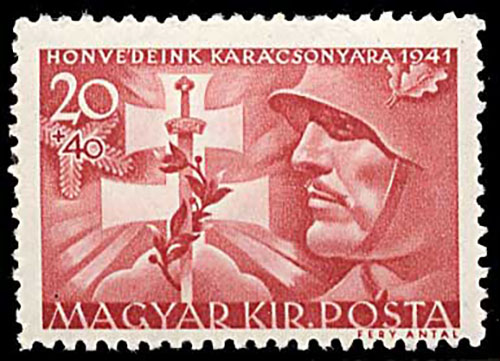
🇭🇺 Hungary, 20f+40f | Issued December 1, 1941
 Armchair Philately