
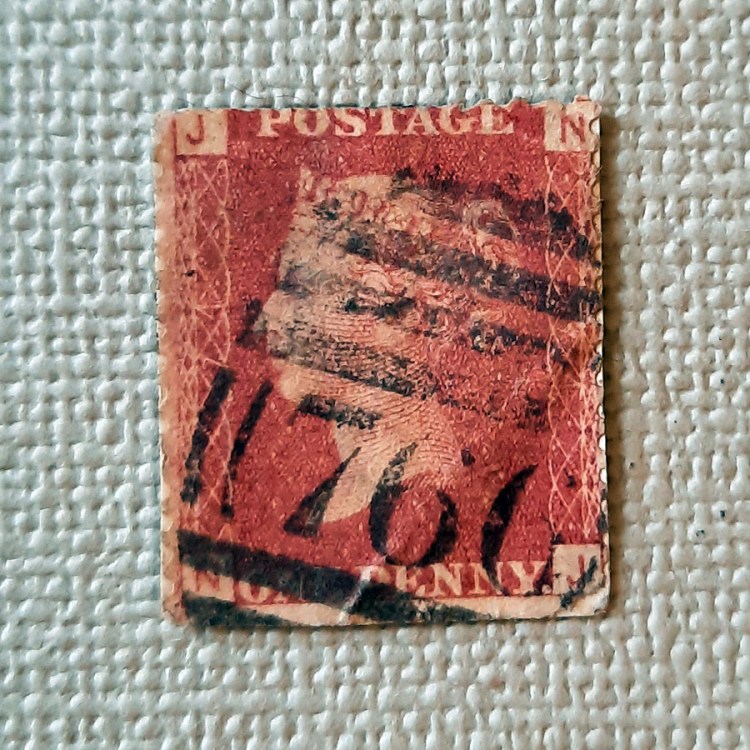
🇬🇧 United Kingdom, 1d | Issued 1864–1879 | Scott 33
Color and contrast enhanced for clarity.
Somewhere out there, someone is keeping a list of stamp superlatives. What’s the biggest stamp? The smallest? What’s the “weirdest” stamp?
Some of these superlatives may be subjective, but there is one everyone agrees on: What was the first adhesive postage stamp? The answer: a stamp of Queen Victoria, commonly called the Penny Black for its denomination and color, first issued in the United Kingdom on May 1, 1840. However, it turned out that black cancellations (or even red) on a black stamp were difficult for postmasters to discern. So the Penny Red was issued on its heels in 1841.
When weeding through a large and unruly worldwide collection this summer (what a joy!), I flipped a stamp right side up and nearly gasped. It was a Penny Red!
Could it be worth millions? Or is it truly the “poor man’s Penny Black”? I took a dive into the details of the Penny Red to find out.
What is the Penny Red postage stamp?
As I mentioned above, the Penny Red is the second penny-value stamp issued by Great Britain. It succeeded the Penny Black and continued as the main type of postage stamp in the UK from 1841–1879, with only minor changes to the design during that time (and a few different catalogue numbers). The stamps were printed in sheets of 240 (20 rows of 12 stamps), so one row cost one shilling and a complete sheet cost one pound. Over the course of 38 years, nearly 21 billion Penny Reds were printed.
What are the elements of the Penny Red design?
Design
Many early British stamps featured portraits of the reigning monarch. No doubt, this practice began with the Penny Black and Penny Red, which each featured the profile of Queen Victoria in the center. Victoria inherited the throne from her uncle, King William IV, in 1837 at age 18. In 1840, when the Penny Black was issued, young Victoria was only three years into her 63-year reign. I see a parallel between this fresh-faced monarch and the nascent technology on which her profile appeared—both poised to take the world by storm!
Above her profile is the word “POSTAGE” and below it reads “ONE PENNY.”. On each side is a series of overlapping lacework semicircles. Each corner of the stamp bears a letter, with opposite corners matching each other on later printings.
Perforations
Initially, the Penny Red was printed directly from the same plates used to print the Penny Black. That meant that, like the Penny Black and the Twopence Blue, early Penny Reds were imperforate. Individual stamps had to be cut from the sheet with scissors. In 1850, stamps were printed with experimental perforations (gauge 16), and perforated Penny Reds became standard practice in 1854. In January 1855, the perforation size was changed from 16 to 14 to prevent the stamps from pulling apart too easily.
Corner Letters
Each stamp on a 20×12 sheet of Penny Reds has a unique two-letter signifier. The top row of a sheet was labeled A, the second row was labeled B, and so on. Similarly, the first column was labeled A, the second column was labeled B, and so on. That means that the AA stamp from the top left position on the sheet would read “AA” in the bottom two corners. The HB stamp would read “HB”, etc. Above, I have an “NJ” stamp, tenth from the left on the 14th row of a sheet.
Early Penny Reds had stars in the top two corners and letters only in the bottom two. Beginning in 1858, the stars at the top were replaced with the same check letters as used in the lower corners, but in reverse order.

Plate Numbers
Over the course of nearly 40 years, more than 400 different plates were used to print the Penny Red. (This includes plates first used to print the Penny Blacks. “Black plate” Penny Reds are worth more to collectors.) Very early issues can be pretty easily distinguished by their perforation status and watermark. But as of April 1864 (beginning with Penny Red Plate 71), the plate number was engraved directly onto the design. If you turn the stamp and look very closely at the lacework, you may be able to read a two- or three-digit number. The last plate (225) was put to press on October 27, 1879.
Stamps from some of the individual plate numbers are very rare and sell for enormous premiums. For example, one Penny Red from Plate 77 was auctioned for UK£495,000 (US$716,000) in 2016, making it the second most valuable stamp in all of the United Kingdom at its sale.
Let’s date and value my Penny Red!
Working through the elements of the Penny Red design listed above, let’s take a look at the details of my stamp and try to estimate how much it’s worth.
Firstly, the overall design. The stamp is obliterated by a fairly heavily ovular design with the numbers “766” inside—a numeral obliterator. The cancellation obscures Victoria’s portrait, but interestingly, the weakest part of the cancellation is over her face, allowing some details to shine through. However, the perforations cut pretty heavily into the top margin, and the right one is not too great either. So overall, not the finest specimen.
Next, let’s look at the perforations. Since the stamp is still on paper, and trimmed almost dangerously close (especially along the top left), it’s hard to see the perforations at all at first. But using my gauge, I can confirm that it’s a 14 perforation. Since those were not issued until after January 1855, we know that it’s not an early stamp, and certainly not a black plate. The presence of letters in the top two corners also confirms that. In fact, it pushes the printing of this stamp to after 1858.
Now, let’s take a detailed look at the plate number (closeup above). As mentioned, red plate numbers were printed in the side lacework for plates 71–225, starting in April 1864. And I do see a red plate number on my stamp! However, because of the cancellation mark, it’s hard to discern the number clearly on either side of this stamp. But I do see a “74”, which could be either plate 74 or plate 174.
According to Warwick & Warwick:
Penny Red Plates, which have been known to turn up in boxes by the thousand, are worth … not much more than 10p to 30p. Some mint stamps have survived and are worth more.
Well, that’s no good. What does the Scott Catalogue have to say?
Cancellations on stamps from the 1847 issue to the 1900 issues … are usually heavy. Values quoted are for stamps with better than average cancellations. Poorly centered stamps and heavily cancelled stamps may sell for 10 to 20 percent of the values listed here.
The emphasis above was Scott’s. But I feel called out, because that’s exactly what I have. How does that value break down, then?
Plate 74 Used value = $3.00
Plate 174 Used value = $3.00
10–20% of $3.00 = $0.30–0.60
So there we have it. Whether plate 74 or 174, my post-April 1864, poor condition, red plate Penny Red stamp will probably not net a million dollars in the next prestigious stamp auction. It may not even be worth listing for 99c on eBay.
Even so, it still holds a special spot in my small, beginner’s collection—right at the top of the first page of my stock book. After all, if you’re going to collect anything, you should start at the beginning. And the Penny Red gets me pretty darn close.
What do you think? Do you collect Penny Reds or other early British stamps? Can you help me date the plate number on my stamp? Let me know your thoughts!
 Armchair Philately
Hi Sarah
I too am a beginner but have been collecting coins forever!! Like you I too inherited a very large stamp collection and have slowly been adding my own taste to the old collection again like you I was Looking through a bag I had recently purchased and GASP was not even close to what I saw
first I found a bunch of penny reds and there were a lot of doubled letters like 4 j”s & 4 D’s
but the next one was 4 A’s one one each corner that one took my breath away UNTIL I thought i had double vision with the next stamp it was/is a 2 pence blue (no big deal right) wel wait for it the very next stamp was another 2 pence blue with the EXACT SAME LETTERS ON THE 4 CORNERS GASPING FOR AIR!!! AGAIN & AGAIN I CHECKED THEM AT LEAST 20 times before I found the plate numbers and this will blow your mind YES!!! IT HAS ONE NUMBER THAT IS THE EXACT SAME NUMBER AS THE FIRST 2 PENCE BLUE STAMP!!! I AM STILL IN SHOCK AND HAVE NO IDEA WHAT TO DO???
Why you may ask well I feel if this is nall legit and one of the stamps not a fake or whatever
HAVE YOU ANY IDEA WHAT THESE 2 STAMPS MIGHT BE WORTH As I NEVER have seen or heard of such a thing from a single source and I have checked the internet everywhere even-though its very hard to explain this find I even ran it by some serious stamp collectors asking what if and just made it like a what if scenario were to happen and every singe one laughed and said first of all this could not happen without giving me a reason But secondly they all said it would be a million dollar or maybe even more as it would be a first in history to find such a matched pair WOW!!!! matched pair!! OH LET ME ADD JUST ANOTHER LITTLE BUT BIG FACT
One of the stamps looks like it might or could be a penny black KINDA COLOR.
ANY THOUGHTS WOULD BE VERY WELCOMED
Regards
Patrick.
LikeLike
Hi, Patrick – I would love to tell you those stamps are worth a fortune, but I would also hate to let you down. I would first check a stamp catalogue; I frequent the local library to flip through their copy. The next thing to do is examine the quality of the stamp; if it’s creased or torn, that would lower its value significantly. If you’re still feeling optimistic, the next step is to send it to a stamp expertiser. In the U.S., the APS should be a great resource for that. Good luck, and let me know how it goes!!
LikeLike