

There are many great resources online and at the local library designed as primers for beginning stamp collectors. When were postage stamps invented? What are perfs, and how do you measure them? What tools do you need for the hobby? These questions and many more have been answered ad infinitum.
Conversely, nearly two centuries of philatelic scholars have studied the most minute aspects of postal history and stamp production. When did specific rates change during the German inflationary period? What watermarks match which color varieties of certain nineteenth century stamp issues? Which ships docked where on which dates, and how does that correspond to the authenticity of ship cancellations? All great questions! And there are specialized stamp clubs and publications designed to address them.
But what about the intermediate collector? Where does she go to further her knowledge on the way to becoming an expert in the hobby?
As the first post in my highly anticipated Philately 201 series, I’ll attempt to answer one recent question for myself: What are Crosby covers?
More than five years into the hobby, I had never heard of or seen reference to Crosby covers. Then I won one at a recent stamp show auction (I liked the cache design). Less than a month later, a member of my local stamp club brought one to our monthly show and tell, presenting it as if everyone should already know what they are.
So what are they? Let’s find out!
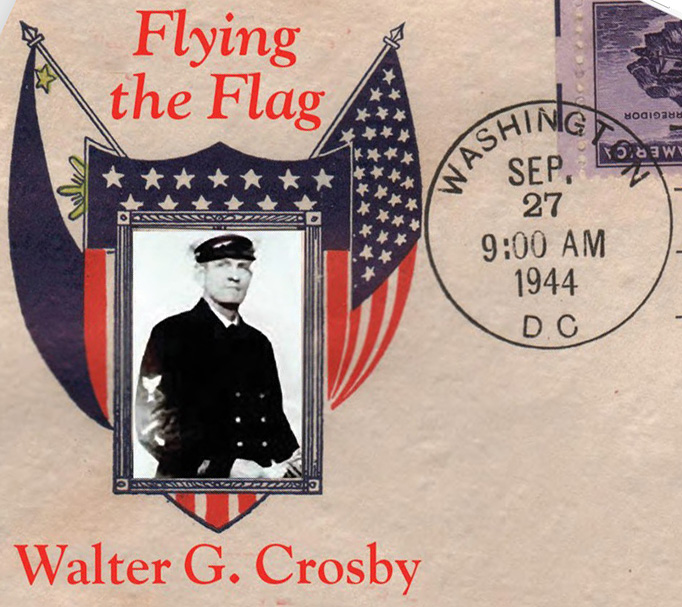
Who was W.G. Crosby?
Walter Garfield “Bones” Crosby (November 2, 1881–September 28, 1947) was born just a few miles from the Pacific Ocean in Santa Maria, California. At the age of 17, young Crosby enlisted in the Navy and served aboard the USS Mohican as an Apprentice Boy 3rd Class during the Spanish American War. According to the Universal Ship Cancellation Society’s member bio, Crosby performed admirably in the Navy, advancing through the ranks to the position of Chief Gunner’s Mate. After a successful naval career, Crosby retired from the Navy in December 1925.
In 1931, Crosby opened a stamp, coin, and curio shop in San Pedro, CA. As a collector-dealer, Crosby “was very active in the new hobby of navo-philately” and specialized in U.S. Navy ship cancels, CAM (Contract Air Mail) and FAM (Foreign Air Mail) covers, First Flights, and odd postmarks.
In 1935 for the California Pacific International Exposition, he “stunned cachet makers worldwide” with a new cachet design format that would become his signature cover style: designs featuring thermographic print and real photographs. According to the San Diego History Center, “The proximity of the Exposition made it possible for Crosby to produce a wide variety of philatelic postal history from the first day of the Exposition to the last.” Today, Crosby’s signature covers are still coveted by collectors—primarily naval cover, Air Mail, first day cover, and patriotic cover collectors.
During his retirement, Crosby was also a prominent member of several active philatelic organizations. After his death, Crosby’s widow, Emma, continued the business with the help of Ralph “Shorty” Burkholder. Crosby’s legacy continued through the work of several significant cache makers, including William “Duke” Gmahle and Emil Bilka.
How were Crosby covers made?
In the early part of his dealer career, Crosby created a variety of “standard” cover designs. However, for the California Pacific Expo, I suspect Crosby wanted to create something that would stand out from the rest of the dealers servicing the event.
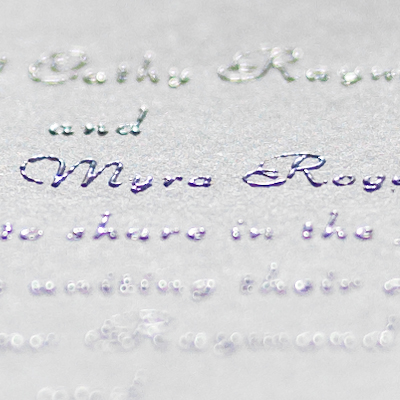
Thermographic printing, or thermograving, is a post-print process achieved by combining traditional printing methods with thermography machines. Printed material is run through thermography machines in three sections:
- Section 1 – The cache design is printed with slow-drying inks that will remain wet during the application of a powder. A thermographic/embossing powder made from plastic resins or wax is applied.
- Section 2 – A vacuum system removes excess powder from areas of the sheet that were not printed.
- Section 3 – The cover runs through an oven set to a high heat (900–1,300ºF) for 2.5–3 seconds. The powder melts from the heat, creating an embossed-like effect as the powder cools and the ink dries.
Crosby went one step further, regularly pasting on a small real photo designed to fit the cachet design—a feature that would become his signature mark.
Though thermograving does not yield as sharp an effect as true embossing, it does offer a shiny, raised effect without the high initial cost. When paired with the real photos inset on the design, authentic Crosby covers are a handsome addition to any cover collection.
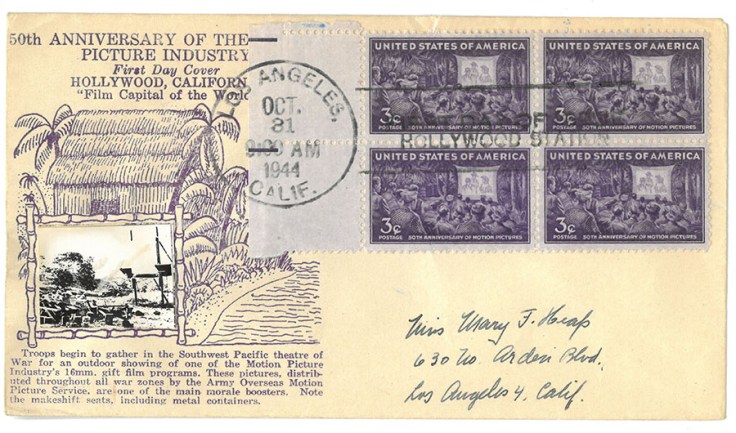
🇺🇸 United States, 3¢ | Issued October 31, 1944
What does my Crosby cover depict?
I enjoy a fun philatelic cover as much as any gal, even though cover collecting is not a particular focus of mine. However, when I see an opportunity to jump in and snag an auction lot at the opening bid, I’ll take it!
In March, I won a lot of three philatelic covers, including this Crosby cover. The cover features a block of four “50th Anniversary of Motion Pictures” stamps, selvage included, with a first day of issue cancellation at Hollywood Station in Los Angeles, CA (9:00 AM, October 31, 1944). It is addressed to Miss Mary F. Heap, 630 No. Arden Blvd., Los Angeles 4, Calif. A Google map search of that address shows a small bungalow just a few blocks from the Paramount Studios water tower and Hollywood Forever Cemetery.
Mary must have led an interesting life, but it’s the cache on the left that we’re looking at today.
Partially obscured by the stamp block’s selvage, the top of the cache image reads:
50TH ANNIVERSARY OF THE MOTION
PICTURE INDUSTRY
First Day Cover
HOLLYWOOD, CALIFORNIA
“Film Capital of the World”
However, underneath is not a typical Hollywood scene. Instead, there is a waterside grass hut crowded by palm trees and other tropical plants. Underneath, the cache reads:
Troops begin to gather in the Southwest (sic) Pacific theatre of
War for an outdoor showing of one of the Motion Picture
Industry’s 16mm. gift film programs. These pictures, distrib-
uted throughout all war zones by the Army Overseas Motion
Picture Service, are one of the main morale boosters. Note
the makeshift seats, including metal containers.
The “makeshift seats” referenced are pictured in a small real photo image adhered to the cover, delicately set inside a bamboo pole design arranged as a frame. The black and white photo appears somewhat overexposed. But if we’re to believe it was taken under the hot sun of the South West Pacific, that’s understandable. What I can make out are some sailors (in white naval caps) sitting on the left, looking up toward a makeshift film screen posted about six feet off the ground.
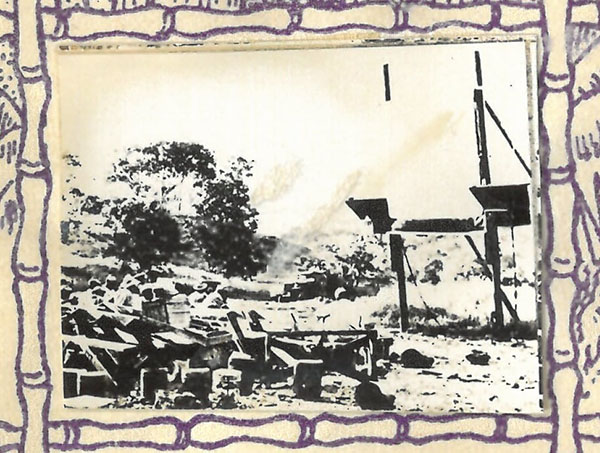
There’s no way for me to know exactly where these troops were stationed during this screening, nor what movie they were shown (Days of Glory? Bathing Beauty? Laura?). The South West Pacific theatre included areas of Australia, Borneo, the Dutch East Indies, New Guinea, the Philippines, and the Solomon Islands. At the time of this stamp’s release, America was well into the Solomon Islands, New Guinea, and Philippines Campaigns—though the photo was likely taken some time earlier in order to reach Crosby.
But it is interesting that a former Navy man like Crosby would celebrate a stamp issued at Hollywood Station not by promoting the glamor of the red carpet, but by highlighting the impact the film industry can have on troop morale in the middle of a then-active conflict zone.
Where can collectors learn more about Crosby covers?
Crosby covers were new to me. But as mentioned, they’ve been popular among cover collectors for just shy of 100 years. As such, there are a number of ways to dig deeper into the life of Crosby the man and the history of Crosby covers.
Philatelists have collected a variety of FDCs, naval covers, and more from Crosby. There’s a nice variety of Crosby covers highlighted on this forum.
Kenneth M. Stern has compiled a comprehensive catalog dedicated to Crosby’s first day cover cachets. Broken out into five volumes by date, the catalog covers Crosby’s output (and that of his widow, Emma, after 1947) from the years 1928–1949. Featuring color images, the catalogs purport to showcase “the depth and quality which made him such a popular cachetmaker”.
Stern admits that he was not the first to tackle a Crosby catalog:
In 1992 William H. Stroebel published his much appreciated book entitled “Walter G. Crosby, Philatelic Cachet Specialist.” The book covers Crosby’s full scope of cachet making activity and is a must have resource for any serious collector of W.G. Crosby cachets. It gives descriptions of many of Crosby’s covers, including large photographs (though not in color) and describes details of Crosby’s methods, explaining to some degree how Crosby managed to create so many different varieties of cachets for the same event or first day cover issue.
Collectors can also mine the archives of specialized stamp clubs and organizations for additional info—particularly the American First Day Cover Society, Naval Cover Museum, and Universal Ship Cancellation Society.
Have fun!
What do you think? Had you heard of Crosby covers before? Would Crosby covers with real photos enhance your philatelic collection? Do you have a favorite Crosby cover? Let me know your thoughts!
 Armchair Philately
Leave a comment